Monday, September 9, 2013

Mount Rainier National Park – Spray Park Hike

Overview


We started at Mowich Lake, following the advice on the Mount Rainier Spray Park Trail page and the WTA’s Spray Park page. We intended to hike up to Spray Park and turn around, but we ended up wandering toward Observation Rock. We never made up to Observation Rock (8,364 ft); we turned around at 7,200 ft at the edge of Flett Glacier. The Spray Park hike puts at 75 total hiking miles this summer over 7 substantial hikes (minus the jaunt to Hidden Lake). Our annus mirabilis for hiking.
 

Flora and Fauna

In the first part of the hike, which is filled with trees with occasional sun, we saw the following:
  • Ochotona princeps - American Pika. Spotted around the Mowich Lake parking area.
  • Corydalis scouleri - Scouler's Fumewort Flowers. We are going to guess that this plant honors the Scottish naturalist, John Scouler (1904 – 1981) who visited the Northwest in 1825.
  • Lycopodium clavatum - Running Clubmoss with it’s handsome sporophylls.
  • Mycena strobilinoides – Scarlet Fairy Helmet found in needle beds and moss.
  • Cladonia sp. – Cladonia, a moss-like lichen with “tube-like” structures.
  • Pterospora andromedea – Pinedrops
After we arrived in the Spray Park meadow we saw:
  • Gentiana calycosa - Mountain Bog Gentian in the Spray Park meadows.
  • Potentilla flabellifolia - Fan-Leaved Cinquefoil
  • Tofielda glutinosa - Sticky False Asphodel with its reddish flower buds.
  • Amanita muscaria - Fly Agaric, the quintessential toadstool. What is agaric? From Wikipedia “An agaric is a type of fungal fruiting body characterized by the presence of a pileus (cap) that is clearly differentiated from the stipe (stalk), with lamellae (gills) on the underside of the pileus.” The specific epithet comes from the Latin musca for fly and is based on a history of its use as an insecticide when sprinkled in milk.
As we climbed higher into Spray park we saw:
 

Stats

Length: 12 miles roundtrip.
Duration: 10:07 left trailhead, arrived back at 5:35pm. About 7.5 hours.
Elevation: Started at 4,000 (Mowich Lake), turn around at 7,200 (estimated), near, but well below Observation Rock (8,364 ft) at Turn around point from Garmin: N 46°, 54.559", W 121° 48.424" or 46.9093, -121.8071.
Location: Mt. Rainier -- NW - Carbon River / Mowich, Mt. Rainier National park.

Left: Cladonia sp.; Right: Lycopodium clavatum - Running ClubmossCladoniaLycopodium clavatum - Running Clubmoss

Left: Mycena strobilinoides; Center: Pterospora andromedea – Pinedrops; Right: A handful of forest berries including Streptopus amplexifolius (left, red), Clintonia uniflora (middle, blue), and Rubus pedatus (right, red)
Mycena strobilinoidesPterospora andromedea – PinedropsA handful of forest berries including Streptopus amplexifolius (left, red), Clintonia uniflora (middle, blue), and Rubus pedatus (right, red)

Corydalis scouleri - Scouler's Fumewort Flowers
Corydalis scouleri - Scouler's Fumewort FlowersCorydalis scouleri - Scouler's Fumewort Leaves

Amanita muscaria - Fly Agaric
Amanita muscaria - Fly AgaricAmanita muscaria - Fly Agaric

Gentiana calycosa - Mountain Bog Gentian with Insects
Gentiana calycosa - Mountain Bog Gentian with InsectGentiana calycosa - Mountain Bog Gentian with InsectGentiana calycosa - Mountain Bog Gentian with Insect

Left: Tofielda glutinosa - Sticky False Asphodel; Center: Potentilla flabellifolia - Fan-Leaved Cinquefoil; Right: Aster alpigenus submerged in water
Tofielda glutinosa - Sticky False AsphodelPotentilla flabellifolia - Fan-Leaved CinquefoilAster alpigenus submerged in water

Pedicularis - Lousewort and Castilleja - Indian Paint Brush in Spray ParkPedicularis - Lousewort and Castilleja - Indian Paint Brush in Spray ParkPedicularis - Lousewort and Castilleja - Indian Paint Brush in Spray Park

Lagopus leucura – White-tailed Ptarmigan and Empetrum nigum – CrowberryLagopus leucura – White-tailed Ptarmigan and Empetrum nigum – CrowberryLagopus leucura – White-tailed Ptarmigan and Empetrum nigum – Crowberry

Cicindela depressula – Dispirited Tiger Beetle in Spray Park. Thanks to reader cicindela who pointed this out.
Cicindela depressula – Dispirited Tiger Beetle in Spray Park.Cicindela depressula – Dispirited Tiger Beetle in Spray Park.

Left: Lupinus lepidus var. lobbii – Dwarf lupine on pumice and scoria; Center: Melanoplus femurrubrum?; Right: Saxifraga tolmiei – Tolmie’s Saxifrage
Lupinus lepidus var. lobbii – Dwarf lupine on pumice and scoriaMelanoplus femurrubrumSaxifraga tolmiei – Tolmie’s Saxifrage

Left: Mount Rainier from Eagle's Cliff Lookout; View from Spray Park Looking North


Left: View Looking Up Flett Glacier Toward Mount Rainier with Echo Rock; Right: View Up Flett Glacier Looking Toward Mount Rainier with Observation RockView Looking Up Flett Glacier Toward Mount Rainier with Echo RockUp Flett Glacier Looking Toward Mount Rainier with Observation Rock

Left: View Toward Ptarmigan Ridge West and Tillicum Point; Right View Northwest from Spray Park
View Toward Ptarmigan Ridge West and Tillicum PointRight View Northwest from Spray Park

Left: View from Below Observation Rock, looking north over Spray Park; Right: Echo RockView from Below Observation RockEcho Rock

Left: Ochotona princeps - American Pika; Right: Topo map showing the start and finish of the Spray Park hike
Ochotona princeps - American PikaTopo map showing the start and finish of the Spray Park hike


Tuesday, September 3, 2013

Lady Gaga Channels Mina?

Lady Gaga Applause Album Cover Surrounded by Mina Album Covers


The album cover for Lady Gaga’s single Applause kept nagging at us when we first saw it. What could it be? The smeared painted face and accentuated eyes – hmm. Bingo – Mina! Mina is Mina Anna Mazzini, one of the Italy’s most successful and longest running singers of all time. Of course, Mina has been no stranger to this blog, see Mina, Mina, Mina / Carosello – Italian Ads / Bula Bula / Back to Mina / E Poi, Mina.

Speaking of déjà vu, during the video for Applause, there is a part where Lady Gaga is wearing a head scarf and we kept think ah, “Little Edie” – Edith Bouvier Beale.

The album covers (“copertine” in Italian) are from left to right, top to bottom:

Addendum

The other day in spin class, the instructor put on Lady Gaga’s Applause and for 30 seconds and I thought it was Ethel Merman! Never mind that Merman passed in 1984. Applause lyrics start off as “I stand here waiting for you to bang the gong; To crash the critic saying, ‘Is it right or is it wrong?”. 


Monday, September 2, 2013

Binomen Art – Pinus (Pine)

Left: Pinus Spelled with Pinecones; Right: Ponderosa Pine Cone
Pinus Spelled with PineconesPonderosa Pine Cone
Pinus Ponderosa (ponderosa pine) has three needles per fascicle. Fascicles are present in all pines and the number of needles per fascicle are a key identification characteristic. In Trees & Shrubs of Washington there is a handly key to evergreen trees that shows the number of needles for a few different pines. This pine is near Lake Wenatchee. The owners of the cabin where we were staying looked at me funny as I collected pinecones.

Left: Fascicles of Ponderosa Pine; Right: Looking Up to the Crown of a Ponderosa Pine
 Fascicles of Ponderosa PineLooking Up to the Crown of a Ponderosa Pine Key to Evergreens (fromTrees & Shrubs of Washington)
Key to Evergreens (fromTrees & Shrubs of Washington)

Sunday, September 1, 2013

Central Cascades Hike – Hidden Lake Hike

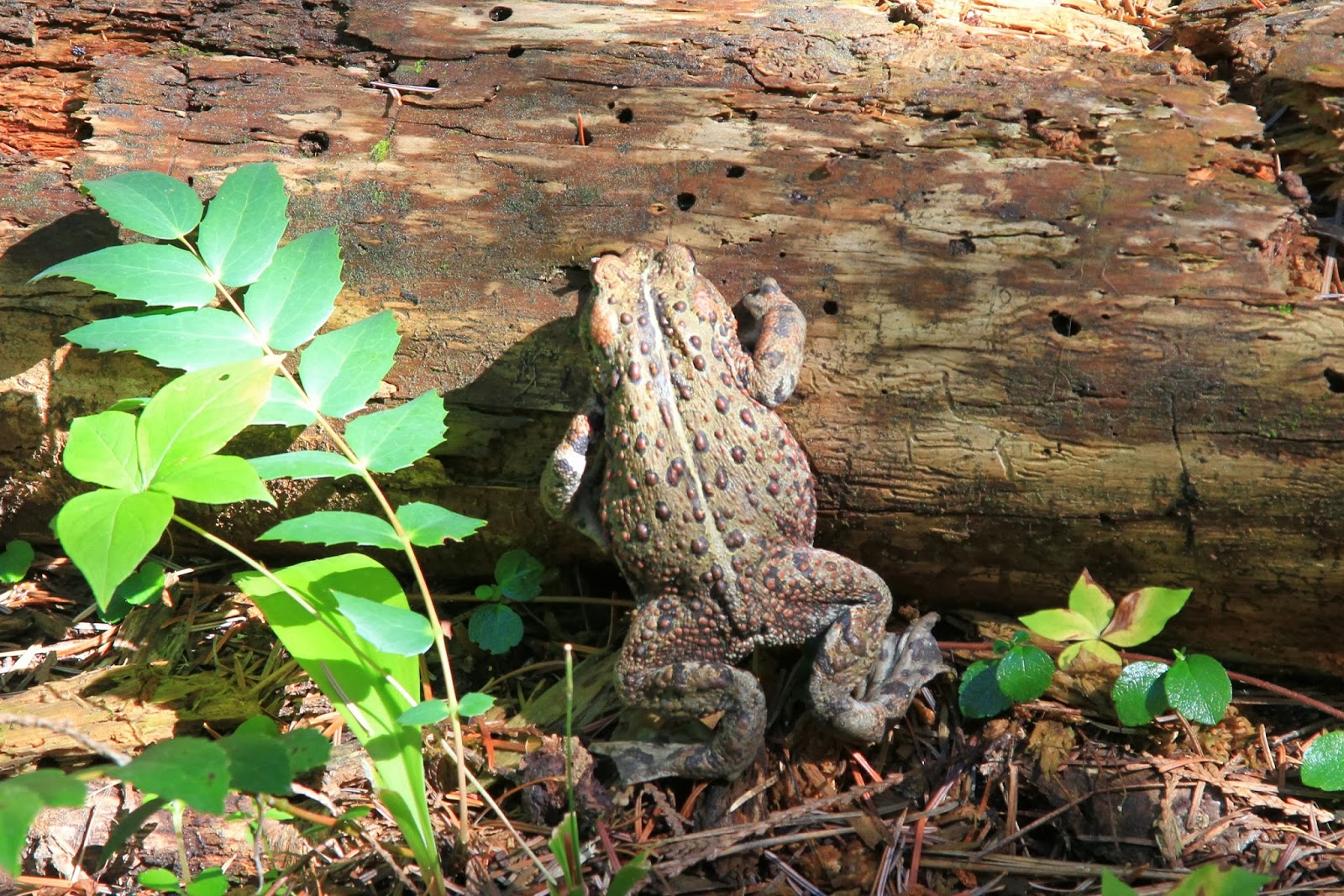
Left: A Swim in Hidden Lake; Right: Bufo borealis – Western Toad

A Swim in Hidden Lake Bufo borealis – Western Toad

The Hidden Lake Hike is a short jaunt (1.2 miles) to Hidden Lake located just south the western end of Lake Wenatchee. (After a challenging hike up to Aasgard Pass the previous day, this was a welcome relief.) Judging by the number of people we saw with towels, it is popular to take a dunk in. Of the six of us, four of us went in for a dip. The kids were fascinated with the little fish that swam around our feet as we cooled our toes on the lake’s edge.

Here are a couple of plants and animals we saw on the trip back and forth to the lake.

Bufo borealis, Western Toad. This is the first time we have seen one of these guys. We think we saw him twice, once on the way to the lake and once on the way back. He just hopped along at a leisurely pace, slightly annoyed we were watching him.

Sorbus scopulina, Western Mountain-Ash shrub. I think this is S. scopulina based on the sharp-pointed leaflets of the compound leaf as compared to S. sitchensis with more rounded leaflets at the tips and being toothed from middle to end.

Paxistima myrsinites, Oregon Boxwood. For this etymology, I found this interesting information at the US Forest Service Celebrating Wildflowers site:

The exact etymology and correct spelling of the genus have been debated for nearly two centuries. Most scholars assume the name comes from the Greek words “pachys” for thick (think of a thick-skinned elephant, or pachyderm) and stigma, in reference to the somewhat thickened stigma of the flower. Rafinesque and others have variously spelled the name as Pachistma, Pachystima, and Pachystigma, although Rafinesque’s original spelling of Paxistima is the name most widely accepted today. The species epithet, myrsinites, also comes from the Greek for “myrrh”, which the Mountain-lover’s tiny flowers are said to resemble in scent.

Rosa gymnocarpa, Baldhip Rose growing in shady damp spots along the trail. The specific name derives from the Greek gymno meaning “naked” and carpa meaning “fruit” and refers to the fact the sepals fall away from the fruit unlike other rose hips.

Symphoricarpos albus, Common Snowberry. The generic name derives from the Greek symphorein meaning “to bear together” and carpos meaning “fruit” and refers to the fact that berries are often packed closely together. The specific name albus means “white”.

Left: Rosa gymnocarpa - Baldhip Rose; Right: Symphoricarpos albus - Common Snowberry

Back at the nearby cabin we were staying at, we found some more interesting bits of nature: a lizard, a large insect, and some berries and flowers.

We posed a Sceloporus occidentalis, Western Fence Lizard(found dead in a bathtub) with a Ergates spiculatus, Ponderous Borer Beetle (found dead in the garage). A bit of trivia or at least an interesting story: the site of artist and novelist Barb Bentler Ullman mentions that “The sawing jaws of the larvae are said to have inspired the design of the chain saw.” No wonder we found it in the garage.

Around the house, we found Sambucus cerulea, Blue Elderberry and Achillea millefolium, Common Yarrow.

Sceloporus occidentalis - Western Fence Lizard and Ergates spiculatus – Ponderous Borer Beetle. Just a hint of blue on the belly of the lizard gives us a clue to one of its common names “Blue-Belly”.

Sceloporus occidentalis - Western Fence Lizard and Ergates spiculatus – Ponderous Borer Beetle Sceloporus occidentalis - Western Fence Lizard and Ergates spiculatus – Ponderous Borer Beetle

Left: Sorbus scopulina – Western Moutain-Ash; Center: Sambucus cerulea – Blue Elderberry and Achillea millefolium – Yarrow; Right: Paxistima myrsinites – Orgeon Boxwood

Sorbus scopulina – Western Moutain-AshSambucus cerulea – Blue Elderberry and Achillea millefoliumPaxistima myrsinites – Orgeon Boxwood

Left: Topo Map (Google) of the Hidden Lake Trail; Right: Two Bumps Boys on a LogTopo Map (Google) of the Hidden Lake TrailTwo (Bumps) Boys on a Log