Showing posts with label new orleans. Show all posts

Saturday, August 11, 2012

New Orleans Botanical Garden

New Orleans Botanical Garden Conservatory (left) and Shady Oak (right)
New Orleans Botanical Garden Conservatory New Orleans Botanical Garden Oak

The New Orleans Botanical Garden is located in City Park, due northeast from the French Quarter. From the French Quarter we took the 48-City Park/Museum Streetcar. There is a lot to do in City Park. Too much for one day, really. We spent most of a Saturday afternoon there (last April) at the New Orleans Museum of Art (NOMA) viewing an exhibition called Hard Truths - The Art of Thornton Dial. After that, we wandered around the beautiful Sydney and Walda Besthoff Sculpture Garden. By the time we got to the Botanical Garden we were a bit tired and probably didn’t appreciate as much as we should have. Though, the shade of the live oaks (Quercus virginiana) was very much appreciated.

New Orleans Botanical Garden Brochure and Garden Map New Orleans Botanical Garden Brochure and Garden Map New Orleans Botanical Garden Brochure and Garden Map
New Orleans Botanical Garden Brochure and Garden Map New Orleans Botanical Garden Brochure and Garden Map

Information about Quercus virginiana (left) and Allee Leading to Conservatory (right)
Information about Quercus virginiana Allee Leading to Conservatory

Sunday, April 29, 2012

Binomen Art - Tillandsia usneoides

 Binomen Art - Tillandsia usneiodesBinomen Art - Tillandsia usneiodes with Digital Assist

Besides being struck by the architecture and ambience of the French Quarter, we couldn’t stop drooling over the beautiful, and quite large, Live Oak trees (Quercus virginiana) in New Orleans. Of course, great examples can be found in parks and, in particular, in Audubon Park and City Park, two parks we visited.

On many live oaks you will find Spanish Moss (Tillandsia usneoides) and Resurrection Fern (Pleopeltis polypodiodes). The Spanish Moss sways in the breeze giving the massive trees a gentle and dreamy look.

City Park has some of the oldest Live Oaks in the world, some between 600 and 800 years old! Inside City Park, next to the New Orleans Museum of Art there is a beautiful sculpture garden with free entry, The Sdyney and Walda Besthoff Sculpture Garden, where we attempted to spell out Tillandsia. A large branch full of T. usneoides was lying on the ground and this is where we gathered the spelling material.

The genus Tillandsia is “[n]amed in honor of the Swedish physician Elias Erici Tillands (Tillander, Tillandz, Til-Landz, Til-Lands), 1640-1693, botanist, Dr. med. Leiden 1670, professor of medicine at Åbo, wrote Diputatio de atrophia.” [Quattrocchi]. The species epithet, usneoides, refers to the fact that this plan ressembles Usnea, a lichen. T usneoides is in the Bromeliacea (the bromeliad) family and includes terrestial plants like the pineapple and epiphytic plants like T. usneoides which gather water from their leaves.

Spanish Moss on Oak with Arnaldo Pomodoro (1926 - ) - Una Battaglia (A Battle) 1971
The Sdyney and Walda Besthoff Sculpture Garden
Arnaldo Pomodoro (1926 - ) - Una Battaglia (A Battle) 1971

Spanish Moss on Oak with Gaston Lachaise (1882 - 1935) - Heroic Man, 1930-34
The Sdyney and Walda Besthoff Sculpture Garden

Gaston Lachaise (1882 - 1935) - Heroic Man, 1930-34

Tillandsia usneoides Flowers, Right with “Average?” Thumb for Scale
Tillandsia usneiodes Flowers

Live Oak Information – City Park Botanical Garden, New Orleans

Head of Spanish Moss

Friday, April 27, 2012

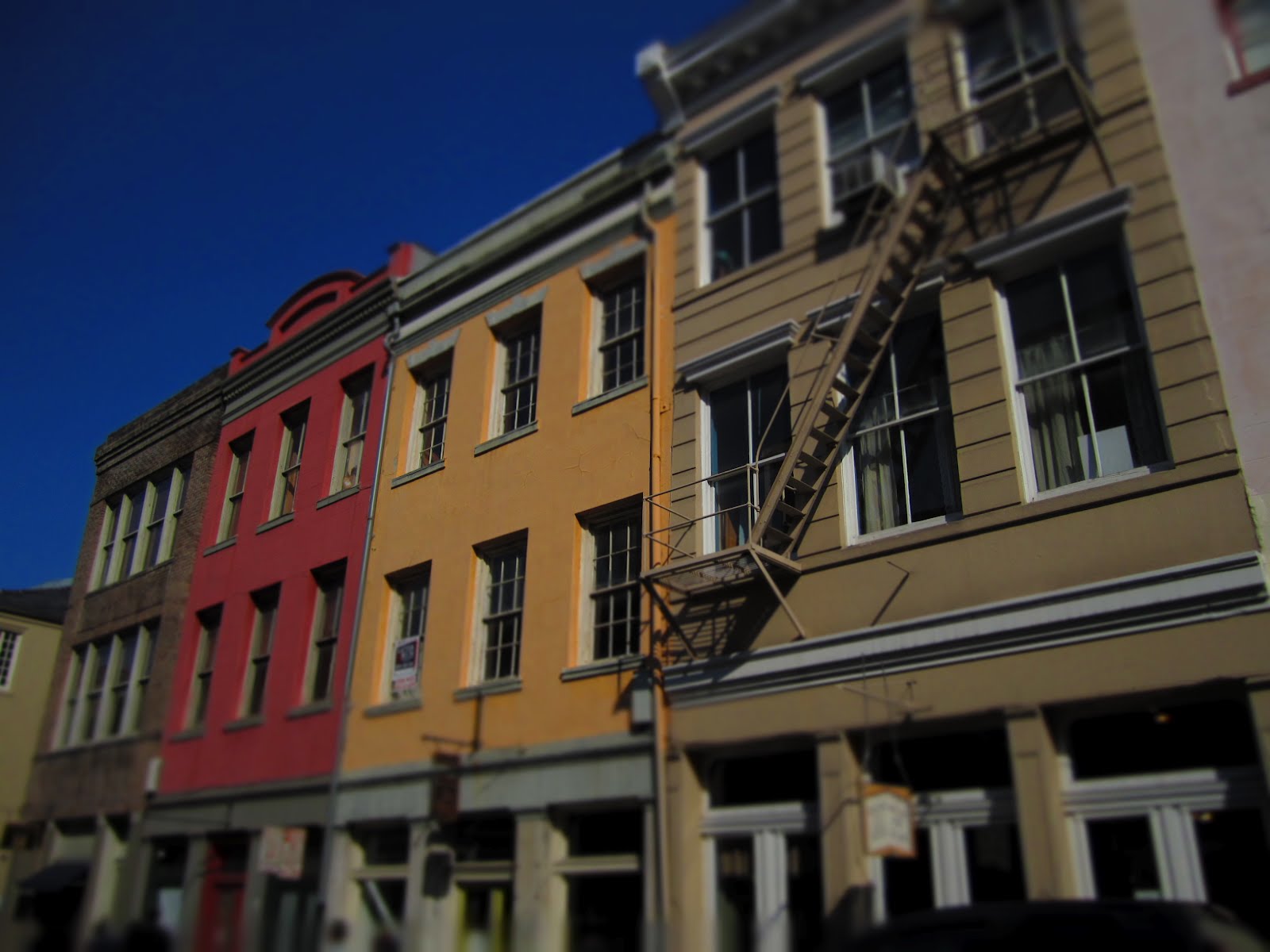
The Balconies and Bright Colors of the French Quarter, New Orleans

French Quarter Balconies Series 1


We spent just a few days in the French Quarter but were immediately struck by its fascinating architecture. Most of the quarter’s architecture was built during the Spanish rule over New Orleans, a relatively short 40 years from 1762 to 1803. There are plaques in the walls of buildings in the French Quarter that give the Spanish names of the streets when New Orleans was the Capital of the Spanish Province of Luisana. From Wikipedia:

The Great New Orleans Fire (1788) and another great fire in 1794 destroyed most of the Quarter's old French colonial architecture, leaving the colony's new Spanish overlords to rebuild it according to more modern tastes—and strict new fire codes, which mandated that all structures be physically adjacent and close to the curb to create a firewall. The old French peaked roofs were replaced with flat tiled ones, and now-banned wooden siding with fire-resistant stucco, painted in the pastel hues fashionable at the time. As a result, colorful walls and roofs and elaborately decorated ironwork balconies and galleries, from both the 18th century and the early 19th century, abound. (In southeast Louisiana, a distinction is made between "balconies", which are self supporting and attached to the side of the building, and "galleries" which are supported from the ground by poles or columns.)*

It is those pastel stucco walls and balconies and galleries that caught our eye. The architectural scale and playfulness feels right. They are in such contrast to the cold, blocky business district which butts up against the French Quarter. So be it. Old meets new. Perhaps the French Quarter really just stirred memories of the countless, pleasant hours we spent wandering Italian towns and villages? Here we assembled some dreamy photos (just like the Spanish moss swaying in the breeze on the live oaks) - always looking up at the balconies. Most of the photos were taken in the French Quarter and just a few in the warehouse district.

Plaque Recalling the Name of a Street When Spain Ruled

French Quarter Balconies Series 2

French Quarter Balconies Series 3

French Quarter Balconies Series 4

French Quarter Balconies Series 5

Monday, April 9, 2012

National World War II Museum, New Orleans

Operation Overload, The Plan (left) and The Fleet (right)
Yet another little surprise about New Orleans: it boasts an interesting World War II museum called the National World War II Museum. The museum is about a 20 minute walk from the French Quarter heading south by southeast.

Not only did New Orleans undoubtedly contribute to the war effort in countless ways like many cities did, it also has the distinction of being home to the boat designer and builder, Andrew Jackson Higgins. The boat commonly referred to as a Higgins boat and technically called Landing Craft, Vehicle, Personnel (LCVP), was so crucial for landing on open beaches that General Dwight D. Eisenhower stated:

“If Higgins had not designed and built those LCVPs, we never could have landed over an open beach. The whole strategy of the war would have been different.”

The Higgins Boat story in the larger story of the war of course, is featured (we only made it through the Normandy Invasion, not the Pacific Theater), but it’s done in context and doesn’t overshadow the main focus which is telling of the story of Operation Overload (Battle of Normandy 1944). The museum uses photos, audio, video, and personal objects and stories covering the time leading up to the landing, the actual landing (in some detail), the first days of fighting after the landing, and the eventual retreat of the Germans from France.

Some favorite quotes we saw while visiting the museum: “Smash the Axis, Pay your taxes” (a saying during the war effort) and “In wartime, truth is so precious that she should always be attended by a bodyguard of lies.” (Prime Minister Winston Churchill said this in 1943).

Propaganda and Imagery During the War Effort

National World War II Museum Brochure
National World War II Museum, New Orleans - Brochure, Visitor's GuideNational World War II Museum, New Orleans - Brochure, Visitor's GuideNational World War II Museum, New Orleans - Brochure, Visitor's GuideNational World War II Museum, New Orleans - Brochure, Visitor's Guide

Sunday, April 8, 2012

Hard Truths - The Art of Thornton Dial

Lost Cows, 2000-2001
Cow skeletons, steel, golf bag, golf ball, mirrors, enamel and Splash Zone compound

We headed to City Park on a bright and pleasant Saturday morning while in New Orleans for a few days. We took one of the branches of the Canal St. Streetcar (the red cars) to City Park. From where the street car ends (and turns around) in the park, it is just a few minutes’ walk to the New Orleans Museum of Art or NOMA. Featured at the museum when we visited was an exhibition called Hard Truths, The Art of Thornton Dial (through May 20, 2012). In the exhibition, over 40 of Dial’s large-scale paintings, drawings and found-object sculptures are featured. Thornton Dial is an American artist from Alabama whose work came to prominence in the late 1980s. From the NOMA site: “Born in poverty in Alabama, Dial has lived his entire life in the American South, and his art, informed by decades of struggle as a black working class man, offers compelling commentary on our most pervasive social and political challenges.”

The social and political “challenges” that Dial tackles are transformed into his found-object sculptures as fantastical, sometimes hard to look at, twisting and chaotic forms. The sculptures are assemblages of cast-away objects that address issues such as global conflict, African American history, and homelessness. The pieces have evocative titles like Crosses to Bear (Armageddon) 2001-2004 and Lost Cows 2000-2001 - both shown here, and The Beginning of Life in the Yellow Jungle 2003 - featured on the exhibition brochure and shown here as well. The information cards accompanying each piece are hints on how to “read” the piece. Therein lies a minor misstep of the exhibition: the hints (bullet-pointed nonetheless) are not really helpful to enjoying the piece. Rather, the hints seem forced and bit pedantic and block the viewer’s interpretation of the piece. Solution for the viewer: don’t read the explanations. Instead, let the pieces speak the “hard truths” that Dial intended them to convey.

Hard Truths Brochure

Crosses to Bear (Armageddon), 2001-2004
Steel, wire, tin, tire scraps, caret, wood, clothing, plaster hand, enamel, spray paint, and Splash Zone compound

Friday, April 6, 2012

Italian Mutual Benevolent Society Tomb - New Orleans

Italian Mutual Benevolent Society Tomb - New OrleansItalian Mutual Benevolent Society Tomb - Plaque - New Orleans

In the spirit of our Italian-related travels - we end up again in a cemetery once again, but this time in New Orleans. One of the stops after Marie Laveau’s tomb in the Saint Louis Cemetery #1 was the Italian Mutual Benevolent Society Tomb. The plaque on the tomb reads:

“This architectural masterpiece is the most notable of the many multi-vaulted society tombs in the cemetery. Designed by Pietro Gualdi it was fabricated in Italy and erected in 1857 at a cost of $40,000. Ownership was ceded to the cemetery in 1986 by Loggia Dante #174, F. & M, which had acquired ownership from the Italian Society in 1949.”

A society tomb is an option where you could be buried in a tomb (not in just a wall or at all) if you or your family couldn’t afford your own tomb or if you felt a close association with the particular society. The way it worked is that you joined the society and paid dues of some kind or recurring fees so that by the time you died, you could be buried in the tomb. Society tombs are typically themed as this one is - Italian poor immigrants. Your remains in a society tomb might only remain in the initial placement in the tomb for a year and a day. As newly dead arrived and space was needed, your remains would be pushed to the back of the tomb and down into a great collective bone pile. The Italian Mutual Benevolent Society tomb is said to have space for more than 1,000 remains and is the tallest monument in the Saint Louis Cemetery #1. The statue on top is known as ‘Charity’.

Contrary to the commonly held idea that above-ground burial in New Orleans is only due to the high water table, the real reason is likely a combination of a high water table and other factors such as Spanish burial tradition and the ability of above ground tombs to accommodate a large number of dead without taking up valuable arable land.

In a different post, we talked about the feel of New Orleans and, in particular, the French Quarter. It is interesting to reflect now - after the visit - that New Orleans and surrounding parishes are not part of the protestant Bible belt that dominates religion in the south. New Orleans has a high percentage of Catholics and it is perhaps this influence that we felt familiar with and was unexpected.

Speaking of things Italian, we never made it into the Central Grocery to get a muffaletta sandwich. Che peccato! (In fact we missed the Piazza d’Italia - we may have walked by it but didn’t stop - and the American Italian Renaissance Museum & Library.) The Italian-American Central Grocery was founded in 1906 by a Sicilian immigrant, Salvatore Lupo. The muffaletta sandwich which appears on most of the menus we looked at in New Orleans was invented by Lupo. It is a sandwich made with the Sicilian muffaletta sesame bread. The vero-muffaletta always has marinated olive salad - ingredients typical of a jar of giardiniera. According to New Orleans Online, the majority of Italian immigrants to New Orleans are from Sicily and started to arrive in large numbers in the 1880s.


From Grocery to Grave? Central Grocery (left) and Charity on Top of the Mutual Benevolent Society Tomb (right)
Central Grocery Co Sign - New OrleansCharity on top of the Mutual Benevolent Society Tomb - New Orleans

Italian Mutual Benevolent Society Tomb – Saint Louis Cemetery #1, New Orleans
Italian Mutual Benevolent Society Tomb - New OrleansItalian Mutual Benevolent Society Tomb – Saint Louis Cemetery #1, New Orleans

Italian Mutual Benevolent Society Tomb – Saint Louis Cemetery #1, New Orleans