Showing posts with label leonard da vinci. Show all posts

Friday, April 11, 2008

Would the Real Leonardo Please Stand

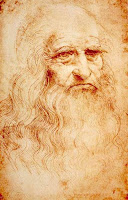
I came across this short TED talk (watch it) on the true face of Leonardo da Vinci by Siegfried Woldhek. It was fascinating to me because it seems so simple, yet elegant. I’m sure there will be some controversy. Basically, Woldhek combed through all the images of Leonard and discarded ones that didn’t fit the bill: not a profile, not male, not detailed enough, and too ugly or was a caricature - because Leonardo was always described as beautiful. What’s more is that Woldhek connects the remaining portraits to a statue of David by Verrocchio that some believe is a model of Leonardo. Leonardo could have been the model because Verrochio was his teacher. Here is Woldhek’s post on the identification. The images he connects are in order:

- Andrea del Verrocchio’s David, started in 1473-5, Leonardo age 13-15
- Portrait of a Musican, created in 1485, Leonardo age 33
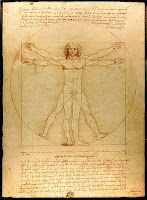
- Vitruvian Man, created in 1490, Leonardo age 38
- Self Portrait Sketch, created in 1513, Leonardo age 63

Verrocchio's DavidPortrait of a MusicianVitruvian ManLeonardo Sketch

Thursday, March 13, 2008

Vitruvian Man

Vitruvian Man 

Marcus Vitruvius Pollio was a Roman writer, architect, and engineer who lived in the 1st century BC. His treatise on architecture, De architectura, gave all sorts of useful advice for planning, designing and building structures big and small. It is the only known written source of classical architecture of that time. As was common in the Renaissance, old Greek and Roman written works were revisited with fresh eyes. 

De architectura was an important inspiration for none other than our favorite Renaissance man, Leonardo da Vinci (1452 – 1519) De architectura is split into ten “books” with each book broken into chapters. Book III is about symmetries you can use when building temples. Chapter 1 of Book III is “On Symmetry: In Temples and in the Human Body.” It is from this part that Leonardo da Vinci got the dimensions for his famous Vitruvian man drawing. I always thought that Leonardo developed the dimensions himself. No worries, he still was a genius artist-engineer. Here is the text from Vitruvius: 
  
“For the human body is so designed by nature that the face, from the chin to the top of the forehead and the lowest roots of the hair, is a tenth part of the whole height; the open hand from the wrist to the tip of the middle finger is just the same; the head from the chin to the crown is an eighth, and with the neck and shoulder from the top of the breast to the lowest roots of the hair is a sixth; from the middle of the breast to the summit of the crown is a fourth. If we take the height of the face itself, the distance from the bottom of the chin to the under side of the nostrils is one third of it; the nose from the under side of the nostrils to a line between the eyebrows is the same; from there to the lowest roots of the hair is also a third, comprising the forehead. The length of the foot is one sixth of the height of the body; of the forearm, one fourth; and the breadth of the breast is also one fourth. The other members, too, have their own symmetrical proportions, and it was by employing them that the famous painters and sculptors of antiquity attained to great and endless renown.” [Project Guttenberg

In the diagram with this post is my attempt to show the dimensions. I started without looking at Leonardo’s diagram and got close but decided to just overlay measurements (crudely) on his diagram.