Showing posts with label american culture. Show all posts

Monday, March 9, 2026

Voting Against Our Own Interests: A Three-Layer Puzzle


Every election cycle someone asks a version of the same question:

Why do people vote against their own interests?

The question usually arrives with a mix of frustration and disbelief. It’s often asked about someone else: rural voters, urban voters, young voters, retirees. Whoever the speaker thinks should “know better.”

But the more we read and think about it, the more slippery the question becomes. What exactly counts as someone’s own interests? And why do we assume that voters make decisions the way economists imagine them to—coolly calculating costs and benefits like shoppers comparing tomatoes at the market?

Recently, our Scrapbook assistant pulled together ideas we’ve collected over the years. None of them fully explains the puzzle. But together they suggest a layered way of thinking about it.

The answer seems to live in three layers: psychology, politics, and the information environment.

Voting against our interests - three layers

Layer 1: The Human Mind Is Not a Calculator


Start with psychology.

People like to think they reason their way to political opinions. In practice, it often works the other way around. We adopt beliefs first, then construct reasons afterward.

Jonathan Haidt famously compared human reasoning to a lawyer defending a client rather than a judge evaluating evidence. Once we adopt a belief, we instinctively search for arguments that support it.

Several well-known mechanisms reinforce this tendency:

Cognitive dissonance.
When evidence contradicts our beliefs, we feel psychological discomfort. Instead of changing the belief, we often reinterpret the evidence.

Confirmation bias.
We seek out information that reinforces what we already think and quietly discard the rest.

Motivated ignorance.
Sometimes people avoid information entirely because knowing the truth would force them to reconsider their identity or social group.

In that sense, sticking with a belief—even when evidence mounts against it—can actually be the psychologically comfortable choice.

So before we even get to politics, the first complication appears:

People are not neutral processors of information.

Layer 2: Politics Is About Identity as Much as Policy


Now move up one layer—from psychology to politics.

If voters were motivated purely by economic self-interest, elections would look very different. Instead, political choices often reflect identity and belonging.

People vote in ways that signal
  • who they are
  • which group they belong to
  • what values they want to express
That’s why voters sometimes support policies that appear economically harmful to them. The policy may conflict with their wallet but align with their moral worldview or group identity.

There is another wrinkle here.

Political scientist Suzanne Mettler documented what she calls the "government–citizen disconnect." Many people benefit from government programs without recognizing them as such. Tax credits, subsidies, or infrastructure investments simply appear as part of normal life. Because the connection is invisible, voters may support cutting programs they indirectly rely on.

In other words, people are not always voting against their interests. Sometimes they simply don’t see the connection between policy and outcome.

Layer 3: The Information Environment Shapes What We Believe


The third layer sits beneath both psychology and politics: the information system.

Democracy depends on something we rarely think about—a shared information environment. Citizens need some baseline agreement about facts in order to debate policy.

That shared environment has been fragmenting.

For most of the twentieth century, people in many countries consumed roughly the same news sources. Today, information is filtered through personalized feeds, partisan media ecosystems, and algorithmic recommendation engines.

The result is what some researchers call "bespoke realities".

Different groups encounter different information streams, reinforcing different interpretations of events. In such a landscape, arguments about competing realities quickly turn into arguments about reality itself.

And once reality becomes contested, identity becomes an even stronger guide for decision-making.

The cycle feeds itself:
  • identity shapes which information people trust
  • trusted information reinforces identity
  • political choices follow from that identity

Putting the Layers Together


Seen this way, voting behavior isn’t a simple puzzle of rational choice.

It’s the outcome of a three-layer system:

Psychology
Identity and cognitive biases shape how individuals interpret information.

Politics
Group belonging and moral narratives influence how people translate beliefs into votes.

Information Systems
Media environments determine what information people encounter in the first place.

Put those layers together and something important emerges.

Voting decisions often reflect identity and narrative coherence more than economic calculation.


Laminated Card Version


Layer 1 — Psychology

Why individuals believe things.
identity → motivated reasoning → cognitive bias

Layer 2 — Politics

Why certain leaders and movements succeed.
anxiety → populism → demagogues → democratic erosion

Layer 3 — Information Systems

Why the environment amplifies these forces.
media fragmentation → algorithmic outrage → collapse of shared reality.

The Real Question


So maybe the question “Why do people vote against their interests?” starts from a flawed assumption. It assumes that interests are purely economic and that voters approach politics as rational calculators.

But humans rarely operate that way.

We vote as members of tribes, participants in narratives, and inhabitants of information worlds that shape what we see and believe.

Seen from that angle, the mystery isn’t why people sometimes vote against their interests. The mystery might be why we ever expected them not to.


Voting against our interests - three layers


Tuesday, August 18, 2020

Thoughts on Ivy in Italy: Problem or Part of the Scenery?


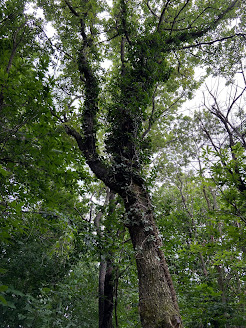
Examples of ivy invading trees in winter, near Bergamo.Examples of ivy invading trees in summer, near Bergamo.
Left: Examples of ivy invading trees in winter, near Bergamo. Right: Examples of ivy invading trees in summer, near Bergamo.

Introduction


We are obsessed with ivy, Hedera. In our opinion, ivy is seems rampant in Italy. If all ivy were removed in Italy, we fear Italy would collapse – ancient ruins, fences, and perhaps, even people – without the binding power of ivy. Okay, a bit of an exaggeration you say. Is ivy really that bad in Italy? We thought so and to challenge the idea, we posed four questions:

  • Question 1: Do Italians consider ivy offensive to look at when running rampant?
  • Question 2: Is ivy invasive in Italy?
  • Question 3: Are we doing more harm than good when we remove ivy?
  • Question 4: Why are we obsessed with ivy?

The answers we found surprised and calmed us a little. TL;DR answers:

  • Answer 1: No, not really.
  • Answer 2: No, at least not at a level that causes significant economic impact.
  • Answer 3: It depends on how it removed and how much ivy there is.
  • Answer 4: We were conditioned to dislike ivy from our years living in Seatte, where it was drummed into our heads that ivy is invasive.

In the remainder of the post, we provide some evidence and personal observations that led to these answers.


The roots


Ivy – commonly called English Ivy – is a woody evergreen perennial native to northern temperate and subtropical zones of Asia and Europe. According to IPCW Plant Report, ivy was introduced in North America by colonial settlers from the United Kingdom; they were bringing a little piece of home with them as was a common custom.

Ivy has old roots in Western culture. Theophrastus (c. 317 BC – c. 287 BC), the father of botany, described ivy in Enquiry Into Plants (Historia Plantarum) (ca. 314 BC). He writes “Wherefore it is mischivous to plant this [ivy] against any tree; for it destroys and starves any tree by withdrawing the moisture.” Even Theophrastus was on to ivy. [p. 277 of Enquiry into plants, translation by Sir Arthur Hort, 1916]

A page from a translation of Enquiry Into Plants: Theophrastus was on to ivy.

Ivy can grow in different soil types and once established is drought tolerant. There are two forms to ivy: a juvenile and an adult form. During its juvenile phase, ivy spreads by vegetative growth. The adult form adds the trick of reproducing with berries and seeds. When we see ivy berries, we cringe because it means the ivy has been there for a while as the juvenile phase lasts at least ten years.

Some species and cultivars of ivy are beautiful, especially those with variegated foliage and interesting leaf shapes. You need only head over to the American Ivy Society web site and peruse the different ivies to find yourself thinking about possible indoor or outdoor uses. What about Ivy of the Year 2016, the cultivar Hedera helix ‘Midas Touch’? There are hundreds of cultivars to choose from.

Ivy’s scientific genus name is Hedera. In the genus there about a dozen species, but H. helix and H. hibernica are the two species that are the most troublesome. Note that the American Ivy Society shows cultivars, a cultivated variety of a species like H. helix that is selected for desired characteristics then maintained through propagation.

And while we are talking about names, we should note that Boston Ivy (Parthenocissus tricuspidata) is not a true ivy being part of the grape family (Vitaceae). Boston ivy is pleasant to behold on the wall of a building and rarely found strangling trees – at least that we’ve observed. Also not related to ivy is poison ivy (Toxicodendron radicans).

Advantages of ivy are: evergreen foliage, attracts and supports wildlife, can add an aesthetic touch in gardening, is inexpensive, easy to grow, drought tolerant, aids in nutrient cycling, soil erosion, and animal forage. Note that ivy is not parasitic.

Disadvantages of ivy are: unsightliness when left unchecked, potential damage such as uprooting or breakage of the host tree during storms, competition with native plants and even host trees, and negative impact on under story plants.

To be honest, unsightliness is our biggest gripe with ivy, especially when it runs amok over trees. To be fair, many of the places we observe this are roadside borders and natural areas close to urbanization. These areas are often neglected in the sense that no one takes care of them, but everyone sees and passes through. These throw-away, border areas can be public or private. Often, ivy is planted purposely as a screen or a barrier.

Walking in the highly curated area of Alta Badia (Dolomites) that we are familiar with, we never see ivy. See for example A Hiking Week in the Dolomites, Val Badia and Val Gardena. Walking to Canto Alto just outside of Bergamo, we see extensive patches of ivy. See for example A Classic Bergamo Hike: Canto Alto.

Ivy is simply where people are. Local response (or better yet tolerance) to ivy varies greatly between regions and provinces of Italy.

As a final scientific note, we were pleased to discover that in the Orobanche (Broomrape) family, a family of parasitic plants, there is one species that targets ivy: Orobanche hederae.

Rorschach test


What do Italians see when looking at ivy? We can only offer anecdotes:

  • We were walking with some Italian friends along a wooded street just outside of Bergamo center. It’s a pleasant winter day. We ask them to look at a tree, without leaves and completely smothered in ivy, and tell us what they see. The answer: nothing unusual. What!? We see a tree smothered, struggling and ripe for falling or being blow over and susceptible to disease.
  • We are visiting some friends in the posh Quintino Alto neighborhood of Bergamo and touring the property that their restored farmhouse sits on. We can’t help ourselves and instinctively start ripping ivy out of their trees. They look at us through questioning eyes asking what we are doing. We try to explain how ivy takes over other habitats creating unhealthy conditions. We are not sure they believe us.
  • We walk by a recently cleaned up lot just outside of Città Alta where trees were removed, and the remaining trees trimmed. But the result? The remaining trees (fine specimens at that) where all full of ivy. It’s as if no one gave a thought to remove the ivy.
  • A friend sent us the video by Oscar Farinetti – La fortuna di nascere in Italia – which talks about the great biodiversity in Italy. The video is factual with some exaggerated marketing manipulation of numbers as you might expect from the owner of Eataly. As soon as the video clip ended, we joked that half the biomass in Italy must be ivy.

From our experience, we believe that ivy is not a problem to Italians. It’s not offensive to look at. Rather, it’s a normal part of the scenery. Ivy grows and it gets chopped down, end of story. If ivy takes over a tree, so what. In short, we think that Italians don’t seem to find ivy offensive.

Quantifying US impact


In the book Weeds: In Defense of Nature’s Most Unloved Plants, author Richard Mabey writes “The best-known and simplest definition is that a weed is ‘a plant in the wrong place’, that is, a plant growing where you would prefer other plants to grow, or sometimes no plants at all.” That wrong place can be where you want crops to grow, or where a weed’s dominance adversely impacts wildlife (the growth of native plants) and leads to new problems like increased fire conditions and impeded waterways.

Invasive species – like ivy – have environmental and economic impacts. In the book, Invasive Plants: Guide to Identification and the Impacts and Control of Common North American Species, ivy is included and it noted that it is particular abundant in the Pacific Northwest – where we spent our formidable gardening years.

“English ivy grows along the ground and climbs on any plant or object in its path. The dense blanket blocks light and germination of other plants beneath it, reducing local plant diversity. It will grow several stories up the sides of building or into the canopy of a forest, adding weight to trees. Covering tree trunks, ivy can loosen bark and hold moisture against the tree trunk, encouraging fungus and decay. In some cases it provides shelter and food for birds. The berries are mildly toxic though, so few bird species feed on them.”

The Draft Written Findings of the Washington State Noxious Weed Control Board (November 2001) also gives a good overview of ivy, description, history, and impact. These sources don’t give any indication of realy dollar economic impact. To be fair, all environment impacts are ultimately economic impacts and maybe with ivy, those impacts aren’t well quantified because while it’s unsightly, it isn’t impactful as other invasives.


In terms of quantifiable economic impact from invasive plants and animals, the NISC – National Invasive Species Council – Invasive Species Impact on Infrastructure gives some idea of invasives that have tangible economic impacts. Examples include:

  • Invasive grasses, such as buffelgrass (Pennisetum ciliare) and cheatgrass (Bromus tectorum), which literally fuel fires that burn down buildings and damage transportation infrastructure. The National Invasive Species Council describes a well established “feedback mechanism between invasive species and fire”.
  • Formosan termites (Coptotermes formosanu) impact residential, commercial, and federal buildings, including historical landmarks. A 1998 study concluded that Formosan termites exist in more than a dozen southern states, costing an estimated $1 billion a year in property damages, repairs, and control measures ($300 million in New Orleans, LA). The total cost of impacts has likely increased substantially over the last 20 years.
  • Nutria (Myocaster coypus), sucker mouth catfish (Subfamily Hypostominae), and other burrowing invasive species are known to compromise the structural integrity of roads, dams, levees, and bridges - thereby jeopardizing the safety of entire communities. Nutria contributed to a recent levee failure resulting in flood damage in excess of $500 million.

Looking at these impacts (and more examples in the Invasive Plants guide), makes our crusade against ivy feel a bit petty doesn’t it? To boot, the U.S. Department of Agriculture National Invasive Species Information Center doesn’t even list ivy. There must be bigger invasive fish to fry. The U.S. Department of the Interior – National Invasive Species Council however does mention ivy, for example, a notice for an ivy pull at a state park in California. In fact, ivy pull events, are common in the Northwest. The No Ivy League is very active in Portland, Oregon and there is young adult comic book story built around it. Similarly, in Washington, California and other states in the US, the message is clear: ivy is removed because it is not wanted.


We can only conclude that ivy is not desired and has, on balance, a negative environmental impact in some areas of the US, but it’s not as serious as other invasive plants. The US National Invasive Species Council wasn’t kicked off in 1999 over ivy outrage, it was over concerns about ants and termites, grasses, rodents, fish, clams, and other species.

A word about terminology. The Invasive Plants guide has the interesting twist when talking about natives and invasives: “All ‘native’ dominants from ponderosa pine to the American bison and Canada gooes were once successful invasives”. The guide also has this wisdom to keep in mind: “All invasives are aliens but not all aliens are invasives”.

Beyond the US


In the EU, the European Commision List of Invasive Alient Species of Union concern (2016 - 2019) list species it’s keeping an eye on. Ivy is not there. The commision’s well-produced brochure does interestingly list a lot of aquatic plants and hogweeds, Heraculeum mantegazzianum, H. persicum, and H. sosnowskyi. And we thought hogweeds were pretty to see when walking in mountain pastures!

In Italy, the Italian Legislative Decree on invasive species (2017) is the statement of compliance dealing with the same EU list, and obviously no ivy is included.

On the global level, the Global Invasive Species Database at least has Hedera helix as an entry. Unfortunately, they don’t list how invasive they consider it. We can at least say that ivy isn’t on the 100 of the World’s Worst Invasive Alien Species. (We were almost rooting for ivy not to be on the list.) Instructive is what is on the list: insects, viruses, algae, aquatic and terrestrial plants and animals. Again the takeaway is that ivy is a concern, just not of high concern.

After casting about here and there in official documents looking for at least a mention of ivy, it occurred to us, that maybe because ivy is native to Eurasia that it – in its natural state on undisturbed land – would naturally be kept in check. Furthermore, the ivy that we are complaining about is ivy that is in disturbed areas. Following this line of thought, this means that what we are really complaining about disturbed areas that are not maintained, and nothing more. Ivy thrives in disturbed areas and much of Italy is for better or worse, disturbed area, at least around population centers. We should not be blaming ivy but blaming the disturbers: us.

Word games


Looking at the Italian language Hedera Wikipedia entry, you will not find one use of the word invasivo/a (“invasive”) or any related words. In the English language Hedera Wikipedia page, at time of writing you’ll find eight uses of the word “invasive”. Even at the level of language, the association of ivy as invasive in Italian just isn’t there.

Not super scientific and widely cautioned against, we can look at Google Ngram Viewer to see if we can say something more about word relationships. Let’s do two searches:
  • Search 1: Input “ivy, invasive” from 1920 to present in the “American English (2012)” corpus.
  • Search 2: Input (in Italian) “edera, invasiva” from 1920 to present in the “Italian (2012)” corpus.

The interesting trend revealed by these searches is not the absolute numbers, because those are difficult to compare, but the cross over when the percentage of the “invasive” term crossed that of the “ivy” term. In the American English corpus that crossover happened in 1980, while in the Italian corpus it happened in 2003. Interesting, but what does it mean? Italy is 20 years behind English-speaking countries in terms of demonizing ivy? We’ll have to leave it at a curiosity at this point.

Fun with Ngram viewer. English terms "ivy, invasive".Fun with Ngram viewer. Italian terms "edera, invasiva".
Fun with Ngram viewer. On the left English terms "ivy, invasive". On the right Italian terms "edera, invasiva".

To pull or not to pull


Ivy in the US is particularly invasive in the Pacific Northwest – and our ivy-vendetta is learned from our years spent in Seattle. From weekend to serious gardeners, Northwesterners have been trained that ivy is invasive and not to plant it. Here’s a typical example of the press ivy gets, this from the Seattle public radio station KUOW titled Rip the ivy out of your yard right now. Seriously.

Besides the obvious environment impacts listed elsewhere in this post, there are some philosophical reasons we don’t like ivy:
  • Using ivy is a quick fix to a problem that could be solved with different plant choices. Ivy is a quick spreader and climber and that appeals to the just-get-it-done gardener. Rather than wait and do things correctly, corners are cut, and ivy enters the mix. And ivy is cheap.
    • We had a Seattle neighbor who let ivy invade a 30+ foot cherry tree to the point that the tree eventually had to be removed due to disease as it was considered dangerous. After many years of looking at said eyesore tree, we got up the courage to ask why the ivy had been left to fester. The answer was practical: our neighbor liked the fact that the ivy blocked the view of other neighbors.
  • Rampant ivy speaks to us of decay and neglect. It doesn’t take much to keep ivy at bay, we know, we had to work to keep it under control in our yard for years. The idea of neglected, “throwaway” areas is something we hate. (We hear you: form our own ivy pull squad. We took a step in that direction and recently purchased pruning shears so when walk around Bergamo we can be ready.)
  • From a purely visual point of view, trees or spaces overrun with ivy look awful.

To pull or not to pull ivy? Specifically, does it hurt the environment to remove ivy? Is the habitat or food source of insects and animals adversely affected?

Curiously, we found lots of (well-reasoned) caution when it comes to ivy removal that is British based, for example:
  • The Royal Horticultural Society says that you don’t need to always control ivy.
  • The BBC report Five reason why ivy is important cites some compelling reasons to leave non invasive ivy alone including fact that ivy can provide late-season food shelter for some insects and animals and can keep building warmer in winter and cooler in the summer.
  • The Arbtalk forum thread concludes with this on removal: “it depends”.
  • The article Ivy – Boon or Bane? points out that there is little quantitative evidence to determine the true impact of ivy in the British landscape (specifically on trees).

It could be our personal Internet search bubble, but we just couldn’t find much sympathy in the US for ivy as shown in the examples above. We found one measured response in the article If I Pull Invasive Ivy Down from Trees, Does it Hurt the Ecosystem?: it depends on the impact on biodiversity. Beyond that, it’s pull baby, pull. 

Pulling is the easiest if not most labor intensive way to remove ivy. We like pulling, especially pulling ivy out of trees. In fact, when we see a tree smothered in ivy to its crown, we don’t think “what a lucky tree”? We don’t think of all the habitat and berries that the ivy provides. On the contrary, we think the opposite, of all the insects and animals who are not presented with their normal habitat and food. And the danger to the tree. In short, a neon sign the word PULL lights up in our minds.

Perhaps we can think the difference in point of view between US and Britain regarding ivy in terms of the culture, history, and the sizes of the respective countries. Britain has been living with ivy way before the pilgrims took off and brought it to the US. Also, by our reckoning, there is a strong garden culture in Britain and attentiveness to nature that translates into ivy being effectively kept under a watchful eye and managed. We remember our time in England driving from London to Hastings and then from Hastings to Bath. The number of gardens-for-visit we encountered was mind-boggling; We can't imagine ivy not being much of a concern with so much garden pride and attention. Finally, in the US, vast spaces can become infested with no one’s watchful eye to keep it in check. Perhaps that’s why the the idea of ivy pull gatherings/squads is common.

Conclusion


Here are the questions we set out to investigate with answers, restated with answers. While we still believe ivy can be unsightly as hell, we have softened slightly in terms of why that is the case.

Question 1: Do Italians consider ivy offensive to look at when running rampant?

On average, no. There isn’t the demonization of ivy as invasive in Italy as there are in other parts of the world, in particular parts of the US. It’s not offensive to Italians because they haven’t been beat over the head with public service campaigns against ivy because ivy hasn’t impacted the environment in a significant way.

Regarding the aesthetic appeal and acceptance of ivy – again, when it runs rampant, we can only speculate that it’s part and parcel of being Italian. Ivy exists. Ivy twists and twines through trees, fences, roofs, roman amphitheaters, and Etruscan tombs. And often it is planted specifically. Italians are at peace with ivy. (We are not.)

We would love if our friends, whose property we were touring and ripping ivy out of their trees, would warm up to what we would call good management of their property and trees regarding ivy eradication, but that’s not likely to happen.

Question 2: Is ivy invasive here in Italy?

No, at least not at a level that causes significant economic impact. Ivy doesn’t seem to effect agriculture (be it food crops or wood output). Instead, ivy thrives in “un-productive” spaces, nature adjacent to urban areas and where people frequent.

Ivy is not on the EU/Italy list of invasive species. End of story. We have to trust that the officials have thought about this list a bit.

Question 3: Are we doing more harm than good when we remove ivy?

It depends on how it removed and how much ivy there is. The method you choose for removal will have an impact. Laying waste to a patch of ivy with chemicals is probably not a good idea in terms of the health of the environment. Manually removing ivy is better.

If ivy isn’t invasive (whatever that means in your particular context), it could provide habitat and shelter for some insects and animals and confer some other benefits. In this case, removal may not be necessary – but only in the case that the piece of land/garden/terrace in question is under the watchful eye of someone who can keep the ivy from fruiting and becoming invasive. That’s a taller order than it might seem. We recommend you err on pulling ivy out.

Question 4: Why are we obsessed with ivy?

We are obsessed with ivy because we are aesthetically sensitive to urban / natural environments in a state of decay or neglect. As well, we’ve learned from 20 years in the Pacific Northwest and public service campaigns that ivy is invasive. These kinds of campaigns do not exist in Italy, as far as we can tell.

References


Here are some of the references and resources we used to write this post.


[1] American Ivy Society

[2] Hedera Wikipedia page (English)

[3] Hedera Wikipedia page (Italian)

[7] U.S. Department of Agriculture National Invasive Species Information Center – Ironically, ivy (“ivy”, “hedera”, “helix”) isn’t listed here. There must be bigger invasive fish to fry.

[8] U.S. Department of the Interior – National Invasive Species Council – Ivy is mentioned, for example, an ivy pull at a state park in California.

[9] Draft Written Findings of the Washington State Noxious Weed Control Board (November 2001) – A good overview of ivy, description, history, and impacts.

[11] https://www.invasive.org/gist/moredocs/hedhel02.pdf - a good guide to removal and costs in time

[12] https://www.portlandoregon.gov/parks/47820 - Portland, Oregon no ivy league, could we imagine something like this in Italy?

[13] https://www.portlandoregon.gov/parks/article/201781#whyH. hiberna is the dominant plant; there is a ploidy different with H. helix.

[14] https://wildlife.ca.gov/Conservation/Plants/Dont-Plant-Me/English-Ivy

[15] https://www.cal-ipc.org/resources/library/publications/ipcw/report55/ - California Invasive Plant Council.

[16] https://www.fs.fed.us/database/feis/plants/vine/hedhel/all.html - Ivy most invasive in the northwest.

[17] European Commision List of Invasive Alient Species of Union concern – Lists documents dealing with invasive species from 2016 – 2019.

[18] Italian Legislative Decree on invasive species (2017) – The statement of compliance with EU invasive species.

[19] 2015 Effect of Manual Ivy Removal on Seedling Recruitment in Forest Park, Portland, OR. American Journal of Undergraduate Research

[20] If I Pull Invasive Ivy Down from Trees, Does it Hurt the Ecosystem? – Answer: it depends.


Photo Gallery

Examples of ivy in trees in and around Bergamo. There are a lot of beautiful places around Bergamo and we are only showing these examples of ivy to illustrate a point about how ivy can invade areas.

Summer - A grove of pines with ivy removed in Almè.Summer Ivy - Bergamo - Via Felice Cavagnis.Summer Ivy - Bergamo - Via Felice Cavagnis.
Left: Summer - A grove of pines with ivy removed in Almè.
Center and right: Summer Ivy - Bergamo - Via Felice Cavagnis.

Summer Ivy - Bergamo -Via Colle dei Roccoli.Summer Ivy - On Way to Canto Alto.Summer Ivy - On Way to Canto Alto.
Left: Summer Ivy - Bergamo -Via Colle dei Roccoli.
Center and right: Summer Ivy - On Way to Canto Alto.

Summer Ivy - On Way to Canto Alto, a fallen tree, due to ivy?

Summer Ivy - On Way to Canto Alto.Summer Ivy - On Way to Canto Alto.Summer Ivy - Parco Sant'Agostino. Ivy knocked back on the tree trunk.
Left and center: Summer Ivy - On Way to Canto Alto.
Right: Summer Ivy - Parco Sant'Agostino. Ivy knocked back on the tree trunk.


Winter Ivy above Ponteranica.Winter Ivy above Ponteranica.Winter Ivy above Ponteranica.
Winter Ivy above Ponteranica.

Winter Ivy above Ponteranica.Winter Ivy above Ponteranica.
Winter Ivy above Ponteranica.

Winter Ivy above Ponteranica.

Wednesday, September 6, 2017

History in the Streets - Comparison Between Italian and American Street Names


Walking through a typical Italian city you can't help but get a lesson in Italian history: it's all encoded in street names. It wouldn't be uncommon to receive directions such as "Follow Viale Vittorio Emanuele II, turn left on Giuseppe Verdi and follow it until you come to Via Cesare Battisti." In the course of your journey you would be honoring, respectively, Victor Emmanuel II, the first king of a united Italy in the late 1800s, Giuseppe Verdi, the famous Italian opera composer of the second half of the 1800s, and Cesare Battisti, the Italian patriot and socialist politician of the late 1800s and early 1900s.

It turns out that street names in Italy fall into a couple of broad categories dealing with important people and events in Italian history.  By contrast, street names in the United States tend to be based on numbers (e.g., First, Second) or names of trees (e.g., Oak, Elm). 

In this post, we'll compare and contrast street names between the US and Italy. Specifically, we'll talk about the top names used for Italian streets. Then, we'll use Bergamo as a specific Italian city example and list some street names found there. Finally, we'll close out by talking about American street names.

Italian Street Names


The data discussed here is from Laboratorio internazionale di onomastica (LIOn), but unfortunately doesn't seem to be easily accessible anymore. (Long live data on the internet!) So, we have to rely on others who analyzed the data, in particular these two references:


These two references (circa 2013) give the following top 20 Italian street names:

  1. Roma 
  2. Giuseppe Garibaldi 
  3. Guglielmo Marconi 
  4. Giuseppe Mazzini 
  5. Dante Alighieri 
  6. Camillo Benso conte di Cavour 
  7. Giacomo Matteotti 
  8. Giuseppe Verdi 
  9. IV Novembre 
  10. Castello 
  11. Papa Giovanni XXIII 
  12. Cesare Battisti 
  13. Alessandro Manzoni 
  14. Aldo Moro 
  15. Antonio Gramsci 
  16. Chiesa 
  17. Vittorio Veneto 
  18. Piave 
  19. Alcide de Gasperi 
  20. Umberto I

Some information and observations about this list of street names:
  • The list of top street names came from over 8,100 Italian cities. 
  • Reference 1 states that streets named for John Fitzgerald Kennedy comes in at number 66. 
  • The names of important Risorgimento (Italian unification) / Irredentism and political figures provide 50% of the top 20 names. 
  • A full 75% of the top 20 are the names of people, specifically men. 
  • Reference 2 reports that names of women make up 2.4 % of the total list of names and the first woman to appear is "Santa Maria" at 57th place. 
  • The three "place" street names in the list (Roma, castello, chiesa) are all you would ever need in a town: how to get to Rome for business, how to get to church for absolution, and how to get to your nearby castle for protection. And rest assured, these streets take you there, if not quickly, at least eventually. (If you are wondering, there isn't a via Roma in Rome, but there is a Via Roma Libera. For more information, see the Italian Wikipedia page on Via Roma. There it is stated that many of the Via Roma street names come from Fascist times in Italy.) 
  • Score one for science! Guglielmo Marconi comes in high on the list at number 3, only behind Garibaldi. 
  • Other, older top street name lists are from 2011: Il Risorgimento scende in strada and 2005: I dieci nomi delle vie più diffusi in Italia. Their data is slightly different.

Categorizing the top 20 names gives us a handy list for a possible crash-course in Italian history.

Risorgimento / Irredentism: Giuseppe Garibaldi (1807 - 1882), Giuseppe Mazzini (1805 - 1872), Camillo Benso Conte di Cavour (1810 - 1861), Cesare Battisti (1875 - 1916)

Statesman: Giacomo Matteotti (1885 - 1924), Aldo Moro (1916 - 1978), Antonio Gramsci (1891 - 1931) , Alcide di Gasperi (1881 - 1954), Umberto I (1855 - 1900)

Artist / Scientist: Guglielmo Marconi (1874 - 1937), Dante Alighieri (1265 - 1321), Giuseppe Verdi (1813 - 1901), Alessandro Manzoni (1785 - 1873)

Place: Rome, Castello, Chiesa

WWI: IV Novembre (Armistice of Villa Giusti ending war between Italy and Austria, 1918), Piave (river and site of Italian victory over Austria in 1918), Vittorio Veneto (battle 1918)

Religion: Papa Giovanni XIII - pope (1958 - 1963)

I remember my first few times in Italy and the feeling of heaviness the names conveyed. I didn't know Battisti from Gramsci. After a year, they seemed less opque as I've began to slowly imbibe Italian history from friends and reading. Heavy, yes, but interesting I must say. Compare the top Italian street names with the bland, functional names of the top American street names (listed in full below) like First, Second, Third, and so on. The streets of Italy are rich history lessons. Italians live their history daily.

The categories we give above, in particular, Risorgimento, Statesman, and Artist/Scientist, are our inventions, used for convenience. People or events in a category don't always neatly fit. Take for example Antonio Gramsci. Yes, in general, he was a statesman, but he was also a journalist, a linguist, and a philosopher - to name just a few other hats he wore. In the Risorgimento cateogry, conte di Cavor's was a businessman and politician as well as a key protagonist of the Risorgimento.

And sadly, there are not shortage of tragic stories in these street names, including Matteotti - murdered during a kidnap attempt by Fascist secret police, Moro - kidnapped and murdered, Gramsci - imprisoned the by Fascist government, which led to a serious decline in health and his death, and Umberto I - assassinated.

Bergamo Street Names


The following list of streets in Bergamo is not an official list. The names were not rigorously selected nor are they selected based on popularity or relevancy. Rather, they are simply streets in Bergamo Città Alta and Città Bassa that we've noted. Still, the list is interesting for two reasons. First, it confirms a similar pattern seen in the list of street names across Italy, that is, names honoring the Risorgimento, national statesman, and artists. Second, many Bergamo street names honor a local prominent citizens of the past, so that in these cases, there is a local history lesson. For example, streets in Bergamo honoring "locals" like Locatelli, Camozzi, or Colleoni are not found in the top 20 street names for all of Italy.

Bergamo street names honoring prominent local people and places:

Statesmen 
  • Antonio Locatelli (1895 - 1936) 
  • Gabriele Camozzi (1823 - 1869) 
  • Francesco Cucchi (1834 - 1913) 
  • Bartolomeo Colleoni (1395 - 1475) 
  • Giacomo Costantino Beltrami (1779 - 1855) - patriot/explorer 
  • More info about personaggi illustri or promiment citizens of Bergamo. 
Artists / Scientists 
  • Girolamo Tiraboschi (1731 - 1794) - historian 
  • Mario Lupo (1720 - 1789) - historian 
  • Torquato Tasso (1544 - 1595) - poet 
  • Giacomo Quarenghi (1744 - 1817) - architect 
  • Andrea Fantoni (1659 - 1734) - sculptor 
  • Giacomo Manzù (1908 - 1991) - sculptor 
  • Evaristo Baschenis (1617 - 1677) - painter 
  • Gianandrea Gavazzeni (1909 - 1996) - composer 
  • Gaetano Donizetti (1797 - 1848) - composer 
  • Simone Mayr (1763 - 1845) - composer 
  • Antonio Stoppani (1824 - 1891) - scientist 
  • Clara Maffei (1814 - 1886) - a woman of letters and important backer of the Risorgimiento 
Places 
  • Viale delle Mura - runs along the top of the Venetian walls or "mura" of Città Alta, the wall of which are now officially a UNESCO site. 
  • Via alla Rocca - takes you to the fortification called La Rocca
  • Via della Fara - runs alongside the green space in Città Alta called the Fara. 
Religion 
  • Papa Giovanni XXIII (1881 - 1963) - beloved pope from the Bergamo area; Bergamo's main hospital is named after him as well as many other buildings and organizations in Bergamo and around Italy. 
  • Angelo Mai (1782 - 1854) - religious scholar; today the beautiful Biblioteca Angelo Mai carries his name as well. 
  • Street Saints: Via Sant'Alessandro, Via S. Giovanni, Via S. Giacomo, Via San Salvatore, Via San Lorenzo, Via San Pancrazio, Largo di Porta S. Alessandro, Vicolo Sant'Andrea

American Street Names


In 1993, the U.S. Census released a tally of common street names (a scan someone made of the data; the original data is hard to find). In 2014, a new set of data was released. Both the 1993 and 2014 dat are discussed in two references we'll use here:


From Reference 1, we have the following top 20 street names (1993 data):

  1. Second, 2nd 
  2. Third, 3rd 
  3. First, 1st 
  4. Fourth, 4th 
  5. Park 
  6. Fifth, 5th 
  7. Main 
  8. Sixth, 6th 
  9. Oak 
  10. Seventh, 7th 
  11. Pine 
  12. Maple 
  13. Cedar 
  14. Eighth, 8th 
  15. Elm 
  16. View 
  17. Washington 
  18. Ninth, 9th 
  19. Lake 
  20. Hill

Categorizing the names as we did for Italian street names leads to:

Numbers: Second/2nd, Third/3rd, First/1st, Fourth/4th, Fifth/5th, Sixth/6th, Seventh/7th, Eight/8th, Ninth/9th

Trees: Oak, Pine, Maple, Cedar, Elm

Places: Park, Main, View, Lake, Hill

Statesmen: George Washington

Almost 50% (9/20) of the top 20 across all of America are numbered streets. Just one surname, Washington, appears in the top 20. If you look at the top 50 names, the numbers start to become less common, the tree and place names stay about the same, and more surnames start to creep in: Lincoln (#26), Jackson (#33), Johnson (#40), Jefferson (#42), and Wilson (#44).

For me, the numbers, trees, and place names used for American streets are a far cry from weighty Italian street names. Why that's the case I'm not sure and won't hazard any guesses.

Finally, Reference 2 for American street names gives information about variations in the top 10 names by state. While there are variations between states, the top 10 lists are consistent in their use of numbers, trees, and places. What variations there are speak a little to history and surroundings. For example, Arizona has "Apache" and "Mesquite" while Hawaii has "Aloha" and "Lehua". Connecticut has neither, or at least in the top 10.

Saturday, March 13, 2010

Let's Evolve: Change We Can Believe In

Mike Rosulek Darwin Poster
Every politician promises change but it never seems to arrive. Well, there is change you can believe in: the change brought about by the process of natural selection, the key mechanism of evolution. The image is courtesy of Mike Rosulek. His take on the iconographic Obama poster has several versions all around the theme of evolution. Profits from use of the images benefit the National Center for Science Education (NSCE) - a great organization whose mission is to keep evolution a part of science education.

Sunday, January 24, 2010

Citizens United v. Federal Election Commission


It remains to be seen how this past Thursday’s Supreme Court ruling, Citizens United v. Federal Election Commission, on campaign financing will play out. However, we have a bad feeling about this nugget of conservative judicial activism that basically opens the floodgates of spending from corporations and unions in elections. Apparently, existing safeguards on spending by corporations was a restriction of their free speech. Hmm. In that light, it is interesting reading through Justice Steven’s dissenting opinion, in particular, what he had to say about corporations (page 88 of ruling):


“In the context of election to public office, the distinction between corporate and human speakers is significant. Although they make enormous contributions to our society, corporations are not actually members of it. They cannot vote or run for office. Because they may be managed and controlled by nonresidents, their interests may conflict in fundamental respects with the interests of eligible voters.”

The case was brought before the court because of the nonprofit corporation Citizens United’s attempt to show Hillary the Movie in violation of the McCain-Feingold Act (which is now essentially null).

Tuesday, January 5, 2010

Knock, Knock, Who’s There? Edward Jones.

The other day the doorbell rang and we thought oh it’s one of those darn door-to-door religious nuts, but we answered it anyways. Well, well, it wasn’t someone warning us about the end of the earth, but rather advertising financial advising services. Whoa. We don’t live in that upscale of a neighborhood. After a little research it seems it is common with Edward Jones. Still a bit weird for my taste. The knocker even followed up with a Christmas card.

Saturday, July 11, 2009

Slow Money: Inquiries Into the Nature of Slow Money

Slow Money Book Jacket
The book by Woody Tasch titled Slow Money: Inquiries Into the Nature of Slow Money – Investing as if Food, Farms, and Fertility Mattered was an interesting read for me because it echoed lots of ideas about our economic system that I’ve often thought about but never could articulate. What’s slow money? It’s the opposite of fast money, it’s place over profit, it’s about thinking, acting, investing, and purchasing locally, and underlying it all it’s about restoring fertility to the soil. It’s easy to agree with the idea(l)s but hard to practice them. Every visit to the grocery store becomes a struggle if you ask about the origin of every item purchased. Forget about investments – who knows the exact location of their investments at any given time? But this is precisely the struggle and questions Tasch wants you to deal with.

The principles of the Slow Money Alliance are partly poetic -“bring money back down to earth” – and partly practical - “what would the world be like if we invested 50% of our assets within 50 miles of where we live?” In chapter 2 Reconnoitering, Tasch gives an idea of how fragmented our lives have become writing:

“Producer is separate from consumer. Investor is separate from citizen. Where we live is separate from where we work. Communication is confused with thought.
Diversification is confused with direction. Mobility takes precedence over responsibility. We become a nation of commuters and tourists. We become a nation of migrants and white-itinerant-money-people.”

In chapter 5 War on Terroir, Tasch muses about the differences between homeland and household and threats to both:

“Distant markets and cyberspace do not attack us directly. They come bearing gifts: food out of season, cheap goods made in foreign factories, 24/7 opportunities for shopping and surfing the Internet. But something happens as their influence pervades the household. We lose touch with the notion of the household as a locus of production and settle into the notion of the household as a locus of consumption. Even worse, we slide unawares into the belief that the health of a household and the society of which it is a part are defined by level of consumption.”

Tasch weaves in ideas from the Slow Food movement (the founder of the International Slow Food movement Carlo Petrini wrote the foreword), from E.F. Schumacher (economist and author of Small is Beautiful: Economics as if People Mattered), Wendell Berry (farmer and writer), and Eliot Coleman (farmer and educator) to name a few.

If you think that this sounds like a book that is anti-capitalism, I’ll leave you with this interesting quote from chapter 2 where Tasch is quoting Tom Miller, the first CEO of the Kentucky Highlands Corporation.


“We are not trying to reign in or correct or punish capitalism. We are trying to complete it.

Capitalism remained incomplete because resources seemed inexhaustible and consumption seemed to cause no harm. Now, as we reach a new juncture in our history on the planet, that is not longer the case.”

Friday, June 26, 2009

Departures: Rifle Ceremony and Blondie Bonds with the Locals

South Africa Travel Ad in Departures magazine - Do elephants greet humans this way?

If the Departures magazine is just going to show up in front of us, then it’s fair game to make fun of. This time, two country ads caught our attention. The first ad is from South Africa and shows a group of four people greeting (or at a standoff?) with an elephant with the text reading “Elephants have greeting ceremonies for friends returning from voyages. Secretly, I hoped that when I come back, they’ll remember me as much as I’ll remember then.” The group of four is carrying rifles. Some greeting ceremony. This ad does nothing to want to make us go. Koyaanisqatsi anyone?

The second ad is for Panama and it shows a blonde (American?) getting a stripe painted down her nose and now she has the bragging rights of have so “done” this culture! Again, does nothing to attract us; next time just use a picture of the landscape please.

Panama Travel Ad in a Departures magazine - Blonde tourist in Panama

Wednesday, June 10, 2009

National Geographic Magazine – Stop With the Dumb Ads!


Maybe it’s just me, but I find the National Geographic magazine ads to be getting dumber. Take this ad for “free safes”. The ad is part of a two page spread. The first part of the ad (not shown) gives you no-nonsense financial tips such as “cash is king” and “buy a good safe”. This is followed by part two of the ad (shown above) to let you know that safes are being “doled” out. Someone or something has just opened up its heart and decided to give away safes. Wow, how generous. Oh, by the way the free safes come stocked with 4,100 coins that cost about $2,000 payable in easy monthly payments. The ad also points out that if you bought a dollar coin in 1975 it would be worth 5 times more today. Yup. More reasons for getting the safe. Who cares that you could have equally said that if you invested 1 dollar in the stock market it would be worth almost 10 times more today.

Monday, February 23, 2009

Tiramisù a la Oscar

Tiramisu

A dessert request for an Oscar night party resulted in Tiramisù a la Oscar. Okay, it was just a standard tiramisù with an Oscar statuette motif on top. But, it was marvelous along with a banana pudding another guest brought. Speaking of sweet Italian dishes, some of the partygoers asked: “Who is that Italian drag queen presenting the Oscar for best leading actress”? Uh, that’s Sophia Loren thank you very much. The dismal ballot/score sheet below documents the fact that I scored just a bit higher than randomly guessing. Not so bad considering I haven’t seen any of the movies.

Oscar Ballot

Friday, October 31, 2008

Departures: The Day and Night Watch

Day and Night Watch
We got our Departures magazine this month (the same magazine that gave us Luxurious Flying) and were so delighted to flip through it. Boy are there lots of watch ads. You know how well we love our watches at TravelMarx (see this post). One ad stuck out for us, and that is the Swiss watchmaker Romain Jerome’s watches made from pieces of the Titanic. Okay, not so bad we thought, though, a bit ugly.

Later in the same magazine there was an article on “necessary luxuries” with a quote from the WSJ wealth reporter Robert Frank that goes like this: luxury is not dead, just conspicuous consumption is. Furthermore, we are now in an era where we are buying (luxuries) that “fuel our passion and fulfill a part of our identity”. Does that include food, gas, and healthcare?

After a bit of poking around on Frank’s blog site this article on a watch that doesn’t tell time caught our eye and voilà we are back visiting the Swiss watchmaker. Romain Jerome’s Day & Night Watch only tells you if it is day or night. Why bother with the actual time? If you are wealthy enough to buy this watch, perhaps people wait for you? I immediately think of the Elton John song Mona Lisa and Mad Hatters with the lyric (from the 1972 Honky Chateau album):


While Mona Lisas and mad hatters,
sons of bankers, sons of lawyers, turn
around and say, "good morning" to the night.
For unless they see the sky, but
they can't and that is why,
they know not if it's dark out side or light.


The watch advertising goes “the Day & Night watch offers a new way of measuring time, splitting the universe of time into two fundamentally opposing sections: day versus night”. And to think we thought the calculator wrist watch was radical.

Saturday, October 11, 2008

Luxurious Flying

Luxurious Flying Sample 1 Luxurious Flying Sample 2
We just got back from the East Coast and took a non-stop from Seattle to Boston and back. While not a bad flight, regular class is always a bit cramped and a strain. At least we had the means to make the flight. Today we received this magazine that couldn’t be farthest from our style but it ends up in our mail every so often. (Just call us uneducated and uncouth, but outlandish jewelry dripping with gems and uber-fancy resorts with not a soul in sight just don’t register.) The magazine is called Departures. (It’s so exclusive you can’t even see its Web site without logging in, so there!) In flipping through the magazine we just had to share these two advertisements for a type of flying that is a world apart from what the average person experiences. Welcome to the world of luxury flying. In the first ad, check out the size of those seats! A family of four can easily fit in one. In the second ad, you might think it’s an ad for a hotel room and you would be partially correct. It’s a “personal bedroom at 35,000 feet with dual sliding doors”! What if you have a really loud person one “personal bedroom” over? Diminishes the $9,000 or so for the space. Stick to economy, set your expectations low, and hope to be pleasantly surprised.

Friday, September 26, 2008

Swingers


Sour grapes you can say, but I’m tired of being ignored in the presidential election. Just because I don’t live in a “swing” state means I don't get my fair share of the campaigning attention I feel I deserve. Looking at the map included here (from Wikipedia) shows fairly dramatically how much attention and money is paid to swing states. The data is from the last 5 weeks of the 2004 election. The data comes from the site http://www.fairvote.org/presidential/?page=1677www.fairvote.org. On the map on the left each waving hand represents a visit from a presidential or vice-presidential candidate during the final five weeks of the election. On the map on the right, each dollar sign represents one million dollars spent on TV advertising by the campaigns during the same time period.

In per capita terms, the states receiving the most attention were Iowa, Ohio, and New Hampshire. In absolute time, the three states receiving the most attention were Ohio, Florida, and Pennsylvania. So there you are.

Door-to-Door Magazine Sales

It hasn’t happened for a while, but today I popped out front to do a little yard work and wham, a young door-to-door salesperson showed up selling magazines. You’ve heard the story, a young person trying to earn points to get a job, or scholarship, or something else. To do this, they must sell magazine subscriptions. In this case this young person whose name was Jessica and was from Texas and was working for the firm http://www.dntconnections.com/. She told me that they send “kids” like her around the country to get “experience”. Why would they spend the money (and risk) to send a single mother (she told me she was) to live in a hotel in a far away city to sell magazines doesn’t make sense to me.

Type of questions I was asked: “Are you a generous person?” and “Do you believe in second chances?” My response to both was “no”.

So, I told her I would not write a check or give money, but would consider logging on to a Web site and ordering and trying to give credit to her. The company DNT Connections exists, but you can’t order anything that I could tell. Figures.

After a little more digging (see resources below), I realized that yes, these magazine crews do go around the country and that all not all is well in this little-understood industry (i.e., deaths and exploitation). The lesson I’m coming away with is that trusting your first instinct to be very wary is okay and if you want to help people in this age bracket do it locally through other more reputable organizations. Be on the watch for emotional questions like the ones given above. It’s rehearsed.

Resources

Government site that has some good information in case you did buy and need to know your rights
http://www.ftc.gov/bcp/conline/pubs/tmarkg/magzn.shtm

An exposé from the Portland area from two young women who spilled the beans:
http://www.portlandtribune.com/news/story.php?story_id=115501199061804400

A site dedicated to exposing this industry:
http://www.travelingsalescrews.info/mainpage.html

True stories from people who worked on magazine crews:http://www.magcrew.com/

Saturday, August 23, 2008

Phelps, Bigfoot, and Presidentialism

Alexis de Tocqueville

What do these three things have in common? Perhaps nothing really, but in my early-morning, crow-cawing-pierced, groggy Saturday morning mind they all united in a common theme: fascination with the “top dog” to the exclusion of everything else. I know, sour grapes in regards to Phelps and his medals, but it did not sit well with me the response and media coverage of his effort. It seemed so over-the-top to the exclusion of all other possible stories. Now a pending book. Then throw in another Bigfoot hoax. People just want to believe there is a “big guy”, a “top dog” out there waiting to be discovered. The "discovery" was complete with an official news conference put on by the two car salesmen who made the find. Psst, hey reporters, you know that Bigfoot doesn’t exist and besides (exclusion theme) we have so many other serious problems (war, poverty, etc.) to deal with? Finally, there is the vice president choice for the two presidential candidates. Does it matter? Not really according to many and it displays our endless fascination with the “top dog”. In an interesting piece called The Conquest of Presidentialism, presidentialism as defined by Vanderbilt professor Dana Nelson is: our paternalistic view that presidents are godlike saviors—and therefore democracy’s only important figures. In the same piece there is a reference to a quote by Alexis de Tocqueville (1805 – 1859), a French historian who made some astute observations about 19th century American democracy that are still relevant today, which I’ll repeat here. The quote refers to our capability to select leaders. True or false?

“It is in vain to summon a people, which has been rendered so dependent on the central power, to choose from time to time the representatives of that power; this rare and brief exercise of their free choice, however important it may be, will not prevent them from gradually losing the faculties of thinking, feeling, and acting for themselves, and thus gradually falling below the level of humanity.” (Democracy in America, Volume 2)