Showing posts with label ragusa. Show all posts

Tuesday, February 14, 2017

Ragusa, Sicily - Street Sign Language Lesson XVI

previous lesson | this lesson | next lesson

For this episode of the Street Sign Language Lesson, we are back in Sicily, this time in the Province of Ragusa. (In Sicilia – Street Sign Language Lesson XII, we were in the Province of Catania, around Etna.)

We spent six days based in Ragusa, exploring the city and the surrounding area. Here are a few street signs and announcements that caught our attention. In this episode, you’ll learn what the heck “capuliata” and “MUOS” are, and why people love the first and hate the second.

Left and center left: Explanation of the fundraising for the church organ in Chiaramonte Gulfi. Center right: Sewer cover "fognatura". Right: American unexploded WWII bomb in Chiaramonte Gulfi.
Explanation of the fundraising for the church organ in Chiaramonte Gulfi.Explanation of the fundraising for the church organ in Chiaramonte Gulfi. Sewer cover Chiaramonte Gulfi.American unexploded WWII bomb in Chiaramonte Gulfi.

Adotta anche tu una canna per il restauro del nostro organo – “You too can adopt a pipe for the restoration of our organ”
We had a lunch reservation for the winery Locanda Gulfi and went a few hours early to walk around the nearby town of Chiaramonte Gulfi. Locando Gulfi Winery: great views, okay tour, okay food. It didn’t wow us in particular, but visiting a winery is not the norm for us. On the other hand, the town of Chiaramonte Gulfi was unexpectedly charming, especially the Giardino Pubblico Comune and adjacent Balcone di Scilia with its panoramic views. The plants in the park were well-maintained, and a number of them had associated labels with the scientific and common plant names. That’s my kind of park.

We saw the sign in the photo in the main church, Chiesa Madre S. Maria La Nova. The church is restoring the organ (organo) asking for donations by enticing people to adopt an organ pipe (canna d’organo). Remember, the pronunciation of organo has the stress on the first syllable as òrgano, not orgàno. My American English-trained ear has the tendency to put the stress toward the end of the word, which has people scratching their heads as to what I’m trying to say. Besides òrgano, other words with similar stress are: òrfano, fégato, cómpito, sìmbolo, and sìllaba to name just a few. In these words (sdrucciole) you put the stress on the antepenultimate, or third-to-last syllable of word.

Fognatura – “Sewer system”
This word was on a sewer cover in Chiaramonte Gulfi. Related words are the verb fognare – equipped with sewers, and the noun fogna – a sewer. According to this list of Italian suffixes, tura indicates the action expressed by the verb, in this case fognare.

Bomba da 500 libbre – “500 pound bomb”
This unexploded, American WWII bomb was displayed in Piazza Duomo, Chiaramonte Gulfi. The information plaque on the bomb was partially destroyed, but it looks like it landed somewhere near Comiso.

Left and center left: Glass vessel for killing flies at Castello di Donnafugata with explanation. Center right and Right: A display on the corset at Castello di Donnafugata.
Glass vessel for killing flies at Castello di Donnafugata and explanation.Glass vessel for killing flies at Donnafugata and explanation.A display on the corset at Castello di Donnafugata.A display on the corset at Castello di Donnafugata.

Left: Information on the exhibition Tra pizzi e merletti. Center and right: Views of Castello di Donnafugata.
Information on the exhibition Tra pizzi e merletti.View of Castello di Donnafugata.View of Castello di Donnafugata.

Belle da morire: storia del busto, una vita col fiato sospeso – “Dying for beauty: History of the corset, living with bated breath”
I admit that I was a little obsessed with going to the Castello di Donnafugata. As soon as I knew there was a labyrinth there, it was something we definitely had to do. The day we arrived there, I was patient enough to go through the castle (more a mansion than a castle) first instead of running straight to the labyrinth.

Inside the 28 of the 122 rooms of the mansions open to the public, we saw rooms decorated in a mix of styles as well as a parts of the exhibition Tra pizzi e merletti – Storie di vita privata, dedicated to corsets, bodices, fabrics, and other intimate wear from times of yore. One room contained this display about the corset, il busto. There is a play on word with fiato sospeso, literally “breath suspended”, but better translated as “bated breath”. Wearing a corset caused problems like not being able to breath.

Ampolla con funzione di moschicida – “Ampoule for killing flies”
Also in the Castello Donnafugata, we saw two large glass vessels used to kill flies. Perhaps the translation of ampolla to ampoule doesn’t help because it's a pretty obscure English word. A moscha is a fly. Moschicida is composed of moscha and cida. The Italian suffix cida is used in the sense of tagliare (to cut or slice) or uccidere (to kill), just like those corsets displayed in an adjacent room.

Left: Obscene acts signage. Center: No MUOS sign in Modica. Right: Information sign at Pantalica on how long different types of material take to decompose.
Obscene acts signage.No MUOS sign in Modica.Information sign at Pantalica on how long different types of material take to decompose.

Atti osceni – “Obscene acts”
We were a bit lost. We had finished lunch in Rosolini at the very good Antica Osteria U Suliccenti and saw some pictures on the wall there for prehistoric temples nearby. We thought: how hard could it be to find those. Answer: Hard. We never found what we were looking for.
In a narrow lane somewhere in the farmland north of Rosolini, we ask a guy where Grotta Lazzaro is. He asks some guys in a truck who just pulled up and they start talking about where the place is. Meanwhile, traffic starts backing up and we feel embarrassed. After a few moments, the first guy tells us to follow the guys in the truck. We follow them for a bit and end up at Cava d’Ispica (northern part). It’s not what we were looking for, and it’s closed for the afternoon anyway. We ask the girl in the café nearby, and she and a local talk and consult a book. They give us directions to something nearby, up the road. In the end, we end up in the parking lot near Cannizzara, Cava d’Ispica. It’s the parking area for a number of grottoes, including Grotta dei Santi (“The Saints Grotto") and Tomba a finti pilastri ("Tomb of the Fake Pilasters"). Not what we were looking for, but we'll take it.

In the parking lot near a number of well-known tombs, we found this sign. The sign continues: Chiunque, in luogo pubblico o aperto o esposto al pubblico, compie atti osceni è soggetto alla sanzione amministrativa pecuniaria da euro 5.000 a 30.000. After the trudge through mud to find the tombs, we decided to clean the mud off our shoes in the parking lot. Does that count as an obscene act?

No MUOS – “No to the Mobile User Objective System”
We saw this sign in Modica and then a sign with the same statement outside of Ragusa. That got me wondering and off to the internet I went. MUOS is a global satellite communications system primarily used by the US Department of Defense, scheduled to replace a legacy system. One of the ground stations for the system is in Niscemi, Sicily, about 40 km away as the crow flies from Ragusa and Modica. The No MUOS campaign came up out of concern for the health risks and environmental damage reported to be caused by the radio waves from the system.

Tempi di biodegradazione rifiuti – “Time for garbage to biodegrade”
This sign was seen at the Necropolis of Pantalica where we spent a day exploring some of the thousands of rock-cut tombs. The items mentioned in the sign are sigarette (“cigarettes”), resti di frutta e verdure (“remains of fruits and vegetables”), giornali (“papers”), filtro di sigarette (“cigarette filters”), fazzoletti di carta (“paper tissues”), piatti, posate, bicchieri di plastic (“plastic plates, silverware and cups”), polistirolo (“styrofoam”), accendino in plastic (“plastic cigarette light”) sacchetto in bioplastica (“biodegradable plastic bags”), lattina di alluminio (“aluminum cans”), fiammifero (“match sticks”), sacchetto di plastic (“plastic bags”), bottiglie di plastic (“plastic bottles”), chewing gum, card di plastic (“credit cards”), bottiglia di vetro (“glass bottles”).
A typical example from the sign reads: 100 - 1000 Anni. Bottiglie di plastica: conferiscile nella plastic. This translates as “100 – 1,000 years (to breakdown). Plastic bottle: put them in plastic waste”. Conferire here is to assign. Just think if the population who last lived at Pantalica in the early medieval period had discarded plastic bottles, we might still see them today.

Left: Capuliato at Hotel Sabbinirica. Center and right: Tomatoes at Giovanni Parisi.


Capuliato di pomodoro – “Condiment of sun-dried tomatoes pieces in oil with herbs and garlic”
This capuliata greeted us every morning we went down for breakfast at Hotel Sabbinirica. For once, something in English that has a longer description than its Italian counterpart. Capuliata is a condiment common in Sicilian cooking.

We stayed 7 nights at Hotel Sabbinirica in Ragusa Ibla. The name of the hotel itself, “Sabbinirica” is interesting in that it derives from a respectful way to greet an older person or someone of authority, roughly equivalent to “god bless you” or che Dio ti benedica.

Left: Sign on the kitchen door of Quattro Gatti: Scinni i duocu. Right: Appetizer at Quattro Gattti, spring onions wrapped in pancetta with cheese.
Sign on the kitchen door of Quattro Gatti: Scinni i duocu.Appetizer at Quattro Gattti, spring onions wrapped in pancetta with cheese.

Scinni i duocu – “Get down from there” (in dialect)
As explained to us, scinni i duocu means “get down from there”, in dialect. In Italian proper, you might say scendi da lì. The sticker was on the door to the kitchen in Quattro Gatti restaurant in Ragusa. We ate there twice during our stay. Very good. When we asked what the sticker meant, the owner explained it and also explained that the sticker is to promote a local climbing club with that name.

Left: Duomo di San Giorgio, Ragusa Ibla. Center: Sign at entrance to the church informing people to turn off their phones. Right: Praying that people turn off their phone.
Duomo di San Giorgio, Ragusa Ibla.Sign at entrance to the church informing people to turn off their phones.Praying that people turn off their phone.

Il signore chiama ovunque ma sicuramente non ti chiamerà al telefonino: allora siete pregati di spegnerlo – “The Lord calls everywhere but surely he will not call you on the telephone: so please turn it off”
We saw this note when we walked into the Duomo di San Giorgio, Ragusa Ibla

Left: Affittasi sign - but only call during mealtimes. Right: You want my spot sign.
Affittasi sign - but only call during mealtimes. You want my spot sign.

Affittasi, chiamare ore pasti – “For rent, call at mealtimes”
Ragusa has an interesting, if not slightly confusing, city layout. The city is in two distinctive parts: Ragusa Ibla (or just Ibla) and Ragusa Superiore. Going between the two parts by foot is a nice little work out with some serious stair climbs.

This sign was spotted in Ragusa Superiore. At first, I couldn’t decipher the phrase ore pasti – thinking it was the name of the person renting the space, Signor Ore Pasti. The pronunciation of affittasi along with vendesi and cercasi is and always will be tricky for me due to the placement of the stress affìttasi, véndesi, and cércasi.

Vuoi il mio posto? Prendi il mio Handicap! – “Want my spot? Take my handicap.”
Seen in Rosolini, Sicily. The sign speaks for itself.


Tuesday, February 7, 2017

Six Days in Ragusa, Sicily

View of Ragusa Superiore from Ragusa Ibla. View of Ragusa Ibla from Ragusa Superiore. The cupola of Duomo San Giorgio Ragusa Ibla at night.
Left: View of Ragusa Superiore from Ragusa Ibla. Center: View of Ragusa Ibla from Ragusa Superiore. Right: The cupola of Duomo San Giorgio Ragusa Ibla at night.

Overview

To clarify, here we describe six winter days (February) in Ragusa. We did not make it to the coast at all, instead, we chose to focus on exploring cities and archaeological sites.

We flew into Catania, rented a car, and drove to Ragusa. We chose to base ourselves in Ragusa and its province because it was a part of Sicily we wanted to learn more about. To this end, we dedicated 6 days (7 nights). In this post, we talk about some things you might consider if you are interested in visiting this area of Sicily.

We came to Sicily from Malta where we also spent six days. It was interesting to note the similarities and differences between the two islands. The first people to inhabit Malta are believed to have arrived from Sicily around 5200 BC. For the next few thousand years, those first Maltese people build megalithic stone structures that you don’t see at all in Sicily. The two islands were intimately connected during WWII, although on opposite sides: Italy and Germany used Sicily as starting point of bombers that pounded Malta for several years. And, of course, the two islands share similar Mediterranean weather and flora.

What was most strikingly different between the two islands was the immediate sense of space we got when we stepped foot in Sicily, which felt huge and spacious after coming from Malta. The density in Malta is 1,318 people/km2 compared to 198 people/kmfor the Province of Ragusa. (The world average density is 55 people/km2.) Another thing that hit us was the beauty and variation in Sicily’s landscape with its coasts, mountains, plateaus, large farm tracts, and wild areas.

The earthquake of 1693 (estimated at 7.4 MMS) was a devastating event for the Val di Noto. Val di Noto is the south-eastern part of Sicily which includes Ragusa and the Hyblean Plateau. It is estimated that up to 60,000 died, 5,000 alone in Ragusa, which was over half its population at the time. Out of the devastation came a period of building in a style referred to as Sicilian Baroque. Today, towns in the Val di Noto including Ragusa, are recognized for this rich architectural and artistic style. In recognition of this unique style, eight towns in the Val di Noto were inscribed into the UNESCO World Heritage List in 1992: Late Baroque Towns of the Val di Noto (South-Eastern Sicily).

Rebuilding after the 1692 earthquake in Ragusa resulted in a new urban center (Ragusa Superiore) created next to the old center one (Ragusa Ibla). Ibla is like a spur surrounded by gorges. Superiore is further west and a few hundred feet higher on average. Many of the iconic views looking down on Ibla are taken from Superiore.

The two parts of Ragusa are draped on the hills above the surrounding gorges, with beautiful views to the adjacent plateaus. Finding your way around will take a good part of a day. But rest assured that the most interesting walking routes between Superiore and Ibla will mean lots of stairs.
We stayed in Ragusa Ibla and were glad for our choice. While Ragusa Superiore is certainly characteristic in its own way, Ibla is more enchanting and there are plenty of restaurant choices and things to see. Specifically, we stayed at the Hotel Sabbinirica and we would highly recommend this hotel. From Sabbinirica it was easy to explore Ibla, yet also get to Superiore. A free parking lot is only a few minutes from the hotel by foot.


Ragusa Cattedrale S. Giovanni Battista. Modica Chiesa del Carmine. Rossolini Chiesa Madre.Ragusa Palazzo della Cancelliera.
Examples of architecture in and round Ragusa. Left: Ragusa Cattedrale S. Giovanni Battista. Center left: Modica Chiesa del Carmine. Center right: Rosolini Chiesa Madre. Right: Ragusa Palazzo della Cancelliera.

What to expect

Driving. The geography around Ragusa and in general southeastern Sicily is such that straight shots in a car are rarely possible. Therefore, it takes time to drive between places. Our farthest outing from Ragusa was a 1.5 – 2.0 hour drive (each way) to the Necropolis of Pantalica, and that was pushing it in terms of time we like to be in a car. Be conservative in your driving estimates and factor in time for road deviations and blockages. On our way to Pantalica, for example, we hit a road deviation (we think due to a washed-out road) that had us back-tracking for some miles to take another route. On another day, on our way to visit a farm south of Scicli, all the train crossing gates were unexpectedly down and we needed to get to the other side of the tracks. We keep trying each crossing point further and further down the road with no luck. Finally, we barely squeezed through a tiny underpass used by farmers.

Weather. We experienced some warm sunny days, one or two rain days, and some fabulous skies. At night, it was a little chilly but not below zero. We actually like walking and exploring in cooler weather, so all this was fine by us. The average weather patterns for the area are just that, average; be prepared for extremes and the unexpected.

One weather event that impacted us happened before we arrived: unusually heavy rain and storms in January 2017. We saw a lot evidence of storm and high water damage in the green spaces (gorges) around Ragusa, on roads in the mountains we took to Pantalica, and at Cava d’Ispica.

Trash. Sicily is a wonderful place, but you need to be prepared for stumbling on trash heaps on the side of the road. We still scratch our head as to why this is. It’s like this: you are driving along a country road and suddenly in a pull-out area there a junk heap, anything from bags of trash to discarded furniture. Around Ragusa, we went for a walk in the “Vallata San Leonardo Green Walk” and came across rubbish heaps, which was a bit disappointing.

Is it open? The upside of off-season travel is not too many tourists and feeling like you have the place to yourself. There were a number of restaurants where we were the only clients. (Good thing we made a reservation!?) The downside is that some places aren’t open as expected or they are on holiday themselves, which includes restaurants, museums, or other points of interest. As well, winter is the time to do routine maintenance for places like Ragusa where summer time is the high season.

Food. We found the food in the Ragusa area to be delicious, easy on the wallet, and very connected to the local traditions. During our stay, we were able to spend time talking with restaurant owners (one of those low season perks) and from them we got a sense of how proud they are of their local traditions. Yet, there was a willingness to be inventive and add new twists as well. Some of the food and dishes that were memorable for us on this trip include:


  • Carob – A ubiquitous and beautiful tree in this part of Sicily whose dried pods are ground and used in pastas, cookies, etc. Carob is not just a chocolate substitute. We had several pasta dishes made with carob.
  • Capuliata – An unctuous sun-dried tomato condiment. Good anytime of the day, sort of a Nutella of the south?
  • Ricotta – Added to all dishes, from appetizers to desserts, the ricotta we ate during our stay was always smooth and delicious. It was predominantly ricotta from cow’s milk.
  • Macco – A bean soup that appears on many menus.
  • Biancomangiare – A milk pudding that is especially common in this area of Italy. Eating it for breakfast is especially a delight.
  • Chocolate of Modica – Famous the world over, this is a cold-processed chocolate.
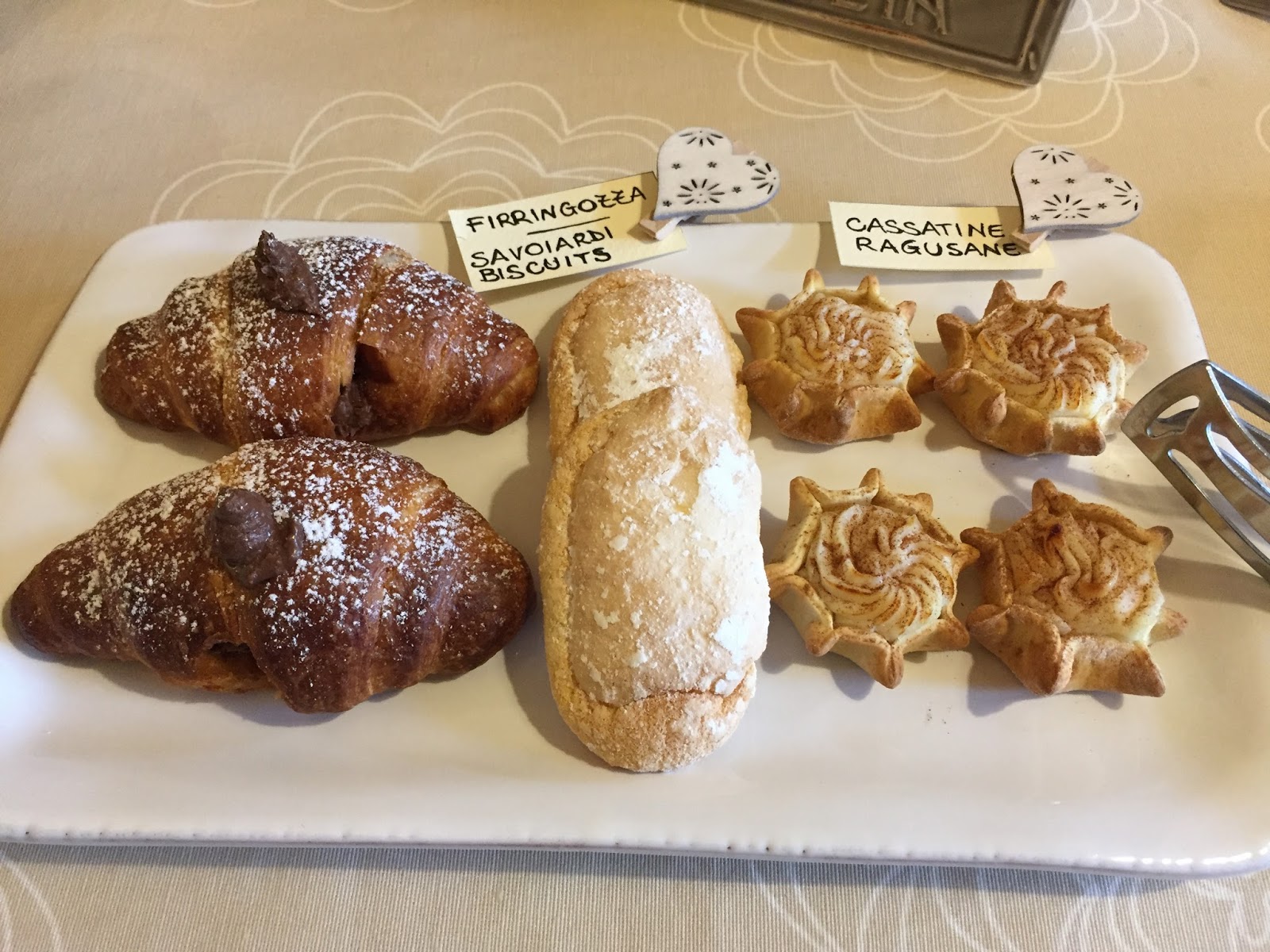
  • Cassatelle ragusane- Little ricotta pastries with cinnamon, typical of Easter.
  • Cavolo vecchio di Rosolini – A member of the cabbage family Brassicaceae (probably a form of Brassica oleracea), this plant has a long history in the Rosolini area where it was grown alongside the manure pile. It is called “vecchio” or old because the plant can live for 5-7 years. We ate it in a pasta dish at Antica Osteria U Suliccenti (in Rosolini).

Fish sample appetizer at Al Galu' Scicli.Pasta made of carob at Antica Osteria U Suliccenti in Rossolini.Appetizer at Osteria U Suliccenti.Breakfast items at Hotel Sabbinirica including cassatine ragusane.Fried ricotta dessert at LoSteri Ragusa. Fish at Ornato in Modica. Spring onions wrapped in pancetta at Quattro Gatti in Ragusa.
Examples of food during our 6 days. Upper left: Fish sample appetizer at Al Galu' Scicli. Upper center: Pasta made of carob at Antica Osteria U Suliccenti in Rosolini. Upper Right: Appetizer at Osteria U Suliccenti. Lower left: Breakfast items at Hotel Sabbinirica including cassatine ragusane. Lower left: Fried ricotta dessert at LoSteri Ragusa. Lower right: Fish at Ornato in Modica. Lower right: Spring onions wrapped in pancetta at Quattro Gatti in Ragusa.

Restaurants that we tried and would recommend include in Ragusa: LoSteri, Quattro Gatti, La Taverna del Lupo, and Taberna Dei Cinque Sensi; in Scicli: Ristorante La Galu; in Modica: Ornato Ristorante; in Rosolini: Antica Osteria U Suliccenti. We ate twice at both LoSteri and Quattro Gatti because they were that good. It didn’t hurt that they had ricotta-based desserts that weren’t easily forgotten: a fried ricotta-filled ravoli at LoSteri and a decomposed cannolo at Quattro Gatti.

Food growing. If you look at satellite photos of southeast of Sicily, you can’t help but notice what appears to be a lot of white structures. For example, see the satellite image included in this post, which is of the area around Vittoria, Sicily. The white structures are actually “greenhouses”, for growing vegetables under controlled conditions. The complexity of the structure and the materials used depend on what is grown inside. In Italy, cultivation in this manner is referred to as serricoltura and the structures are serricolo/serricoli. Here is an overview of serricoltura written Italian, however the pictures are enough to give you the idea. Much of the area around Vittoria (nearby Ragusa), in particular, is given over to growing vegetables in this manner, most of which is dedicated to tomatoes (I know: technically it’s a fruit).

Why do they do this in what seems to be a place with good weather? Well, good weather on average doesn’t mean there won’t be damaging winds or plunging temperatures or strong storms. And, despite good weather in a general sense, it’s not year-round, nor can it satisfy the year-round demand for vegetables. Hence, the protected growing conditions provide more or less controlled conditions throughout the year. There is a long history of protecting sensitive crops in this area. Before plastic, there were numerous other ingenious ways of protecting profitable crops like tomatoes.

We had the opportunity to visit one operation south of Scicli, Az. Agr. Giovanni Parisi. They grow tomatoes, carob, and a special type of bean called “il cosaruciaru di Scicli”, which means sweet thing “cosa dolce” in dialect. The day we visited, we spent time talking about tomatoes, and in particular, the variety datterino. Giovanni explained how the yearly cycle of tomato plants works, plucking a few ready datterini off the vine for us to taste. You can also buy a few of his products to take home. Who wouldn’t want a small jar of sun-dried tomatoes as a souvenir of your visit?

Satellite map of the area Vittoria Sicily showing greenhouse structures. In the greenhouse of Giovanni Parisi with datterini (tomatoes).
Left: Satellite map of the area Vittoria Sicily showing greenhouse structures. Right: In the greenhouse of Giovanni Parisi with datterini (tomatoes).


Things to tweak

No trip is ever prefect, and sometimes we Monday morning quarterback a little too much in the quest for perfection. Here it goes:


Another base of operations? We spend 7 nights in Ragusa (about 6 full days). In retrospect, we might have shaved off a night or two off of our stay in Ragusa and spent them in a town in another part of Ragusa province or maybe even Noto. It would have been nicer to have stayed closer to Pantalica, like in Palazzolo Acreide. See driving tips above for more information.

Too much of a Baroque thing? While we visited the cities of Ragusa, and Scicli, Modica (three of the eight cities on the UNESCO list), we didn’t feel like we really got to know them, especially Scicli and Modica. Part of that was being a bit worn out on Baroque style at the same time really not understanding what to look for. We considered hiring a guide but didn’t and maybe that was a mistake.

I was also surprised at how many of the buildings (churches, palazzi, etc.) we closed or not accessible. Although a lot of the Baroque beauty is on the outside, it’s still nice to go inside and take a look around. In Ragusa, we found QR codes you could use to view the inside of a building. However nice that technological solution is, it made me less invested in what I was looking at since I couldn’t walk in and experience it in person. Here are the links associated with three QR codes we saw: Palazzo Cosentini Chiesa Santa Maria Itria (with the beautiful blue domed campanile), and Palazzo Arezzo Donnafugata.

Got a phone? Here are a few do-it-yourself tours of Ragusa that might be useful before heading to Ragusa: Baroque tour, Green tour, UNESCO tour, and the Montalbano tour.

View of Ragusa Ibla from Ragusa Superiore. View of Ragusa Superiore from Hotel Sabbinirica.iew from Via Solarino with view of cupola of Duomo San Giorgio in Ragusa Ibla.
View of Ragusa. Left: View from Ragusa Superiore. Center: View from Hotel Sabbinirica. Right: View from Via Solarino with view of cupola of Duomo San Giorgio.

Which necropolis? Our day at Cava D’Ispica was a bit of a miss. Our day at Pantalica was better. For more information, see the post A Walk Around the Necropolis of Pantalica. Advice: pick your tombs, rupestrian churches, and necropolis carefully, read up before you go, and/or get some professional guidance. There are tombs and archaeological features to see everywhere you look. If you are going to do one tomb/necropolis visit and have the means to do so, go to Pantalica. If you are going to Cava D’Ispica, do the northern part first and call ahead of time to make sure it's open.

Other case of the hit/miss nature of tomb hunting was late one afternoon when we went looking for sites near Ragusa. We found the interesting and easy to get to (with no open/close times) site Grotta delle Trabacche. But when we went looking for the the nearby Catacomba di Cisternazzi, we struck out. We just couldn’t find it. At this point, we hung up our Indiana Jones hats (actually just Tilleys) for the rest of the trip.
A day of Cava D’Ispica misadventures. We should have gone to northern part of the site first as suggested in the book “Walking in Sicily” [Cicerone], Walk 17: Cave d’Ispica. We instead went to the southern part first and when we got the northern part it was closed in the afternoon.

In the southern part, what could be a really cool attraction, Parco della Forza, was a dud. Parts were roped off, and while €2 isn’t a lot to pay to get in, there wasn’t much there to see. The most interesting feature called “Centoscale” an underground staircase was closed and totally out of the question. We asked. After leaving the Parco della Forza, we tried walking up the gorge, but due to recent rains and a majorly washed out trail, it was almost impossible. Today wasn’t our day.

We tried climbing up to some tombs above the gorge and suddenly out of nowhere a custodian (at least we think he worked at the park) summoned us down. He said his name was “papa” (Francesco?). He was playing with us, but he did show us around a bit: Santa Maria della Cava and the “Jewish” quarters where they worked animal hides. Then again, he could have made it all up. Talking with him – as difficult as it was through his dialect and our bad Italian – redeemed the visit. We threw the towel in around lunch and headed to Rosolini to eat at Antica Osteria U Suliccenti, redeeming the day even more.

During lunch, we kept staring at pictures of of Cava Lazzaro and Tomba del Principe that were hanging on the wall of the restaurant. After lunch, we decided to try and find them, which turned into a wild goose chase. This time there was no “papa” to save us. As the light faded, we ended up at the parking lot for Grotta dei santi, Tomba a finti pilastri, Grotta della Signora, and Grotta di S. Nicola. We did a quick tour of those and really threw the towel in for the day.
Cava d'Ispica - Trying to make our way up the washed out ravine. Cava D'Ispica - Floor detail of Chiesetta Rupestre di Santa Maria della Cava.Cava D'Ispica - Talking to the custodian inside Chiesetta Rupestre di Santa Maria della Cava.
A day at Cava D'Ispica south. Left: Trying to make our way up the washed out ravine. Center: Floor detail of Chiesetta Rupestre di Santa Maria della Cava. Right: Talking to the custodian inside Chiesetta Rupestre di Santa Maria della Cava.

Winery tour? We spent one day north of Ragusa in the Chiaramonte Gulfi area. We spent about an hour and a half walking around the town, followed by a quick tour and lunch at the Locanda Gulfi winery. The winery tour was okay and the meal a bit expensive. We could have skipped both. On the other hand, the town of Chiaramonte Gulfi was unexpectedly charming, especially the Giardino Pubblico Comune and adjacent Balcone di Scilia and its panoramic views. The plants in the park were well-maintained with a number of them associated labels with the scientific and common plant names. That’s my kind of park.

On our way back to Ragusa, just above Chiaramonte, we parked the car (at an abandoned hotel) and took a short walk to Mount Arcibessi. That afforded views north, inland and south toward the coast.

Do a Montalbano themed-tour? A lot of Italians ask us if we did the “Montalbano tour”, that is, visiting the popular spots featured in the Montalbano TV series, which is based on the books by Andrea Camilleri. The majority of the places used in the series are actual places in Ragusa province: along the coast, some in Modica, and some in Ragusa Ibla, for example. If you are a fan or just passively interested, you could organize your time around Ragusa based on the places used in the series as described in i luoghi di Montalbano for the province, or in the Montalbano tour for just the city of Ragusa.

Views of Castello di Donnafuggata including stone sphinx. Views of Castello di Donnafuggata including large banyan tree. Views of Castello di Donnafuggata including external garden.Views of Castello di Donnafuggata including stone labyrinth.
Views of Castello di Donnafuggata including sphinx, large banyan tree, garden, and stone labyrinth.

Chiaramonte Gulfi public gardenView from Locanda Gulfi winery.
Left: Chiaramonte Gulfi public garden. Right: View from Locanda Gulfi winery.

Grotta delle Trabacche.

Grotta delle Trabacche.Above Grotta delle Trabacche, cows graze on the Ragusan plain.
Left: Grotta delle Trabacche. Right: Above Grotta delle Trabacche, cows graze on the Ragusan plain.

Views of Necropolis of Pantalica.Views of Necropolis of Pantalica. Anapo River.
Views of Necropolis of Pantalica. For more information see the post A Walk Around the Necropolis of Pantalica.

Ragusa Ibla, Piazza Duomo.Giardino Ibleo, Ragusa Ibla.Palazzo Cosentini, Ragusa Ibla.
Left: Ragusa Ibla, Piazza Duomo. Center: Giardino Ibleo, Ragusa Ibla. Right: Palazzo Cosentini, Ragusa Ibla.

 Underneath Ragusa Superiore. A large cavern that was once a quarry. View of Hyblean landscape near Monte Ibleo.
Left: Underneath Ragusa Superiore. A large cavern that was once a quarry. Right: View of Hyblean landscape near Monte Ibleo.