Showing posts with label sundial. Show all posts

Monday, October 5, 2020

Wind Directions in Italian – The Sundial on the Bastion San Giacomo, Bergamo


Left and center: Example RAI weather forecasts showing named wind directions, on September 28 and 30, 2020.
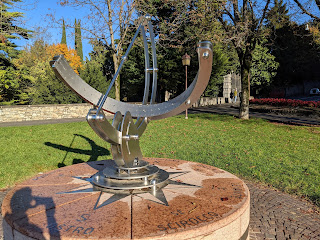
Right: A sundial in Bergamo Città Alta.

This sundial (meridiana in Italian) is an equatorial bow sundial that shows the time and the compass rose. You can find it on the Baluardo di San Giovanni, one of the bastions of the Venetian Walls of Bergamo. Not only being a pretty example of a sundial, it also is interesting because it provides the common names of the direction of winds, which are used often in Italy when discussing the weather.


In the US, wind is usually discussed in terms of direction from which it originates, using the compass rose. For example, winds from the north are northerly winds. There are exceptions and named winds exist like the Santa Ana winds and the Witch of November. For more examples, see the Wikipedia entry List of Local Winds. If you don’t live in an area where a particular named wind is used, you probably wouldn’t know about it. In other words, the named winds (other than based on direction) are not commonly used across the USA.

On the contrary, in Italy the names of winds are common knowledge across the country and are easily seen in any weather forecast. On the rosa dei venti (compass rose) as shown on the sundial pictured in this post, there are eight named winds:

  • N – north – tramontana
  • NE – northeast – grecale
  • E – east – levante
  • SE – southeast – scirocco
  • S – south – ostro
  • SW – southwest – libeccio
  • W – west – ponente
  • NW – northwest – maestrale


There are regional-specific names for the eight names above as well as other regional weather phenomenon names, usually depending on local geography.

The English Wikipedia entry on the compass rose states that the eight names come from the Mariner’s compass rose used by seafarers in the Mediterranean during medieval times, maybe as far back as the 11th and 12th centuries. The names come from a pidgin language called Sabir. While the exact origins are not clear, two (Ostro and Libeccio) have classical etymologies and two (Scirocco and Garbino, another name for SW winds) have Arab etymologies. So, we have ancient seafarers to thank for these names.

The Italian Wikipedia entry on the compass rose adds that to understand the NE, SE, SW, and NW wind names you need to put yourself somewhere in the Ionian Sea. The Greek island of Zakynthos is given as one example. Then the directions for the northeast, southeast, southwest and northwest start to make sense. Northeast of our hypothetical point in the Ionian Sea is Greece (hence, Grecale). Southeast is Syria (Scirocco derives from al-Sharq, east in Arabic). Southwest is Libya (Libeccio is comes from the Greek libykós, meaning "of Libya", or from the Arabic lebeǵ, which derives from the Greek líps-libós, which means "wind that brings rain). Northwest is the direction toward Rome or Venice depending on where exactly your hypothetical is in the Ionian Sea (Maestrale from maestro).


The sundial in Bergamo tells:

  • T.M.E.C. is Central European Mean Team. (Literally tempo medio dell'Europa Centale.) Italy goes to this time (one hour back) between the last Sunday in October and the last Sunday in March.
  • Solare We are not sure how to use this part. It seems like it helps you know what season you are in and whether to use the T.M.E.C. or Legale hours. But we think it must be read at noon to be sure. In our photos below we have three readings:
    • September 16, 2020 at 9:20 am. Time read off of Legale band.
    • October 13, 2020 at 9:18 am. Time read off of Legale band.
    • February 16, 2021 at 9:17 am.  Time read off of TMEC band.
    • November 2, 2021 at 9:16 am. Time read off of TMEC band.
  • Legale is daylight savings time or summertime when clocks are advanced one hour ahead typically from the end of March to the end of October.


On this sundial, there doesn’t appear to be a EOT (equation of time) correction.

The sundial is made by OrologioSolare by Mauro Fizzanotti, and was installed in 2003.


Left: An equatorial bow sundial in Bergamo Città Alta.
Center and Right: Named wind directions at the base of the sundial.


The sundial pointing view north at 9:20 am October 13, 2020.
Left: The sundial set to the latitude of Bergamo at 45°41'56"04 N.
Right: The sundial pointing view north at 9:20 am October 13, 2020. Use Legale band.


The shadow cast by the gnomon at 9:20 am on September 16, 2020 is just below Solare band.The shadow cast by the gnomon at 8:20 am on October 13, 2020 is above the TMEC band.
Left: Gnomon shadow at 9:20 am on September 16, 2020 is just below Solare band. Time read from Legale band.
Right: Gnomon shadow at 9:18 am on October 13, 2020 is above the TMEC band. Time read from Legale band.

Sundial at Bastion San Giacomo Bergamo on 2021-02-16 at 9:17am
The sundial on February 16, 2021 at 9:17am. Time read from TMEC band.

Sundial at Bastion San Giacomo Bergamo on 2021-11-02 at 9:16am
The sundial on November 2, 2021 at 9:16am. Time read from TMEC band.


The sundial on June 20, 2022 at 8:54am, with the help of a hapless assistant. Time read from Legale band, and it's pretty accurate being close to solstice.

The maker of the sundial in Bergamo, "Fizzanotti".


More example RAI forecasts showing named wind directions, from October 5, 2020.


Monday, November 11, 2013

Selected Sundials (Meridiane) of Southwest Piedmont (Piemonte)

Overview

I’ve been stewing over this post for some time because it has been hard for me to wrap my head around how sundials work. I think the modern age has rotted my brain.

We were back in Piemonte in the second half of May this year (2013), and this time we paid special attention to sundials. On a previous trip, Mondovì Sundials (Meridiane e Elementi di Gnomonica), we started to get interested in the sundials that we were seeing and how to read them. In this post, we show twenty sundials and try to delve into how they work. If you are easily confused or, looking for a complete sundial 101 explanation, this isn’t it. However, here are some good references I came across that you might consider:

Twenty Sundials in Piedmont (Piemonte)

The sundials featured in this post are not so much a reflection of towns that have many sundials, rather, the collection of sundials here reflect where we happened to be. That said, almost any town you happen to visit in Piemonte, if you look, will have a few sundials. (In my mind, Piemonte seems to have more sundials than other regions we have visited in Italy. I don’t have facts to back that up.)

All of the sundials (meridiana in Italian) we show here are vertical sundials. Vertical sundials are such that the sun can strike them, all or some part of the year. There can be northern facing sundials, which does make my head spin a little to think about.

Meridiana I

Location: On the path to Santuario di Santa Lucia outside of Villanova Mondovi (location).

Orientation: Faces southeast. Notes: Contains four zodiac signs.

  • Capricorn(♑) – the Goat, winter solstice.
  • Aries (♈)– the Ram, spring equinox.
  • Libra (♎) - the Scales, autumn equinox.
  • Cancer (♋) – the Crab, summer solstice.

From The Sundial Primer site I found this interesting: “The names or signs of constellations are used in sundials instead of dates to specify declination lines. Because of the effects of precession over the period of 2,300 years since the constellations were first named, the signs of the zodiac have slipped by a whole sign, i.e. at the vernal equinox (defined as the first point of Aries), the sun is actually in the constellation Pisces.”

Sundial Near Santuario di Santa Lucia
On the path to Santuario di Santa Lucia outside of Villanova Mondovi

Meridiana II

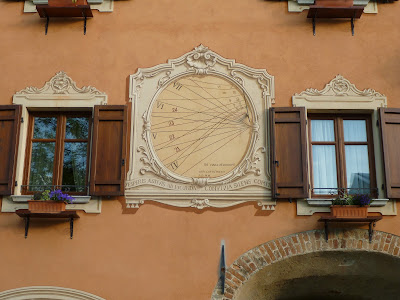
Location: Briaglia (location)

Orientation: North by northwest approximately.

Saying: Vesperis Aestivis ad Iucunda Convivia Silent Comit… [Pleasant evenng meals during the summer]

Notes: We ate a very nice dinner at Trattatoria Marsupino in this building. We go the pleasant meal part right.

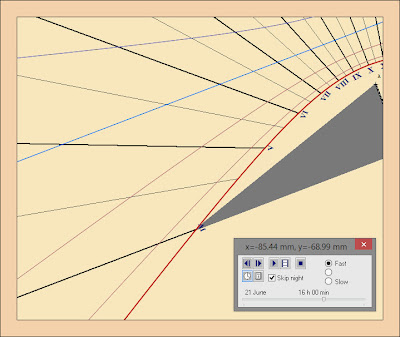
The coordinates of Briaglia are 44.4000° N, 7.8833° E (44 24’ N, 7 53’E). This more or less northern facing dial is unusable from about early November to early February. This date range is what I simuated using using Shadows Pro, a useful program for ceating sundials and simulating shadows on the dial for times throughout the year. To create these images, I created a vertical sundial at the coordinates for Briaglia, with the sundial declination of approximately 158 degrees west. The red line is the summer solstice and the winter solstice is not visible because it’s not useful for this dial.

From the Shadows Pro help “The vertical declining sundial can represent all the states between a vertical direct east dial and a vertical direct west dial, as well as the vertical direct south (north) dial and the northern (southern) dial.” Also applicable to this dial and also from Shadows Pro “A sundial declining towards the North will be lit a litle during the morning and a little during the evening, but not during the day. In Winter, the sundial may not be lit at all.

This dial, during a small part of the year, is lit during the morning. We did not show that here.

The picture was taken on 5/24/13 at 7:30 pm. I also simulated what the sun dial should be showing (removing daylight savings time) and I get about 6:30 pm. The gnomon shadow is hard to make out in the photo, but it’s just over VI.

Sundial in Briaglia, Italy
Briaglia Sundial

Shadows Pro-Created Images of the Sundial in Briaglia. From left to right: Image 1: Summer solstice at 4 pm. Image 2: The day we were there May 24, 2013 at 6:30 pm. (We were on daylights saving time so it was really 7:30 pm.) Image 3: Approximately the last day in Fall when sun stops hitting the dial. Image 4: Approximately the first day in Winter when the sun starts hitting the dial.
 Summer solstice at 4 pm.The day we were there May 24, 2013 at 6:30 pm.  (We were on daylights saving time so it was really 7:30 pm.)Approximately the last day in Fall when sun stops hitting the dial.Approximately the first day in Winter when the sun starts hitting the dial.

Meridiana III

Location: Carrù (location)

Orientation: East.

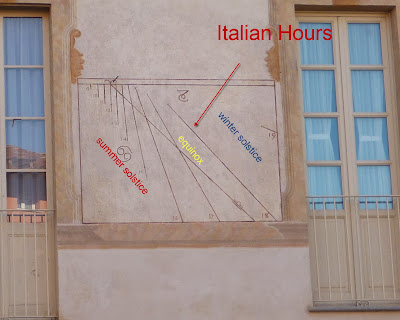
Notes: We were visiting someone in this building. Nearby is the famous “Bue Grasso di Carrú” sculpture. Italian hours (hours since last sunset) are shown.

Left: Sundial in Carrù, Italy; Right: Annotated sundial.
Sundial in CarrùAnnotated sundial

Meridiana IV

Location: Ceva (location)

Orientation: Faces south by southwest.

Notes: On the left side of the window, local time is shown. On the right side of the windows, it looks like Italian hours.

Sundial in Ceva, Italy

Meridiana V

Location: Frabosa Sottana (location)

Orientation: SoutheastSaying: Orariera? solare di Frabosa / Probus invidet nemini [Frabosa sundia / The righteous man envies no man?]

Notes: Date taken 5/23/13 at 8:17 am (local time). The gnomon shadow is near 7, so the dial doesn’t account of daylight savings time. Because the shadow is below the equinox line, we are in summer.

Sundial in Frabosa Sottana

Meridiana VI

Location: Mondovì Breo (lower), Vicolo del Teatro

Orientation: South by southwest.

Saying: Je me suis abillé d’ombre pour defiler dans le temps [I dress as shadow to parade through time?]

Notes: French hours.

Sundial in Mondovì Breo

Meridiana VII

Location: Villanova Mondovì

Orientation: Uncertain, but approximately south-facing.

Saying: Senza sole nulla son Io [Without the sun I have nothing]

Notes: This sundial shows daylight savings time in Arabic numbers and non-daylight savings time in Roman numerals. This photo was taken: 5/26/13 at 8:31 am (local time). On this date, Italy would be on daylight savings time (“spring” ahead) so we read the Arabic numbers and we see we are between 8 and 9 am.

Sundial in Villanova Mondovì

Meridiana VIII

Location: Villanova Mondovì (location)

Orientation: West

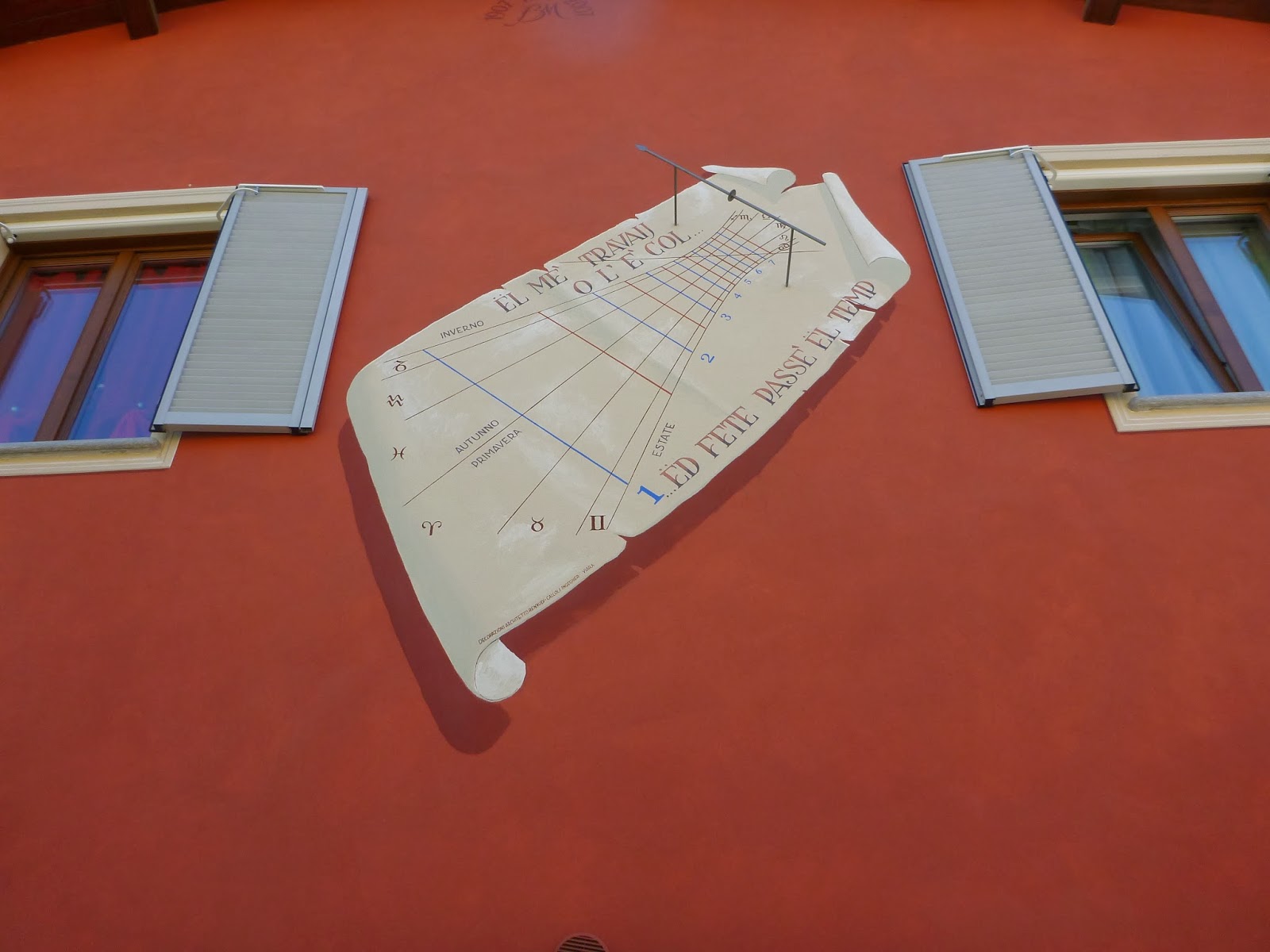
Saying: El Me’ Travaij o L’è col…ed fete passe’ el temp [In Piemontese… a saying about work and the passing of time?

]Notes: Villanova Mondovì, Coordinates 44.3500° N, 7.7667° E. This dial shows equal hours.

The three images of the simulated sundial are from the program Shadows Pro. To create these images, I created a vertical sundial at the coordinates above, facing west. The red line is summer solstice and the blue line is winter solstice declination line.

Sundial in Villanova Mondovì

Shadows Pro-Created Images of the Sundial in Briaglia.
From left to right:
Image 1: The sundial simulated on January 1st, shadow on the winter solstice line.
Image 2: The sundial simulated on March 23rd, shadow on the equinox line.
Image 3: The sundial simulated on June 21st, shadow on the summer solstice line.

Meridiana IX

Location: Villanova Mondovì

Orientation: n/a

Saying: A va gia ben se pij doiure d sol’la seira…altro che marchè l’ore

Notes: Not a sundial, but a play on them.

A riff on sundials in Villanova Mondovì

Meridiana X

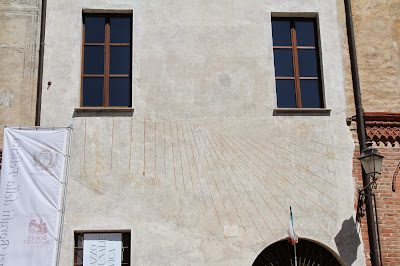
Location: Saluzzo (near Piazza Castello)Orientation: South by South East

Sundial in Saluzzo, Italy
Saluzzo sundial

Meridiana XI - XIII

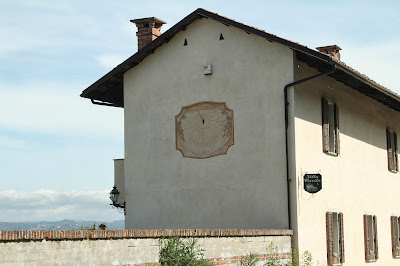
Location: Outside of La Morra (just south)

Sundials near La Morra, Italy
Sundials near La Morra, ItalySundials near La Morra, ItalySundials near La Morra, Italy

Meridiana XIV, XV

Location: Fossano, Castello degli Acaia (location)

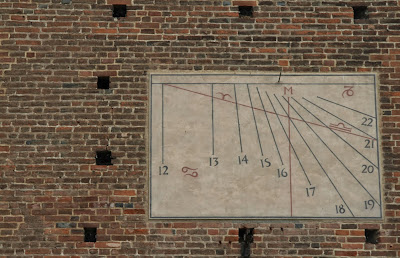
Orientation: Meridiana XIV faces Northeast; Meridiana XV faces South by Southeast. Meridiana XIV is similar to Meridiana III (Carrù), showing Italian hours.

Sundials on the Castello degli Acaia, Fossano, Italy. Left: Meridiana XIV; Right: Meridiana XV Sundials on the Castello degli AcaiaSundials on the Castello degli Acaia

Meridiana XVI

Location: Fossano, Viale Mellano (location)

Orientation: South

Saying: Silenter loquor / Ora vera locale / Pur d’alzar l’alma a quel celeste regno è il mio consiglio, e di spronare di core; erché [il] camin è lungo e [i]l tempo è corto [Silently I speak / True local time / To lift the soul into celestial kingdom my advice is to spur on your heart because the road is long and time is short?]

Sundial in Fossano, Italy

Meridiana XVII, XVIII

Location: Cherasco (location)

Orientation: South

Saying: Je dis a tous, meme si je ne les connais pas [I tell to all, even though I do not know?]

Notes: Photo taken 5/27/13 at 4:49 pm (local time). The top sundial reads about 3:30 pm, off because of daylight savings time. The top sundial is equal hours. The bottom sundial contains equal hours and Babylonian hours (slanted down to the right).

Sundial in Cherasco, Italy
Sundial in Cherasco, Italy Sundial in Cherasco, Italy

Meridiana XIX, XX

Location: Cherasco (location)

Orientation: South

Notes: The sundial contains equal hours and Babylonian hours (slanted down to the right).

Sundial in Cherasco, Italy
Sundial in Cherasco, ItalySundial in Cherasco, Italy

Hours Shown in the Sundials Here

French Hours(Ore Francesi) which was an early name for the equal hour system with two 12 hours days that began at midday and midnight.

Italian or Italic Hours (Ore Italiche) – the number of hours elapsed since the most recent sunset (hour 0) with 24 equal hours per day. Also referred to as an Hours Before Sunset Sundial.

Babylonian Hours – the number of elapsed since the most recent sunrise (hour 0) with 23 equal hours per day.

Unequal Hours or Biblical – 12 hours between sunrise an sunset, or during the night between sunset and the following sunrise. The duration of the hours can vary between 40 to 80 minutes during the year.

Tuesday, November 23, 2010

Mondovì Sundials (Meridiane e Elementi di Gnomonica)

Two Sundials in Mondovì, Piemonte

“La città di Mondovì è ricca di meridiane. Se ne contano 20 complessi in città circa 10 nelle immediate vicinanze.” This is the description on a plaque on the Torre dei Bressano in the Giardino del Belvedere in Mondovì Piazza (upper Mondovì). The sign indiates that Mondovì is rich with sundials. You can find 20 elaborate ones in the city and 10 in the immediate vicinity of the tower. In this post we describe six sundials that we saw. (Hopefully we describe them correctly. We knew nothing about sundials before trying to figure out what we were seeing here in Mondovì!)

Some of the sundials around Mondovì according a sign in the Giardino del Belvedere (pictured here) are:
- Ore Canoniche
- Ore Italiche da Campanile (pictured included)
- Ore Francesi (pictured included)
- Linea Meridiana (pictured included)
- Linee Diurne
- Curva Lemniscata (pictured included)
- Ore Bablioniche

Sundial 1: The first sundial shown here is with Ore Francesi (French Hours) which was an early name for the equal hour system with two 12 hours days that began at midday and midnight. The face of building that this sundial is on faces southwest (azimuth 140 degrees). The photo was taken around 12:30pm. The building is on via della Meridiana.

Sundial 2: The second sundial shown here is the Linea Meridiana (Meridian Line) is on the same building face as the the first sundial. The second sundial provides the local time around noon, often called a Noon Sundial.

Sundial 3: The third sundial shown here is in the same piazza (Piazza San Pietro) as the first two but on a building that faces southeast (azimuth 15 degrees) and shows ore italiche (Italian hours). This sundial shows the number of hours elapsed since the most recent sunset. For more on the terminology used in sundials, check out this informative page.

Sundial 4: The fourth sundial is in Mondovì Piazza, on the Piazza Maggiore, Palazo del Governatore building where there is a large sundial (ore europee con lemniscata sulla linea del mezzogiorno) for indicating hours of the day and noon (noon sundial). This sundial faces southeast (azimuth 30 degrees).

Sundial 5: The fifth sundial shown here is on the Torre dei Bressano. It is a sundial facing southeast (azimuth 85 degrees) with equal hours and equinox lines. The winter solstice line is concave facing up, the equinoxes are the straight line, and the summer solstice line is the concave facing down. For more on what the azimuth means see this primer on azimuth lines.

Sundial 6: The sixth sundial shown here is in the in the Giardino del Belvedere and it is a horizonal sundial. And finally, the seventh sundial is an equatorial sundial adjacent to the Torre.

(The numbering for the pictures shown below refers to the number of the sundial as it was discussed above. The sundials in and around Mondovì do not follow this numbering.)

Sundial 1 on Via Meridiana - Equal Hours Sundial

Sundial 2 on Via Meridiana - Noon Sundial (On the Right)

Piazza San Pietro, Mondovì
Piazza San Pietro, Mondovì

Sundial 3 in Piazza San Pietro, Mondovì - Hours Since Last Sunset
Sundial 3 in Piazza San Pietro, Mondovì - Hours Since Last Sunset

Sundial(s) 4 in Piazza Maggiore, Mondovì

Sundial 5 on Torre dei Bressano (Torre Civica), Mondovì

Sundial 6 in Giardino del Belvedere. Mondovì

Sundial 7 - An Equatorial Sundial - Giardino del Belvedere, Mondovì
Sundial 7 - An Equatorial Sundial - Giardino del Belvedere, Mondovì

Sundial Informational, Giardino del Belvedere, Mondovì
Sundial Informational Signs, Giardino del Belvedere, Mondovì

For more examples of sundials in Mondovì and Piemonte, see Selected Sundials (Meridane) of Southwest Piedmont (Piemonte).