Showing posts with label living abroad. Show all posts

Tuesday, December 16, 2025

Transplants, Time, and the Stranger Within

When we first wrote about living abroad, we described the experience as a kind of transplanting: uprooting from familiar soil and learning to grow in a new cultural ground. We also noted similarities between transplanting and aging. Both migration and aging confront us with the loss of taken-for-granted fluency. In a new country, even ordering coffee or catching a joke requires conscious effort. With aging, the body and social roles we once inhabited without thought begin to demand renegotiation.

Alfred Schutz, in his essay The Stranger, discusses how outsiders must explicitly learn what insiders assume. Later theorists of sociocultural models (TSCM) describe this as the accumulation of cultural “recipes” — scripts for how to act, speak, and belong. Massie and Staude, in their phenomenology of ageing, show that growing old is also an accumulation: of biological rhythms, personal narratives, and historical time. Both processes force us to confront our own strangeness in the world. We wrote Transplants: Notes on Aging and Living Abroad before discovering these references and were delighted to find our observations mapped onto a much larger conversation.

Living abroad, we find ourselves caught between languages and identities, neither fully at home nor fully foreign. Aging, too, places us in a liminal space: still ourselves, but transformed, negotiating continuity and change. To be a transplant is to be a stranger; to age is to become a stranger to oneself. In both cases, the task is not to erase difference but to learn how to live meaningfully within that strangeness.


Learning to Laugh Again


One of the first signs of being a stranger abroad is missing the punchline. Humor depends on shared references, rhythms, and cultural cues. In Italy, we’ve often found ourselves smiling politely while others laugh, only later realizing the joke hinged on a pun or gesture we hadn’t yet absorbed. Schutz would say that insiders rely on “recipes,” while the stranger must consciously accumulate them. Each missed joke becomes a tiny research project, a reminder that belonging requires deliberate learning.

Aging works in a similar way. Massie and Staude describe aging as the intertwining of biological, narrative, and historical time. Just as the migrant must relearn cultural cues, the aging person must relearn bodily ones. A staircase once climbed without thought now requires calculation. A word once recalled instantly now hovers just out of reach. The fluency of youth — cultural or physical — gives way to slower, more deliberate accumulation.


Visibility and Invisibility


Living abroad, our accent marks us as visible. Even when we blend in with clothing or gestures, a single phrase betrays us. At the same time, there are moments of invisibility: when locals dismiss us as not quite part of the conversation, or when our cultural references simply don’t register. Schutz’s stranger is caught in this paradox, both hyper-visible and overlooked.

Aging carries a similar paradox. Wrinkles, slower movement, and retirement make one visible as “old,” yet at the same time older people are rendered invisible in social life. Massie and Staude call this a form of “social death,” where retirement or frailty shifts identity from agent to dependent. In both migration and aging, visibility and invisibility are intertwined experiences of being marked as other.


Negotiating Identity


In our earlier blog we wrote of being “neither fish nor fowl,” caught between American and Italian identities. Aging, too, produces hybrid identities. We remain ourselves, but transformed. Looking at an old photograph, we see someone who is both us and not us. We are looking at stranger we once were. Schutz’s phenomenology of the stranger and Massie and Staude’s analysis of aging converge here: identity is not a fixed essence but a negotiation across time and culture.


The Strange Shape of Time


Living abroad has made us aware of all sorts of unfamiliar rhythms — how people speak, joke, gesture, or structure conversations. But aging brings its own unexpected rhythm, one that doesn’t have much to do with culture and everything to do with time itself.

We came across a study from Yorkshire (Degnen) that stayed with us. The older adults in it didn’t tell stories in neat, chronological order. Their conversations wandered comfortably between decades, past and present sitting side by side as if they had always belonged together. Details that younger listeners might dismiss as “irrelevant” carried their own meaning — a kind of shorthand built from a lifetime of associations. And sometimes the pace of these stories drifted free of what others expected, unfolding in their own logic.

It struck us because it felt familiar. Living abroad has its own version of nonlinear time — moments when the past intrudes unexpectedly, when old habits collide with new contexts, when identity refuses to stay in sequence. Aging just makes this temporal looseness more visible. Perhaps both experiences reveal that time is less of a straight line and more of a shape we grow into. We are invited to embrace nonlinearity.


When Time Stops


We were thinking about this recently as we finished Book Three of Solvej Balle’s On the Calculation of Volume. Its protagonist, Tara, becomes a stranger not because she relocates, but because time itself stops for her. She wakes each day into the same date while the world continues around her in ways she can sense but not join. Tara must relearn the “recipes” of this new condition — how to navigate relationships, routines, memory, and meaning when chronology refuses to cooperate.

Reading her while thinking about migration and aging, we realized that strangeness is not only spatial or bodily. It can also be temporal: a sudden shift in the rules by which life proceeds. Tara’s halted time echoed something we were already feeling — that belonging, at any age, is partly the work of adapting to a world that will not stay still, or in her case, will not move forward.


Toward a Philosophy of Transplants


To live abroad is to transplant oneself into new soil. To age is to discover that the soil itself shifts beneath us. Both experiences demand humility, patience, and creativity. They remind us that cultural or bodily fluency is never permanent. We are always accumulating, relearning, renegotiating. Migration and aging, then, are variations on a theme: becoming a stranger and learning how to inhabit that strangeness.


Living Meaningfully Within Strangeness


To migrate is to discover that the familiar world has become foreign. To age is to discover that the familiar self has become foreign. In both cases, we are transplants — uprooted from the soil of fluency and asked to grow again in uncertain ground. Schutz’s stranger reminds us that belonging requires conscious accumulation of models. Massie and Staude remind us that aging reshapes time itself, expanding the past and narrowing the future. Our own experience abroad reminds us that these processes are not failures but invitations: to relearn, to renegotiate, to live deliberately.

A line from that Yorkshire study keeps echoing for us: older adults aren’t “lost in the past” at all — the past simply moves more freely through their stories, another thread in the weave of lived experience. What can look nonlinear or “irrelevant” from the outside is often just a different way of stitching moments together. That image stays with us. It suggests that strangeness, whether cultural or temporal, isn’t a deficit but another kind of knowing, a rhythm shaped by the layers a person has lived through.

Perhaps this is the gift hidden in strangeness. Migration and aging strip away the illusion of permanence. They reveal identity as a rhythm of continuity and change. To be a transplant is to accept that roots can grow in new soil. To age is to accept that roots deepen even as branches bend. In both, the task is not to recover lost fluency but to cultivate meaning in the midst of difference.

Saturday, December 13, 2025

Living the Dream (Beta)

Living the Dream™ app - inputs Living the Dream™ app - output
Living the Dream™ app inputs (left) and output (right). The app can never be built.

A friend said to us once, "You two are living the dream!" when she found out we were going to live in Italy. It was meant kindly, and we took it that way. Still, the phrase gave us pause. Whose dream exactly? And what did we do to enable this consciously or unconsciously? 

It’s a curious statement, because it tells us as much about the person who says it as it does about our lives here. Their imagined Italy streams in (olive trees, late-afternoon glow, maybe a nonna with an apron and wooden spoon), while our actual Italy bustles around us: conversations, waiting in line at the post office, a walk to a Sunday dinner at a trattoria, and the day-to-day texture that never shows up on postcards.

None of this is bad. It’s just more complicated than the dream phrase suggests. And so, to understand this dreamy projection, we imagined building an app.

The App


We would call it Living the Dream™. The idea is that you open the app and dial in your ideal life in Italy as if tuning an old stereo: financial comfort, preferred location, weather, community, and expectations. A few simple questions, press “Generate Dream”, and eccola!

But what comes out of the app may surprise you.


Dream Inputs


Financial Situation

Settings:
  • Comfortable enough to buy an aperitivo once a week.
  • Rent is manageable.
  • Own a crumbling-yet-charming palazzo.
  • Able to renovate a medieval tower.
Impact: 3%. Turns out money helps, but only to a certain point.

Locale Selector
Settings:
  • Hilltop village (but not the one with 1-euro houses).
  • Periphery of a city with bars on lower windows.
  • Urban palazzo with questionable plumbing.
  • Near a strong Wi-Fi signal.
  • Anywhere but where I am now.
Impact: 7%. After three weeks, any place reveals its traffic, noise, or neighbor who drills at 7 a.m.


Bureaucracy Tolerance
Settings:
  • Scared of paper cuts.
  • Forms induce hives.
  • You queue with impatience.
  • Zen monk of the queue.
Impact: highly erratic. Occasionally transcendental.


Community & Belonging
Settings:
  • You know where the grocery store is.
  • You know the name and birthday of the barista in the café you frequent.
  • People beep and wave at you when you are walking on the street.
  • You are invited to family functions.
  • You find yourself showing up to funerals with hesitation.
Impact: 22%. A fact we’ve rediscovered many times and is often underestimated.


Expectations Knob
Settings:
  • Instagram Dream
  • Aspirational Mood Board
  • Average Tuesday Realism
Impact: Unknown. Expectations are a setting that never stays put.


Weather Sentiment
Settings:
  • You need to wear sunglasses every day.
  • You want winter only long enough to justify a new coat.
  • You function best with moody, overcast skies.
  • You prefer weather that is not actively trying to prove a point.
Impact: 5%. Meteorology resists optimization. The weather doesn’t care about your settings.


Hidden Setting: Presence

Invisible to the user. Adjusted by sleep, good walks, friendships, and noticing small joys.

Impact: Consistently the greatest.


The Unexpected Output


After dialing your settings and pressing “Generate Dream”, you might anticipate a score of feasibility for your dream, the name of a town to start your dream, or something to get you going. But instead, the app – stubbornly or wisely – pauses for a moment and gives it output.

If you are not living in Italy: the output is the moment that convinced you the dream was worth pursuing in the first place. A small, ordinary scene that didn’t look like much at the time, but lodged itself somewhere deeper and quietly refused to let go. A reminder.

If you are already living in Italy: the output is something like this: "You were living the dream last Sunday at 1:14 p.m.”

No score. No city recommendation. Just a moment.

The app has decided that the dream is not settings. It’s an instance. A flash. Something lived but rarely labeled. A moment lived whether you are. A moment that is one of many on your path to achieving the dream.

Whose Dream Is It, Really?


When someone says, "You’re living the dream," we hear it differently now. It’s not about perfection or escape. It’s about the very human instinct to imagine that somewhere else—or someone else—has cracked the code.

But our fictional app insists otherwise: There is no code to crack. Your dream isn’t built from optimized parameters. It’s assembled from moments you noticed. It's created in real time, without settings, and often without realizing you have created it until much later.

And that friend who first told us we were living the dream? We hear her differently now. She’s someone who has gone after and realized many of her own dreams—raising a family, buying houses with potential and turning them into beautiful homes, even moving to Palm Springs for a while before returning to Seattle. Maybe her words weren’t a projection at all, but encouragement from someone who recognizes a familiar arc in someone else’s story.

At the same time, Italians sometimes look at us with disbelief. Why would you choose to live here they ask. Their dreams often point westward, toward the United States; ours pointed eastward, toward Italy. It’s a reminder that dreams are always relative, shaped by circumstances, culture, history, and whatever context we happen to be standing in.

An app could never truly measure or output a dream. Our app won’t ever have an official release version.

Monday, November 17, 2025

Transplants: Notes on Aging and Living Abroad


We’re coming up on ten years in Italy—a decade of new words, new rituals, and new ways of being. In that time, we’ve learned how to navigate the health care system, decode the mysteries of Italian bureaucracy, and even order a coffee without causing a scene.

And yet, disorientation still finds us. We are not quite Italian, but slowly less American. Not quite fluent in Italian yet sometimes reaching for English words we’ve forgotten. We live in the in‑between, and we love it. That middle ground keeps us curious, keeps us younger, and helps us approach situations with fresh eyes.

Over the years, we’ve realized that living abroad has more than a few parallels with getting older. Both involve a slow shedding of certainty, a recalibration of identity, and a humbling encounter with the limits of your own understanding. Both ask you to be patient with yourself, to laugh when you miss the joke, and to keep showing up even when you’re not sure how.

This post is about those parallels—how moving abroad and getting older mirror each other. But before we begin, we want to acknowledge that our story is one of privilege. We chose Italy, supported by passports, savings, and the safety of knowing we could always return. For many, migration is not a choice but a necessity—an act of survival rather than curiosity. Our reflections are not meant to equate the two, but simply to share what we’ve learned from our own, far easier journey.

Accent


We like to imagine our American accent has softened over the years, but the truth is, it hasn’t. It clings to us, unmistakable, a kind of passport we carry in our very voices. It marks us as outsiders, though not always in a bad way. Aging does something similar: your voice shifts, thins, or weakens, and suddenly people treat you differently, as if volume or clarity were the same as comprehension. In both cases—living abroad or growing older—others may slow their speech, raise their voices, or simplify their words, assuming you can’t quite keep up.

Then there are the gaps. In Italian, we often know exactly what we want to say, but the word slips away at the crucial moment. What comes instead is a pause, a gesture, a workaround. It’s not so different from the lapses of memory that come with age: the name on the tip of your tongue, the phrase that refuses to surface.

At first, we bristled when our “Ciao” was met with a cheerful “Hi.” How could they know, so quickly, that we weren’t Italian? It felt like failure, as if our accent betrayed us before we’d even begun. But over time, we reframed it. Those exchanges became opportunities to help others practice their English, and we discovered that once conversations moved beyond pleasantries, they almost always circled back to Italian. What once felt like a wall became a doorway.


Cultural cues


In Italy, we sometimes miss the joke. Humor is slippery as it depends on shared history, on references you don’t yet have. In a new culture, the punchline can sail past you just as an older person might miss a cultural reference in their own language. Each missed cue becomes a small research project, a chance to learn the context and catch it next time.

We were reminded of this long before moving abroad. On a Christmas road trip from Seattle to San Francisco in 2012, we stopped at a Dutch Bros drive‑thru. The barista asked something perfectly ordinary, but her phrasing and expressions threw us. After a few confused “huhs,” we finally understood. For a moment, we felt like strangers in our own country. From that day, we joked that you could feel foreign anywhere, even at home.

Italy has only deepened that lesson. We’ve had to learn the choreography of greetings, the etiquette of queues, the subtle rules about when to address someone formally and when not to. Aging brings a similar recalibration. The rules you grew up with—about gender, technology, etiquette—shift beneath your feet. You adapt, or you don’t. Either way, you notice. In both cases, you find yourself in new terrain, learning how to belong all over again.


Looked at and overlooked


In a past blog post The Expat Life – Thoughts and Suggestions for Better Terminology, we suggested “transplant” as a better word than expat. No one has taken us up on it yet, but the metaphor still feels right. Living abroad is like a long hike: you've transplanted yourself somewhere else, you’re exploring, awed by what you find, and constantly aware of the terrain beneath your feet.

On that hike, we are sometimes hyper‑visible and sometimes invisible. Hyper‑visible because we’re easy to spot—our pace (always too fast), our clothes, our names, the subtle cues that mark us as not‑quite‑Italian. Cars beep at us on the street, and we turn to each other asking, “Who was that?” They recognize us, but we don’t recognize them. Around here, anonymity is rare; stepping outside almost guarantees at least two encounters before reaching the corner. It can be inconvenient when you’re in a rush, but mostly it’s a joy.

And then there are the moments of invisibility. A driver asks for directions, but as soon as we answer, our accent betrays us and our advice is dismissed. In conversations with new acquaintances, we’re asked the usual questions—why Bergamo, what brought us here—but once the talk turns to politics, sports, or scandals, the thread slips away. Sometimes we jump in to prove we can follow along; other times we let the pleasantries stand. Either way, the message can feel like you don’t quite belong in the deeper layers of the conversation.

Aging carries the same duality. You’re either fussed over or ignored, depending on the moment. You’re visible when people project assumptions onto you, invisible when they assume you have nothing to add.

And like aging, living abroad often requires asking for help with things that once seemed simple—forms, instructions, even the right word at the right time. The lesson in both cases is humility. You learn to ask. You learn to receive. And in that exchange, you discover a different kind of strength.


Né pesce né pollame


Neither fish nor fowl, we live with one foot planted in each world. There’s no neat percentage that can measure how Italian or how American we feel. Identity shifts like the weather—on some days we lean into our Americanness, on others we find ourselves moving, speaking, even thinking in ways that feel distinctly Italian.

This in‑between space, far from being a liability, has become an advantage. It forces us to stay flexible, to notice, to adapt.

Sometimes that means starting over with things we thought we’d already mastered—earning a driver’s license again, building a credit history from scratch, learning the rules of a new system. There’s a strange grace in being a beginner twice in one lifetime.

Other times, the parallels are so close to our American life that only small adjustments are needed—a tweak in etiquette, a shift in timing, a new rhythm to familiar routines.

And then there are the discoveries: foods that surprise us, rituals that anchor us, pleasures that remind us why we came. These are the gifts of transplanting yourself to another place. But they are also the gifts of aging—of realizing that change, whether chosen or inevitable, keeps reshaping you long after you thought you were fully formed.


Places act like time


In her 2025 essay “Sky Full of Forests,” part of the collection No Straight Road Takes You There: Essays for Uneven Terrain, Rebecca Solnit reflects on the upheaval brought by climate change. She writes: “We are leaving behind our old familiar world whose stability we can remember as a great kindness and entering into a rough new set of circumstances. Like refugees leaving a place, we are leaving a time. What should we carry with us?”

That image—refugees in time—struck us. It captures the disorientation of change that arrives uninvited. You don’t move, but the world around you does. The familiar dissolves, and you find yourself in a new reality without ever packing a bag.

But there’s another kind of shift: when you do move, when you leave your natal country and step into unfamiliar terrain. In that case, you’re not just swept along by change, you initiate it. You choose to disrupt the stability, to trade the known for the unknown.

Both paths lead to transformation. One is passive, the other active. But each raises the same question: what do we carry with us into the new time?

To understand how change shapes us, perhaps we need a metaphor like Einstein’s Twin Paradox. Imagine two twins: Bob and Joe. Bob moves to Italy; Joe stays in their hometown. In physics, the paradox explores time dilation. But here, let’s consider something more personal and let's call it experience dilation: the idea that place, like time, can stretch or compress the way identity evolves.

So, does Bob experience more, less, or the same as Joe, assuming all else is equal? That’s the catch—everything else is never equal. The answer depends entirely on the individuals, their circumstances, and the unpredictable variables of life.

And then there’s the vanity question: does Bob age faster, worn by the stress of adapting to a new culture? Or does he age more slowly, rejuvenated by adventure, lifestyle, the Mediterranean air? Is the living abroad a wrinkle-maker or a wrinkle-smoother?

We ask because we’ve been wondering about our own aging—especially in comparison to friends who never left the country. Has the move helped us age better? We’d like to think so. But without a version of us who stayed behind, there’s no control group to measure against.

At the next reunion, will we look radiant, glowing from a life lived boldly abroad—as one friend calls it, “living the dream”? Or will we show the wear and tear of navigating Italy’s bureaucracies, cultural shifts, and daily challenges? Only time—and perhaps a few candid photos—will tell.

In closing - for now


As we think about how moving abroad has shaped us, we’re also aware that our journey is just one version of migration. As we mentioned in the introduction, others carry heavier burdens, forced to leave homes behind under far harsher conditions. Their courage reframes our own small disorientations. If anything, our experience has taught us to practice humility—for what we don’t yet understand, for what others endure, and for the truth that moving, whether by choice or necessity, reshapes us all.

And so, as we look ahead, we wonder less about whether we are “aging well” and more about whether we are aging openly. Living abroad has taught us that the measure of a life is not in how seamlessly you fit in, but in how willing you are to keep learning, keep laughing, and keep asking for directions when you’re lost.

Perhaps that is the real gift of both transplanting yourself and aging: the chance to be beginners again, to carry humility like a passport, and to discover that belonging is not a fixed destination but a practice renewed each day.

Thursday, June 15, 2023

The Expat Life – Thoughts and Suggestions for Better Terminology


Views around Bergamo, Italy. Our new home: transplants.


Overview


Lately, we’ve been doing a lot of thinking about what it means to live outside the country you were born in. This is our 7th year living outside the country we were born in (the USA). What started out as a sabbatical in Italy morphed into living here. See TravelMarx: Sabbatical Lessons: Thoughts and Stories from our Italian Sabbaticals.

We recently started rethinking about what we call ourselves as we finished two unrelated books "The Lion and the Nightingale” and "Two Lives: Gertrude and Alice". That coupled with the unease of referring to ourselves as expats started us down the road of many walking-conversations around Bergamo to work this out.

We think words matter and, in this post, we propose some ways of thinking about the situation of living outside the country you were born in.

Terminology


When dealing with the concept of people who live outside their native country, here are some words you might run into. It's a word soup with each term having some baggage associated with its usage.

Expatriate - a person living outside their native country.
  • Simple enough, right? No, because the term is often used to describe rich white people who live outside their country.
  • We get that, but for us, what bothers us more is the image conjured up by the word. As if we were living it up in Paris with the likes of Ernest Hemingway, Gertrude Stein, and F. Scott Fitzgerald. We don’t identify with the Lost Generation.
  • As well we don’t identify with influencers, libertarians, or cryptocurrency stars calling themselves expats and fleeing something inconvenient, taxes, or needing to take refuge somewhere until the storm blows over.
Emigrant – a person when they leave their country of origin.
  • Yes, you could say we emigrated from the USA.
Immigrant – a person when they arrive at their destination. (definition)
  • Yes, you could say we were immigrants in Italy.
Migrant – a person who moves around from place to place typically looking for work or better living conditions.
  • This doesn’t apply to us in the normal use of the word unless you really stretch “better living conditions” to include a greater sense of happiness. But that is a stretch.
Dispatriate - a term used by the writer Luigi Meneghello as opposed to expatriation. Dispatriation for Meneghello meant a deliberate, sometimes painful, distancing of himself from the Italian culture he had grown up with, learning a new grammar of being.
  • This neologism avoids the racist overtone of expatriate while more precisely indicating intent of the move. Dispatriate is an expatriate who intentionally distances themselves from their nation of origin.
  • We are not intentionally trying to distance ourselves from American culture. Of course, moving away naturally creates distance, which can lead to feeling disconnected. It's unavoidable.
Move abroad – when someone moves outside their native country.
  • We don’t like the term because no matter the starting and ending point, it suggests a hierarchy, a movement from a “central” place to somewhere else floating, untethered.
  • Maybe it’s best to just to say “moved”, as it applies to us: we moved to Italy.
Nomad – someone who doesn’t stay long in the same place.
  • We are not nomads. We thought about trying it. We wondered if we could spend a year or two in a city or country and then move on to another. We abandoned the idea.
  • When we thought about being nomads, we realized we need a community that builds around us in time. A base of operation is more our style.
  • Today there is the fashionable term “digital nomad” – someone who works online in locations that change.
Extracomunitario – someone/something that isn't part of the European Union. 
  • Often used to refer to an illegal alien in Italian, and not in a positive way.
  • We've had friends use it with us as a joke.

    
Views around Bergamo, Italy.

Transplants


Perhaps the best, neutral word we can think of in our case and others like us is “transplant”. We transplanted ourselves into another country. Why did we transplant ourselves? It wasn’t for economic gain (that’s for sure!), for fear of persecution (though with current situation in the US, you might wonder), or because there was a community of ex-Americans hanging out in Italy that we wanted to join (we are not those types).

We transplanted ourselves into Italy because we wanted to. We were curious and wanted to explore Italy. That curiosity and sense of exploration started when we took several trips here long before we moved here. Instead of visiting and saying “oh, that’s nice, no need to return”, we kept wanting more. The process of getting citizenship was part of the exploration.

As a point of reference, I only need to think about moving around in the United States. I was born on the East Coast but would never live there again if I didn’t have to. But it’s not just the East Coast. I wouldn’t live in the Southeast and Central US. Why? These areas simply don’t appeal to me. These parts of the country have their merits and people who love living there, just not me. It's kind of like that with Italy.

On the subject of places to live in the US, my thinking of the US has never been the same after reading American Nations: A History of the Eleven Rival Regional Cultures of North America.

Once I moved to the West Coast, I realized that was more my home, where I fit better. I “transplanted” myself there in my late 20s. But why did I fit better there? Too many factors that are hard to describe (or I’m too lazy to attempt). Again, it's similar to our move to Italy.

Speaking of expats, we recently finished the book Two Lives: Gertrude and Alice about Gertrude Stein and Alice B Toklas. This is not at all the kind of book we would pick to read but we ended up with it, and I have to say once I started, I wanted to finish it. The author Janet Malcolm has some great turns of a phrase, like this on The Making of Americans (a work by Stein): "It is called a novel, but in reality it is a series of long meditations on, among other things, the author's refusal (and inability) to write a novel."

Stein is one of the colorful characters of the post-war (WWI) expatriate generation, the Lost Generation. Stein is credited with coining the term and Hemingway popularized it. After finishing Malcolm’s book, we decided we would never want to voluntarily go to a dinner party with Gertrude or Alice as guests. Insufferable people (and lost apparently).

There is a interesting graphic at the World Migration Report, that shows migrations “corridors” between starting and ending country. (I guess in one year we were officially counted in the migration, at least statistically.) The USA has been the main country of destination for international migrants (transplants?) since 1970. Germany is the second top destination. Italy is just outside the top 10. Most of the migration to Italy is from Romania.

The work of the sculpturer Bruno Catalano and his “The Travelers” statues, also known as Les Voyageurs deals with emigration. His haunting bronze surrealist sculptures represent emigrants with pieces missing making them see-through.

Finally, we stumbled across the American Expat Finance web site that tracks people who are trying to get rid of their USA citizenship, officially termed “renunciation”. Many, are accidental Americans. Being a US citizen (no matter if you don’t reside in the US or ever did) means you are liable to pay taxes. So, it’s understandable why some would choose to renounce. In 2020, there were about 6,000 people who renounced.

Our Thoughts


These thoughts come from a larger list we’ve kept over the years of things we noticed after we transplanted ourselves in Italy. It’s interesting that we even keep a list. Then again, that is the value of being a transplant...you see and feel things differently and you need to stop and capture them.


* When outside your home country, your outside status is clear, at least at first. The sights, sounds, and language are the clues. You have a definite place as an outsider. Over time, that distinction may dissolve, but in the beginning it's a high. How do we hold on to the “happy discomfort” of the first week, month and year in a new place?


* Even in your own country, you can sometimes feel like an outsider, but you can't call yourself a transplant like you can when you are in another country. That feeling of being just outside is a special power.


* It can be refreshing to be on the outside because it implies no expectations, wide-open eyes to ask questions again, to be more alive.


* We are in Italy, which in many respects isn't that different from the US, but it's different enough to jumpstart our senses.


* We and others often seek relevancy in life. We have many friends moving from Seattle to Palm Springs, which feels like a move at becoming relevant again. For us, we felt both more and less relevant moving to Italy. We were a novelty yes, but also excluded (at least initially) from inside jokes, cultural references, and other “stuff” we’d know if we grew up here.


* When people ask us why we came to Italy, it’s easy to answer. When people ask us why we left (the US), it isn’t easy to answer especially when asked by an Italian. Italians often scratch there heads as why we would be here.


* We are getting better but still find it annoying when asked questions like (1) “When are you coming back (home)?”, (2) “Don’t you miss the US?”, or (3) “Which do you like better, US or Italy?”. Answers: (1) We don’t know or have it in our plan, and home is here now. (2) Yes, we do sometimes. (3) We like them both, equally. Why choose?


* We are often confronted by people who when finding out we live in Italy, exclaim: “You are living the dream!”. This is odd. The best we can do is take it as a compliment and move on rather than delve into whose and what dream is this exactly. Is it a personal dream or a collective American dream of Italy? [Since writing this post, we did take a crack at the Living the Dream (Beta) app.]

In the book The Lion and the Nightingale: A Journey Through Modern Turkey by Kay Genç, the themes of leaving or staying in your native country and expatriation are touched on. The book is about a country (Turkey) that could imprison you for what you do if it’s against the state. What do you do? Stay and fight or leave. For us, this wasn’t the case. However, in the USA these days with the rightward swerve of the US, we wonder if we hadn’t moved already would this be a factor for us to move.

In Genç's book, we learned about the poem by C.P. Cavafy called “The City”. A good description of the poem is described in the article by Orhan Pamuk Other Countries, Other Shores, where he writes “Cavafy stayed in Istanbul for 3 years and then returned to Alexandria. His leaving Istanbul is the source of the sorrow that permeates his unforgettable poem...” And continues with the key interpretation of “There is no other city to go to: The city that makes us is the one within us.”


The City by C.P. Cavafy


From Poetry Foundation. Translated by Edmund Keeley.


You said: “I’ll go to another country, go to another shore,
find another city better than this one.
Whatever I try to do is fated to turn out wrong
and my heart lies buried like something dead.
How long can I let my mind moulder in this place?
Wherever I turn, wherever I look,
I see the black ruins of my life, here,
where I’ve spent so many years, wasted them, destroyed them totally.”

You won’t find a new country, won’t find another shore.
This city will always pursue you.
You’ll walk the same streets, grow old
in the same neighborhoods, turn gray in these same houses.
You’ll always end up in this city. Don’t hope for things elsewhere:
there’s no ship for you, there’s no road.
Now that you’ve wasted your life here, in this small corner,
you’ve destroyed it everywhere in the world.


Left: Bruno Catalano statues in Venice. Right: Views of Bergamo, Italy.


Quotes


Here are some quotes that we like about being outside the country you were born and grew up in. Many are from the blog Taken By The Wind (source1, source2).

“You're an expatriate. You've lost touch with the soil. You get precious. Fake European standards have ruined you. You drink yourself to death. You become obsessed with sex. You spend all your time talking, not working. You are an expatriate, see? You hang around cafes.” — Ernest Hemingway (the original expat) from The Sun Also Rises.


“The loneliness of the expatriate is of an odd and complicated kind, for it is inseparable from the feeling of being free, of having escaped.” — Adam Gopnik from Paris to the Moon.


“Loving life is easy when you are abroad. Where no one knows you and you hold your life in your hands all alone, you are more master of yourself than at any other time” — Hannah Arendt


“You know what else is nice about being a foreigner? Whatever you do takes place in a capsule that need not be discovered and opened by someone back home. Nothing really counts–it was the life that falls in the forest. That’s how I looked at it. I felt free to…oh, I don’t know.”— Patricia Marx

“I can’t think of anything that excites a greater sense of childlike wonder than to be in a country where you are ignorant of almost everything. Suddenly you are five years old again. You can’t read anything, you have only the most rudimentary sense of how things work, you can’t even reliably cross a street without endangering your life. Your whole existence becomes a series of interesting guesses.” – Bill Bryson

“What makes expat life so addictive is that every boring or mundane activity you experience at home (like grocery shopping, commuting to work or picking up the dry cleaning) is, when you move to a foreign country, suddenly transformed into an exciting adventure. Try finding peanut butter in a Japanese grocery story or explaining in broken Spanish to the Guatemalan pharmacy that you need cough drops and you’ll understand. When abroad, boredom, routine and ‘normal’ cease to exist. And all that’s left is the thrill and challenge of uncertainty.” – Reannon Muth (the author of the blog takenbythewind.com)

“What I found appealing in life abroad was the inevitable sense of helplessness it would inspire. Equally exciting would be the work involved in overcoming that helplessness. There would be a goal involved, and I liked having goals.” – David Sedaris, Me Talk Pretty One Day


“When you grow up in middle America you are inculcated from the earliest age with the belief – no, the understanding – that America is the richest and most powerful nation on earth because God likes us best. It has the most perfect form of government, the most exciting sporting events, the tastiest food and amplest portions, the largest cars, the cheapest gasoline, the most abundant natural resources, the most productive farms, the most devastating nuclear arsenal and the friendliest, most decent and most patriotic folks on Earth. Countries just don’t come any better. So why anyone would want to live anywhere else is practically incomprehensible. In a foreigner it is puzzling; in a native it is seditious. I used to feel this way myself.” – Bill Bryson

“When I was living in England I found that the more I lived abroad, the more American I discovered I was.” Daniel J. Boorstin

Conclusion


For us living in Italy, we live with less than we did in the USA. No car, a much smaller house. We consume less water and energy. (We know, we measure these things.) For us, it feels just a small step closer to sustainable.

We use the term exploration and awe a lot to describe what we like about our life in Italy. It’s like when you take a long hike and see new things. You explore and you get your awe, at least on a small scale. Living in Italy is like a long hike for us metaphorically: we are exploring and awed at what we find.

When we moved to Italy, we wanted an experience different than what we had back in the USA. We weren’t sure what that experience was until it happened. Experience first, question later.

After writing this post, we flip on the morning news to find that there's been another migrant shipwreck. Governments are in tilt on what to do. It does put things in perspective. The year we came to Italy, we did it in comfort, on a plane. Others didn't make it. We came to Italy with modest means and by choice. No matter what you call us: expats, migrants, living abroad, or transplants, we call ourselves lucky.


Wednesday, March 1, 2017

Sabbatical Lessons: Thoughts and Stories from our Italian Sabbaticals


~~~Hear Ye Hear Ye~~~

"We are going on a sabbatical this fall" I tell my father on the phone one evening in Fall 2015. Silence. I can only imagine the contortions he is making with his face. He finally replies, "Oh, that's nice. Will you work?"

My dad's response is typical because most people don't know what sabbatical really means or how to reply. Heck, every time I say "sabbatical", I still feel like I'm introducing a new term and need to explain it. We've heard fun frankenwords echoed back to us from friends we told about our upcoming sabbatical. One asked if we were going on a "sabbatican" (a sabbatical at the Vatican?). Another was curious about the financial details of our "sabbitaly" (naturally, a sabbatical in Italy). Still, other friends imagine us idly sipping wine in a Tuscan hilltop castle, while others can't get past the logistics like, "What are you going to do with your house"?

The response from our friends and family ranged from surprise, envy, elation, worry, to the worse response of all: no response. Most of the positive responses came from friends. Most of the worry or no responses came from family. Disbelief was also a common reaction when we announced our second sabbatical. It seemed to be too much to swallow for some folks. One sabbatical is unusual enough, but two? Really, are you out of your minds? That's what I took away even if no one quite said it that way. And the answer is that we just might be out of our minds, but boy has it been swell.

We took our first sabbatical in 2007 - 2008 for 9 months. We intended to travel the world, but the stickiness of Florence and our inclination to nest ruled the day and we spent the 9 months in a modern Renaissance town. We were happy with our choice. When we talked about another sabbatical at that time, it seemed like a ludicrous idea. However, the idea of a second sabbatical, dormant at first, began to stir and make noises reaching a growl a few months before we made the decision to do it again in 2015. During sabbatical two's 7-year gestation period, we realized that our first sabbatical was a high point in our lives and we needed to do it again. Furthermore, the memories and experience of the first sabbatical, rather than dampen, brightened in time, a beacon on the runway for sabbatical two.

I wish I had said all that and more to my father on the phone the evening I called him, but all I said was no, "I'll be taking a break from work."
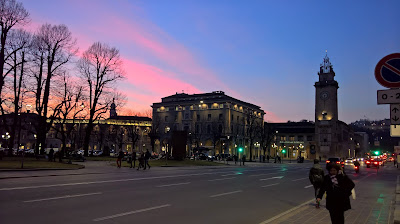
View of Bergamo: Porta Nuova.View of Bergamo: Citta Alta and clouds.View of Bergamo: Citta Alta and Piazza Vecchia.
Views of Bergamo: Porta Nuova, Citta Alta and Clouds, Piazza Vecchia.

~~~Fallowing the Land~~~

So here we are in 2016, over one year into our second sabbatical, and while sabbatical still sounds odd to say, it's the best word we've got. The terms "vacation", "break", "pause", "absence", "gap year", "time-off" and, gulp, "retirement", are vague, ominous, and moreover, don’t address the essence of what we were going for, which was a renewal. The word sabbatical has its roots in the bible and the idea of leaving the land fallow. The word sabbatical in the modern sense is usually considered a privilege granted, for example, to professors, clergy, and high-level corporate positions. They all share the common theme of an extended absence from normal work, be it teaching, administering a congregation, or running a company. During a sabbatical, professors might write a book, clergy might explore their faith in a different way, or an executive might pursue a hobby precluded by a hectic company schedule. One common trait is that sabbaticals are results-oriented.

While the results-oriented aspect of a sabbatical is appealing to us as well (for example, improving our language skills), the biblical sense of a sabbatical in terms of fallowing land and renewing it for some future purpose also resonated with us strongly. It's easy to follow a linear life pattern: you are born, you grow-up, you go to school, you work, you marry, you have kids, you retire, and then you die. Being born, growing up, and dying are unavoidable. It's the other events in the sequence, particularly the school, work, and retirement episodes that we wondered if we could have some control over. Why stick with a linear pattern? Can we repeat the school, work, and retirement phases in a cyclic, nonlinear way? In general, can we mix the phases of our lives as we want? This idea of mixing up our typical life pattern a bit has been a dominant theme and reason for our sabbaticals.

The concept of a renewal of land has a deeper and darker meaning if you choose to think about it in the context of corporate life. Assuming that your land is your body and mind, then working for a corporation is like renting your land out to a big farming operation. We do it because we need to pay the bills. But in time, your land might not be so good for growing the same crop year after year. And if the renter doesn't want to rent your spent land anymore, what happens? They find fresher ground. Why not renew your own land while you can?

~~~Birth of a sabbatical~~~

A pivotal event for our first sabbatical was an unassuming after-work seminar in 2005 on 401(k) plans. We were tired after one of our usual tech-company workdays, but the free refreshments lured us. We also went because while we had 401(k) plans, we had no idea how to manage them, and figured it wouldn't hurt to learn. The two of us and six other brave souls listened to the advisor's hour-long presentation. While we sipped refreshments after the presentation, we talked with the advisor and decided to follow up with him. Eventually, we started a working relationship with the advisor: that is, he would manage our savings. It was a slow process turning over our money and trust.

Our first few meetings with the advisor were nothing at all what we had expected. Instead of talking about numbers, we talked a lot about dreams and plans for the future. During those first few meetings we defined different goals. One of those goals was to take a sabbatical.

Those first meetings with the financial advisor were the first time we sat down as a couple and talked about our goals. Why would it take a financial advisor to do that you might wonder? I don't know, but it just wasn't something we had ever talked about. Up that point in our lives, we were concerned with working and saving money. It took the financial advisor to help us understand the idea of balancing current happiness with future well-being. Out of the search for balance, "sabbatical" as a goal was born. The exact timing wasn't precise, but it was a goal, and it had some money going to fund it.

Our advisor was a little surprised when just two years later, in 2007, we told him that we were actually going to go through with that sabbatical plan. To be honest, we were a little surprised too. We had just finished a house remodel and were finding our financial balance again when suddenly one of us was laid-off. The corporation didn't want to rent the land anymore I guess. They called it something innocuous like reduction in work force, but that didn't help lessen the shock. However, what seemed like a negative turn of events soon turned positive when we decided this opened up the door for a sabbatical.

We knew we wanted to spend the sabbatical in Italy, and we needed to able to stay there legally past the 90 days allowed for tourists. We considered citizenship, which we knew might be an option for us, but at the time it was easier to get visas. So, on a warm summer morning in 2007 we found ourselves standing outside the Italian consulate in San Francisco's Pacific Heights neighborhood, waiting in line to submit our application for visas for the first sabbatical.

It's 9:30 am and the line is already long enough to spill out of the small waiting room and on to the sidewalk of Webster Street, a street that when followed north takes you down to the San Francisco Bay. A tall, young priest in front of us fills out his visa application. I think about how we sweated over the visa questions for days, and yet how relaxed he is filling out the application last minute. This strapping man of God, well-coiffed and dressed in unexpectedly snappy black clerical clothing, tells us that he was hoping to go to the Vatican and that he has applied for a visa several times with no success. Ah, I see.

Suddenly there is shouting from inside. We all crane our necks to see what is going on. Seconds later a man runs out of the waiting room chased by a consulate employee who yells after him: "You'll never get a fucking visa!" Oh, what are we in for today?

Despite the drama, all went well that day. As usual, with anything that involves paperwork and Italy, we didn't get it right the first time, and we had to go home and produce some missing documents.
I wonder to this day if the young priest ever made it to see the pope.

By the end of Summer 2007, visas in hand, we were ready to go. We didn't have clue then that we'd get citizenship in 2010, let alone go for a second sabbatical in 2015. But to think that it all started in a seminar on 401(k) plans still amazes us.

Image of Bergamo: Cannoniera di San Michele.Image of Bergamo: Venetian walls and fog.Image of Bergamo: View west from Porta San Giacomo.
Views of Bergamo: Cannoniera di San Michele, Venetian walls and fog, View northeast from Porta San Giacomo.


~~~Experiences~~~

We are smack dab in the middle of sabbatical two and it's a good time to talk a little about our sabbatical experience. There are some aspects which were expected, like experiencing lack-of-work fear, more specifically, that we'll never find work again. There are other aspects, which we didn't expect, such as the depth of our relationships and how invested we've become in our lives here, particularly in our second sabbatical.

The old bugaboo of finding work
Being out of work itself isn't that scary, rather, it's the idea that we may not be able to find work again that's scary. It's a little nagging fear of not being able to find a job again, being off your game, out of the loop. We had the same feeling back in 2008 as well, so it's not a new feeling. What keeps us in good spirits is that after our first sabbatical, when we were ready, we found jobs and integrated back into work life without too much trouble.

Sabbatical one lasted 9 months and sabbatical two has now reached 15 months with no exact end in sight. We can say that we do miss being part of the technology world, a project, an effort, a product, etc. The newness of our surroundings, language immersion, and new people are what we are becoming part of. But at around 12 months, we started to have a slight yearning to be involved in something else. Could that be, gulp, work? The feeling conflicted us. Was it hopeless? Can we ever separate ourselves from work?

We are American ambassadors
When we are in the US, people rarely ask us questions about America. However, here in Italy, we are often called on to explain America in all aspects, big and small, good and bad. For example, we are asked where certain states are located, to comment on current news, whether everyone in America has a gun, or how the electoral college works. This means that we have to keep reasonably informed about current events in the USA, whether we want to or not. We try to talk about facts and events as if we were ambassadors of the US, without ranting or spouting our views too much.

Given their affinity for America, we also end up talking with a lot of Italians about their American vacations, where they have gone and where they would like to go. And, we are called on to give advice for future vacations. It's interesting to hear these travel stories and plans because it gives us new perspectives on parts of America that maybe we've seen or thought we knew. New York, San Francisco, and Miami are to Italian visitors to America as Rome, Venice, and Florence are to American visitors to Italy. And then there are the Italians who work in amazing trips to see all the key national parks, to drive Route 66, or to explore parts of the deep south, places we have yet to see ourselves.

We are mini, everyday ambassadors of the United States. Think about it. Most Italians don't get to spend very much in-the-flesh time with Americans. You may ask why that is important. It's important because America matters to Italians. We can't underestimate how powerful and pervasive American culture and actions are in Italy. Yes, sometimes America is the object of deserved ridicule here, but much more often, it's admired and respected. The average US citizen is blind to the impact that America has abroad. And therein lies a conundrum for us. How do we represent an America that we ourselves only know a small slice of? What do we say to someone in Italy when we don't know the answer to their question? Or, how do we speak to some of the darker aspects of America's power, culture, and pervasiveness?

Let there be English language
We used to get annoyed when Italians spoke English to us in Italy. It felt like we had failed in our ability to speak Italian, that our Italian wasn't good enough. There are a couple of reasons why this happens. First, their English may be better than our Italian, and in the interest of efficient communication, we communicate in the strongest common language. Second, we find that Italians are eager to speak English, even if they only know a few words. Many Italians want to learn, and want the opportunity to speak English. Italians learn English in school but don't often have a chance to practice it. Furthermore, from our unscientific polling: Italians like the American accent much better than the British accent. American accent equals cool. British accent equals stuffy.

Finally, there is what I would call the over-eager, tourist-friendly service provider phenomenon. Typically, it's a waiter who wants to make you feel as comfortable as possible and speaks in English no matter what. He has sized us up as English speakers, and that's what we are served. What the waiter doesn't know is that while Debbie from Dubuque or Takashi from Tokyo may feel at home with that approach, he loses points with us. Alas, a solution is always at hand. When we want to escape English for sure, we head for the hills. We've been known to talk for hours to a sweet old grandmother in the middle of nowhere.

The rich tapestry of relationships
In this, our second sabbatical, we've fallen into, or better yet, been woven into, a rich tapestry of people and place, that we like to call the Pignolo Tapestry. Via Pignolo is a historic and charming street-cum-neighborhood in Bergamo. Via San Tomaso and via Pelabrocco join via Pignolo at Fontana del Delfino to form our Italian stage set. The area around the fountain is barely a widening of the road, much less than a typical residential road in America. But what this meeting of roads lacks in size, it makes up for in richness in personalities, culture, history, and architecture.

We spend a good part of a typical day in and around via Pignolo: we chat with friends in front of the Fontana del Delfino, we grab a coffee at Caffè Papavero which looks on to the fountain, we buy stamps and a newspaper at the tabaccheria across from Papavero, and some sugar or cream at the bottega a 20 steps further down Pignolo. Sometimes we step into the impressive Chiesa parrocchiale di Sant’Alessandro della Croce for a few moments to relish the solemn and elegant interior.

The key to the magic of this Pignolo Tapestry, and of Bergamo in general, are our relationships here. We are awed and humbled by the kindness we've been shown. We noticed the friendliness of the people in Bergamo right away. In our first month, we already had a pretty good group of friends and acquaintances.

One day in our first week of arriving, we are standing in front of the Fontana del Delfino and an elegant older woman walks down the street, stops, and addresses us in English with a German accent: "You aren't from here, you smile too much." We pause for a moment, and then all three of us begin laughing. And that is our introduction to Lola, a German born Bergamasca transplant, and her dry sense of humor. We would we go on to spend much time speaking with Lola over coffee at Papavero, and lunches and dinners at her house nearby. That is just one small example of an immediate and enduring relationship that formed.

Our encounter with Lola and many others in Bergamo raises an interesting perception that the Bergamaschi have of themselves: that they are not as open nor as welcoming as southern Italians, rarely smile, and care too much about money. As we wrote about in the piece Perché Bergamo, we have not found that to be the case. Of course, there are those folks who are not reachable for various reasons; no matter how many times you try, they look straight ahead and ignore you. Nevertheless, we've found that after a smile and buongiorno or two, the ice breaks and the people of Bergamo open up.

Everyday scenes of Bergamo: A happy bride on Fontana del delfino.Everyday scenes of Bergamo: Papavero-style wedding.Everyday scenes of Bergamo: Fontana della Fiera, Piazza Dante.Everyday scenes of Bergamo: Our palazzo cortile.
Everyday scenes of Bergamo: A happy bride on Fontana del Delfino, a Papavero-style wedding, Fontana della Fiera, Piazza Dante, the cortile of our palazzo.

Bar Papavero and the sisters
Before leaving for our second sabbatical, we read John Hooper's book, The Italians (2015), an interesting look at Italian culture. Hooper, a British foreign correspondent, raises many interesting points about the bel paese, but one point in particular stood out in our minds: your regular or not so regular attendance at your local café. Hooper suggests that cafés are rather possessive of their patrons and if you don't show up time to time, they may think you are cheating on them. We are coffee people and visiting cafés is an important part of our exploration, so Hooper has us a bit worried.

Fortunately, the café gods smiled on us and we found, just steps from our house, the inimitable Caffè Papavero. The café is owned by the gregarious and curious, Sheghi. Her name, Sheghi short for Shaghayegh, in Farsi means poppy, or papavero in Italian. Her bar is frequented by an eclectic mix of people: locals who have lived on via Pignolo for all or most of their lives, university students, teachers, artists, professionals, counts and countesses, and others, like us, who have landed here for various motives and indeterminable duration. Everyone is welcome at Papavero, the vibe is always open and interesting. From the first moment in November 2015 when we walked in and fumbled a simple coffee to now, we always feel welcome and often find ourselves included in something that is brewing: a hike, a weekend getaway, a dinner, or a concert. It's in this café that our good fortune is rooted. You could say that Sheghi and her Bar Papavero are at the center of our Pignolo tapestry.

The warp and weft of this tapestry would be a long list of characters who frequent her café. The "sisters" are one example. From our first days in Bergamo, they have been part of daily experience. We meet them in the stairwell and the cortile of our palazzo, in the street, and at Bar Papavero. The sisters are easy to talk with and are patient with our language mistakes. They offer information and advice freely; we've learned a lot from these guardian angels. If there is anything we need to know, they are the ones to ask.

Two of the sisters live in our palazzo, two floors down. A third sister lives across the street. A fourth sister lives just outside of Bergamo, but is often around hanging out with her sisters. There is a fifth sister that lives in Città Alta, who we haven't me yet, though we feel we have because we know her daughter well. There is no escaping the sisters.

I remember the first time we met one of the sisters, Maria, a tiny, blonde former "sister", in the Catholic sense. We knocked on her door to pick up a key to our mailbox. (Like we said, if you need something in this palazzo, ask the sisters). While standing in the foyer, Maria tells us about her mother who had lived there too. As she talks, she steps from the foyer into the small living room, beckoning us in. She picks up a picture of her mother from the table, kisses it, and shows it to us. Her mother was 97 when she passed away. Her sister Lidia enters with our mailbox key. We talk for a few moments, and there it was. In the space of just a few minutes, we felt more included in the lives of our new neighbors than we could have imagined.

Communication across cultures
As we noted above, the sabbatical has opened up many new relationships for us. It has also changed our existing relationships with friends and family back in the US. Relationships ship or evolve for a myriad of reasons. However, a move outside a culture - from America to Italy as in our case - poses some particular challenges.

One such challenge is physical. In our case, a six to nine-hour time zone difference means that communication patterns change. We are on different rhythms. Before, we had our habitual times when we would reach out to parents, siblings, or friends. We are now out of sync. Our evenings are their mornings, and by their lunch time, we are in bed. It's not uncommon that we are messaging friends first thing in the morning here in Italy as they are just going to bed.

Another challenge is experiential. We have less day-to-day experience in common to share. We are naturally more Italian and European-focused. Our everyday stories aren't as relevant to folks in Seattle, and vice-versa. To the folks back home, we are, in a polite sense, the indifferent expats who left the country, and in a less polite sense, perhaps the two dunderhead expats who don't know what the heck is going on back in the States because we don't live there.

Also with regard to communication, there are folks who have always been key to facilitating relationships within our circles of friends and families back home (whom we can call mavens), and who have kept in close contact. Others have dropped back, waiting for us to return. It's a two-way street because we are equally responsible for any perceived or actual lack of communication.

~~~A rose by any other name ~~~

What a sabbatical should or could be is hard to know ahead of time, especially to choose how long, where, and how it happens. No one is an expert at taking a sabbatical, and it in fact runs counter to many of the cultural ideals that we grew up with in America. Taking a sabbatical is about taking a chance, leaving what you know behind, embracing something different.

When we chose to go on sabbatical, we opened a small riff with our friends and family. We stepped outside our normal lives to take a different path. Some may feel like you are rejecting them or your local or national culture. Others may cheer you on and continue communicating across the riff. Some may even step across to join you.

If you ask the world for permission to take the sabbatical, it won't happen. If you wait for everyone around you to be okay so you can leave without feeling obligations, it won't happen. If you wait for some key milestone to arrive - for example, when you are sixty, or when you work through all your health problems - you might be waiting unnecessarily.

Also, it is wrong to assume that taking a sabbatical requires traveling great distances. It may not require any travel at all. It's about taking the time, changing your perspective not necessarily about where you go. That said, a physical break from your normal surroundings is a powerful way to inspire new ideas and define the sabbatical in a more precise way than what came before it.

At a certain point, in this, our second sabbatical, I started to be bothered by something I perceived as "sabbatical fatigue". That is, it seemed that our friends and families had lost interest in what were doing, they were no longer asking as many questions as I thought they would. Then it dawned on me: our 'sabbatical adventure' had transitioned into the two of us simply living somewhere else, albeit without work. It wasn't fatigue, but rather normalization to our new life. Maybe they had sensed something before we had. And with that insight, the question became: "Is there a precise time when we pass out of sabbatical and into just life abroad, regardless of whether we work?" Connecting the concept of sabbatical with the absence of work suddenly seemed a little problematic. Evoking "sabbatical" to describe our choices and situation now smacks, admittedly, of slight conceit. Though, we can't deny its power to stir romantic and magical images for ourselves and for our listeners. We maintain that those images are more powerfully evoked with "sabbatical" than if we said "we are going to live in Italy for a while," even if the outcome is about the same. We're sticking with the romance and magic for now, because to us it still feels that way.

So, "sabbatical" is still a word we use to describe what we are doing, at least until the next inflection point in our journey. When we return to America, will we resume our pre-sabbatical lives? Is that even possible after our experiences here? Or, will we stay in Italy and finally make a proper transition from sabbatical to living and working here? Whatever the case, I can't wait for the phone call with Dad.

Image of Bergamo: Viale della Mura.View from the Campanone Biblioteca Civica "Angelo Mai".Via Pelabrocco.
Images of Bergamo: Viale della Mura, View from the Campanone Biblioteca Civica "Angelo Mai", Via Pelabrocco.
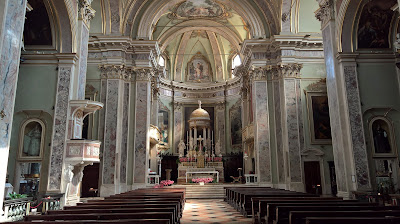
Interior of Sant'Alessandro della Croce.