This chair on the side of Fremont Avenue North reminds me of the Bombay Beach chair from three years ago. Maybe the chair (more properly, the recliner) migrated north for the summer?
Left: Recliner on the Side of Fremont Avenue North; Right: Recliner at Bombay Beach in 2010Friday, August 2, 2013
Thursday, June 2, 2011
Red Hill Marina Boat Launch–Salton Sea
After the passing another rapture opportunity recently, we couldn’t help but have the end-of-world concept in our heads as we stopped at the Red Hill Marina boat launch. Maybe it was the end of the day and the light, but it felt like the end, in a scenic way. The boat launch here was not really operable as the level of the Salton Sea has dropped recently. And, darn it is boating season, April 1 to September 30. The Red Hill Marina boat launch is located at the south end of the Salton Sea.
Years ago we had stopped at Red Hill Marina County Park and the water was higher, you could go boating. On that day we were bird watching (the Salton Sea National Wildlife Refuge is nearby) and hunting around for obsidian. Obsidian is typically found within the margins of rhyolitc lava flows. Across the way from Red Hill, to the southwest is the geographical feature called Obsidian Butte. Some good photos and experience exploring Red Hill can be found here.
The Boat Launch High and Dry
Informational Sign – It’s Boating Season!
Looking West From the Boat Launch
Wednesday, June 1, 2011
Salton Sea Mud Pots
In past trips to the Imperial Valley we visited Bombay Beach, Salvation Mountain, Desert View Tower, and the Imperial Valley Pioneer Museum. This time around the agenda included: mud pots and another sampling of the special quesadilla. The special quesadilla is discussed in the Camacho’s Place entry. In this post we discuss the mud pots.
What is a mud pot? A mud pot is bubbling pool of mud that is found in geothermal active areas where there is a shortage of water. When the mud pot is colored due to minerals it is called a paint pot. Which mud pots are we talking about? The mud pots we visited are at the corner of Davis and Schrimpf roads located at the south end of the Salton Sea just east of Red Hill Marina. In this empty lot you will find mud pots and formations called gryphons – small mud-volcanos usually shorter than three meters. The gryphons form as mud splatters and spews out over time so that a cone builds up.
Every now and then as we walked around we caught a wiff of petroleum. Apparently, researchers have found that mud pots at the Davis-Shrimff seep field can contain juvenile oil and gas. These particular mud pots emit mostly carbon dioxide and at the area at one time was formerly used to commericially collect carbon dioxide [ref]. Moreover, the mud pots in this area are throught to be a southern extension of the San Andreas Fault [ref].
The sound coming from the mud cones is interesting. You don’t hear anything until you get close. Then you hear what sounds like a udu drum – a deep, slurping sound that is part creepy and part soothing. For some cones you can carefully walk up the side and peak into the top to see the bubbling mud. On this early June day, humid and gray, it was just us, the mud pots and gryphons and their hypnotic udu sound. The Davis-Schrimpf mud pots are close to Red Hill Marina and the Salton Sea National Wildlife Refuge, so that’s a natural stop while in the area.
Different Mud Flow From a Gryphon
Mud Bubbling on a Gryphon – Mud Cone
Mud Bubbling Inside a Gryphon Cone
A Greenish Pool With Briney Edge?
Monday, April 19, 2010
Welcome to Bombay Beach
It’s easy to pick on Bombay Beach, California. It’s had its share of ups and downs on the east side of the Salton Sea. First and foremost, what’s the Salton Sea? The Salton Sea is a very salty lake that was created when the Colorado River overflowed in 1905 into the Salton Sink and continued for approximately two years. It’s almost twice the surface area of Lake Tahoe by comparison and is entirely below sea level. It was hoped that the Salton Sea could somehow become a major tourist attraction, a sort of next-Palm Springs. That never happened due to a range of problems like increasing salinity of the sea, pollution and nutrients pouring into it with no outflows, and the vagaries of weather. For more on Salton Sea facts and myths see this article. For more on the history of the Salton Sea's wet/dry cycles over thousands of years see this timeline.
Now, about Bombay Beach. First, it’s on the edge of the Salton Sea (remember, no outflows, pollution, and increasing salinity?) and was flooded in 1976 and 1977 by Hurricane Kathleen and Doreen, respectively. Next you have smell and fish kills - tilapia that die because of an algae bloom in the water (due to nutrient rich waters) and wash up on shore en masse. (It's kind of a catch 22, nutrient rich waters nourish an underwater forest that the tilapia dine on. Migratory birds, for which the Salton Sea is an important feeding ground, in turn dine on the fish.) Finally, add to this list of challenging conditions, brutally hot summers. It’s a bit of a hard sell but anything can happen in the next thousand years. To learn more about the Salton Sea and Bombay Beach check out Plagues and Pleasures, a documentary about the Salton Sea and surrounding locations.
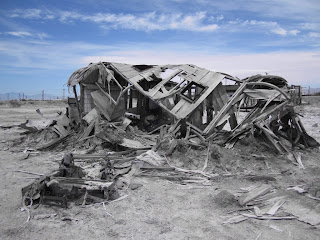
For years now, the ruins of Bombay Beach seem to have become the main tourist attraction. And, that’s what attracted Travelmarx there besides the fact that ½ of Travelmarx grew up just down the road and there was family to visit :-). We stayed a few days in the Palm Springs area and then left the manicured lawns and neatly trimmed palm trees and headed south for the wilds of the Salton Sea and Bombay Beach. We met a guy who has been visiting Bombay Beach for decades and he said it’s actually been cleaned up quite a bit. Things are looking up.