Showing posts with label lake wenatchee. Show all posts

Monday, October 21, 2013

Lake Wenatchee – Cabin Flora


Left: Mist Through the Trees; Right: Mist Over Lake Wenatchee
Mist Through the TreesMist Over Lake Wenatchee
Just over a year ago we were here (Lake Wenatchee Misty Fall Day- Plants We Noticed on a Sunday Morning) at the cabin and it was a misty fall day. Today: blue skies and perfect weather for a little investigation of the flora around the cabin. Most of the trees cabin lot are Ponderosa Pine (Pinus ponderosa) and fir or hemlock (I got stuck on the identification key where it asks “twigs warty where old needles have fallen of”). The understory is composed of Oregon Grape (Mahonia), Oceanspray (Holodiscus discolor), Birchleaf Spiraea (Spiraea betulifolia), Oregon boxleaf (Paxistima myrsinites), Elderberry (Sambucus), Common Snowberry (Symphoricarpos albus), and Western Mountain-Ash (Sorbus scopulina) to name a few.

Left: Nightstand Insect Visitor (Dead); Right: Birchleaf Spiraea
Nightstand Insect Visitor (Dead)Birchleaf Spiraea

Left: Oceanspray; Right: Birchleaf Spiraea
OceansprayBirchleaf Spiraea

Monday, September 2, 2013

Binomen Art – Pinus (Pine)

Left: Pinus Spelled with Pinecones; Right: Ponderosa Pine Cone
Pinus Spelled with PineconesPonderosa Pine Cone
Pinus Ponderosa (ponderosa pine) has three needles per fascicle. Fascicles are present in all pines and the number of needles per fascicle are a key identification characteristic. In Trees & Shrubs of Washington there is a handly key to evergreen trees that shows the number of needles for a few different pines. This pine is near Lake Wenatchee. The owners of the cabin where we were staying looked at me funny as I collected pinecones.

Left: Fascicles of Ponderosa Pine; Right: Looking Up to the Crown of a Ponderosa Pine
 Fascicles of Ponderosa PineLooking Up to the Crown of a Ponderosa Pine Key to Evergreens (fromTrees & Shrubs of Washington)
Key to Evergreens (fromTrees & Shrubs of Washington)

Sunday, September 1, 2013

Central Cascades Hike – Hidden Lake Hike

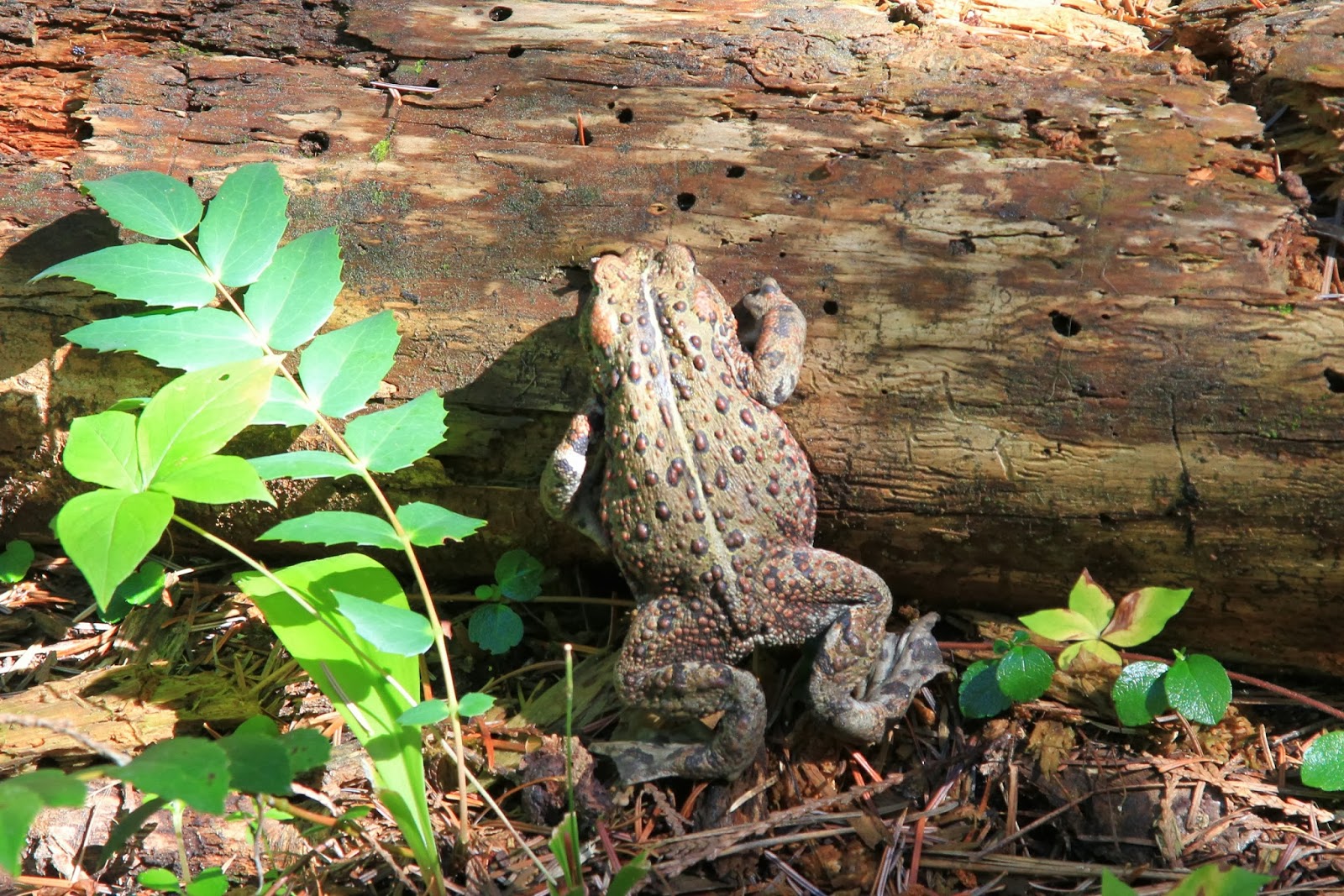
Left: A Swim in Hidden Lake; Right: Bufo borealis – Western Toad

A Swim in Hidden Lake Bufo borealis – Western Toad

The Hidden Lake Hike is a short jaunt (1.2 miles) to Hidden Lake located just south the western end of Lake Wenatchee. (After a challenging hike up to Aasgard Pass the previous day, this was a welcome relief.) Judging by the number of people we saw with towels, it is popular to take a dunk in. Of the six of us, four of us went in for a dip. The kids were fascinated with the little fish that swam around our feet as we cooled our toes on the lake’s edge.

Here are a couple of plants and animals we saw on the trip back and forth to the lake.

Bufo borealis, Western Toad. This is the first time we have seen one of these guys. We think we saw him twice, once on the way to the lake and once on the way back. He just hopped along at a leisurely pace, slightly annoyed we were watching him.

Sorbus scopulina, Western Mountain-Ash shrub. I think this is S. scopulina based on the sharp-pointed leaflets of the compound leaf as compared to S. sitchensis with more rounded leaflets at the tips and being toothed from middle to end.

Paxistima myrsinites, Oregon Boxwood. For this etymology, I found this interesting information at the US Forest Service Celebrating Wildflowers site:

The exact etymology and correct spelling of the genus have been debated for nearly two centuries. Most scholars assume the name comes from the Greek words “pachys” for thick (think of a thick-skinned elephant, or pachyderm) and stigma, in reference to the somewhat thickened stigma of the flower. Rafinesque and others have variously spelled the name as Pachistma, Pachystima, and Pachystigma, although Rafinesque’s original spelling of Paxistima is the name most widely accepted today. The species epithet, myrsinites, also comes from the Greek for “myrrh”, which the Mountain-lover’s tiny flowers are said to resemble in scent.

Rosa gymnocarpa, Baldhip Rose growing in shady damp spots along the trail. The specific name derives from the Greek gymno meaning “naked” and carpa meaning “fruit” and refers to the fact the sepals fall away from the fruit unlike other rose hips.

Symphoricarpos albus, Common Snowberry. The generic name derives from the Greek symphorein meaning “to bear together” and carpos meaning “fruit” and refers to the fact that berries are often packed closely together. The specific name albus means “white”.

Left: Rosa gymnocarpa - Baldhip Rose; Right: Symphoricarpos albus - Common Snowberry

Back at the nearby cabin we were staying at, we found some more interesting bits of nature: a lizard, a large insect, and some berries and flowers.

We posed a Sceloporus occidentalis, Western Fence Lizard(found dead in a bathtub) with a Ergates spiculatus, Ponderous Borer Beetle (found dead in the garage). A bit of trivia or at least an interesting story: the site of artist and novelist Barb Bentler Ullman mentions that “The sawing jaws of the larvae are said to have inspired the design of the chain saw.” No wonder we found it in the garage.

Around the house, we found Sambucus cerulea, Blue Elderberry and Achillea millefolium, Common Yarrow.

Sceloporus occidentalis - Western Fence Lizard and Ergates spiculatus – Ponderous Borer Beetle. Just a hint of blue on the belly of the lizard gives us a clue to one of its common names “Blue-Belly”.

Sceloporus occidentalis - Western Fence Lizard and Ergates spiculatus – Ponderous Borer Beetle Sceloporus occidentalis - Western Fence Lizard and Ergates spiculatus – Ponderous Borer Beetle

Left: Sorbus scopulina – Western Moutain-Ash; Center: Sambucus cerulea – Blue Elderberry and Achillea millefolium – Yarrow; Right: Paxistima myrsinites – Orgeon Boxwood

Sorbus scopulina – Western Moutain-AshSambucus cerulea – Blue Elderberry and Achillea millefoliumPaxistima myrsinites – Orgeon Boxwood

Left: Topo Map (Google) of the Hidden Lake Trail; Right: Two Bumps Boys on a LogTopo Map (Google) of the Hidden Lake TrailTwo (Bumps) Boys on a Log


Monday, October 15, 2012

Lake Wenatchee Misty Fall Day- Plants We Noticed on a Sunday Morning


View Over Lake Wenatchee Looking South
We stayed over one night at a friend’s cabin nearby the lake and on Sunday morning we had a chance to walk around and explore and identify some plants*. It’s fall and the rain has started, finally and well, thankfully this year. The leaves of the Big Leaf Maple (Acer macrophyllum) show interesting patterns in green and gold as they** prepare to drop. The smaller Vine Maples (Acer circinatum) stake out red on the color spectrum. On the edge of a drive way, we spot what we think is Blue Elderberry (Sambucus cerulea): blue dried up berries with a white bloom. Well, at least we are pretty sure of the Sambucus part. Nearby on a dirt road we spot some pine drops (Pterospora andromedea) looking very sticky. Finally, the trees around the cabin have a healthy supply of Wolf Moss (Letharia vulpina) - an almost fluorescent green dues to the vulpinic acid they contain. Cool!

* We probably said it before, but the (Revised) Plants of the Pacific Northwest Coast: Washington, Oregon, British Columbia & Alaska is a good general reference to carry around.

** We use they because we always thought of the tree controlling the show, but it seems the leaves have a part to play. In a book we are currently reading, Botany for Gardeners, author Brian Capon describes it this way: “Leaf senescence, prior to abscission, includes the breakdown of chlorophyll and weakening of cell walls at the base of the petiole, in a narrow band of cells called the abscission zone. In spring and summer, auxin produced in the leaf keeps the abscission zone intact. But low night temperatures and short days in autumn cue the leaves to reduce auxin production and increase the liberation of ethylene.” The ethylene destroys the cells in the abscission zone and the leaf falls away. Who is doing what?

Big Leaf Maple (Acer macrophyllum) leaf with smaller Vine Maple leaf, red (Acer circinatum) (left), Big Leaf Maple Seeds (right)
Big Leaf Maple (Acer macrophyllum) leaf with smaller Vine Maple leaf, red (Acer circinatum) Big Leaf Maple Seeds
Big Leaf Maple (Acer macrophyllum) Spotted Leaf 

Wolf Lichen (Letharia vulpina) on Douglas Fir (Pseudotsuga menziesii)
 

Pinedrops (Pterospora andromedea) – fall colors
Pinedrops (Pterospora andromedea) – fall colors Pinedrops (Pterospora andromedea) – fall colors

Blue Elderberry (Sambucus cerulea) berries (left) and leaves (right)
Blue Elderberry (Sambucus cerulea)Blue Elderberry (Sambucus cerulea)

Plants of the Pacific Northwest (left) and Botany for Gardeners (right)
Plants of the Pacific Northwest Botany for Gardeners