Showing posts with label bus stop biosphere. Show all posts

Saturday, August 24, 2013

Bus Stop Biosphere V

Pictures of flora from a curious commuter, late March to early May 2013.

< Bus Stop Biosphere IV

What: Alcea rosea (Common Hollyhock) leaves
Family: Malvaceae
Where: Underneath the Fremont Rocket.
When: 3/17/13
Notes: According to Quattrocchi, the origins of Alcea is “Greek alkea ‘mallow’, Latin alcea, ae for Malva alcea L. (Plinius).”
Alcea rosea (Common Hollyhock) leaves

What: Daphne laureola (Daphne-laurel) flowers and leaves
Family: Thymelaeaceae
Where: Steps at 40th and Fremont
When: 3/17/13
Notes: I find this plant a bit weedy with a pungent smell when you break its stems.
Daphne laureola (Daphne-laurel) flowers and leaves

What: Rhododendron sp. (Azalea)
Family: Ericaceae
Where: Denny Park
When: 3/25/13
Notes: According the Merriam-Webster, azalea is “New Latin, genus name, from Greek, feminine of azaleos dry, from azein to parch, dry; akin it Hittite, ḫat- to dry up and probably to Latin ador emmer. First Known use: 1760”. According to Quattrocchi, this refers to the preferred habitat of this subgenera of the genus Rhododendron.
 Rhododendron sp. (Azalea)

What: Aucuba japonica (Gold Dust Plant)
Family: Garryaceae
Where: 9th Avenue and Virginia Street in front of Cosmopolitan Condominium
When: 3/25/13
Notes: This is the first time I ever saw this plant with flowers. I was surprised by the brown, almost purple flowers. The genus name comes from “Aukubi or ao-ki or aokiba, the Japanese name.” [Quattrocchi]
 Aucuba japonica (Gold Dust Plant)

What: Aesculus hippocastanum (Horse-Chestnut)
Family: Sapindaceae
Where: Fremont Avenue North
When: 4/6/13, 5/3/13
Notes: This tree has a crazy burl-like structure around the trunk from which lots of new growth sprouts.
 Aesculus hippocastanum (Horse-Chestnut) Aesculus hippocastanum (Horse-Chestnut) Aesculus hippocastanum (Horse-Chestnut)

What: Lunaria annua (Money Plant)
Family: Brassicaceae
Where: Fremont Avenue North
When: 4/15/13
Notes: Purple flowers are followed by ghostly white seedpods that form the basis of many of the plant’s common names: Money Plant, Silver Dollars, Chinese Coins, etc. The generic name means “moon-like,” also referring to the seedpods.
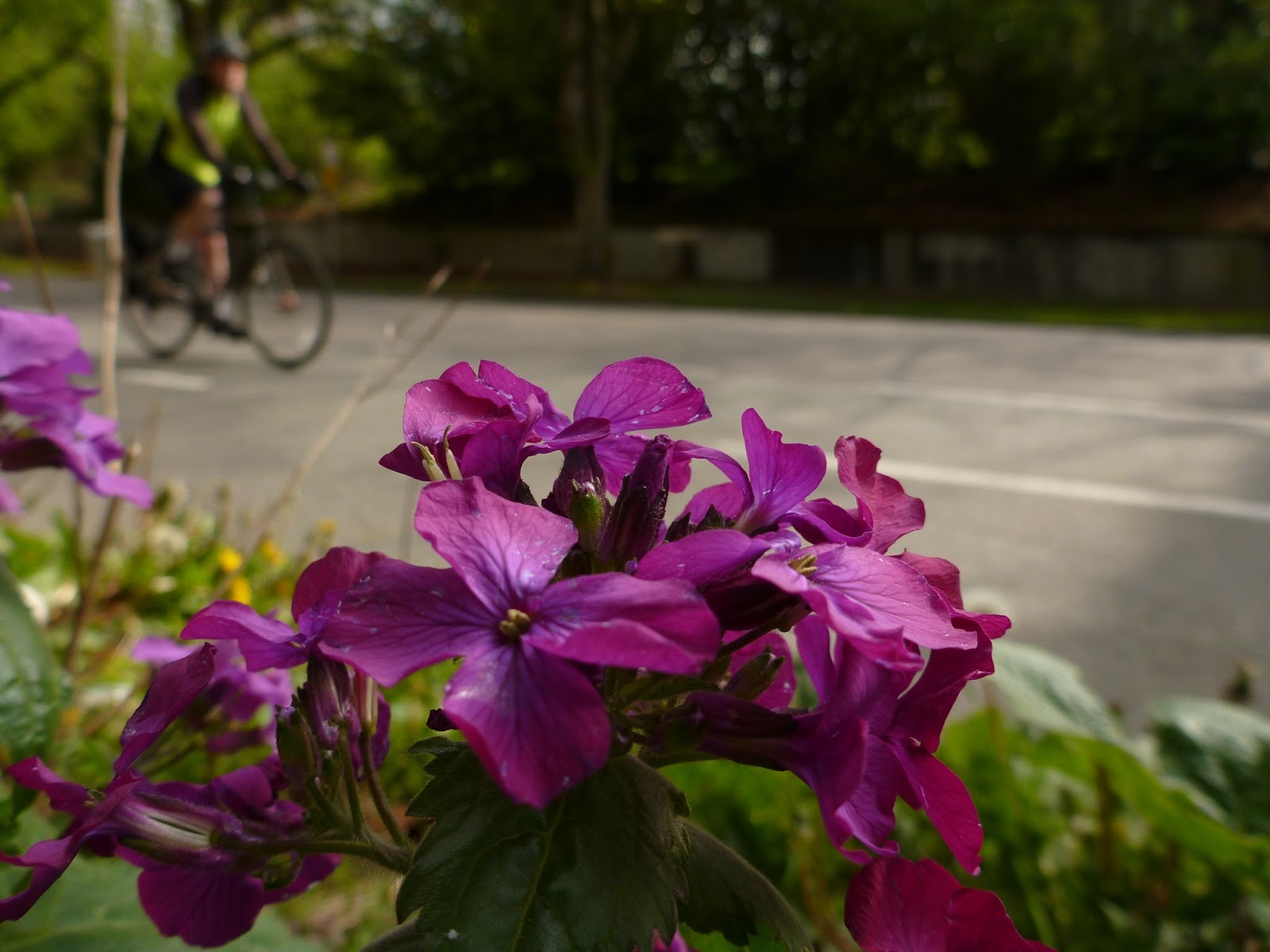
Lunaria annua (Money Plant)

What: Plantanus sp. (Sycamore)
Family: Plantanaceae
Where: 9th Avenue between Lenora Street and Virginia Street.
When: 5/3/13
Notes: The “Beebe and Runyan Furniture Northwest” refers to a company that occupied the building. According to Seattle.gov “[b] By 1936 at least until 1955, the building housed the Northwestern Furniture Sales Company and, subsequently, was the home of Beebe and Runyon Furniture.”
Plantanus sp. (Sycamore)

What: Trifolium incarnatum (Crimson Clover)
Family: Fabaceae
Where: Near Stone Way North and North 41st Street.
When: 5/9/13
Notes: This clover is another one of those plants that stops me in my tracks when I see it and I wonder why I don’t have some.
Trifolium incarnatum (Crimson Clover)

Monday, April 22, 2013

Bus Stop Biosphere IV

< Bus Stop Biosphere III | Bus stop Biosphere V >

Some late February and early March 2013 pictures of plants and other small wonders in the city.


Left: Lichen in a pear tree; Right: Moss on a pear tree

Lichen in a Pear TreeMoss on a Pear Tree

Left: Flowering currant in Olympic Sculpture Park; Right: Bellis perennis in Myrtle Edwards Park lawn with red-tipped underside of petals

Flowering currant in Olympic Sculpture ParkBellis perennis in Myrtle Edwards Park lawn

Left: Pheasant Grass with blue wall; Right: Oregon Grape (Mahonia x Media ‘Charity’)Pheasant Grass with blue wallOregon Grape (Mahonia x Media ‘Charity’)

Left: Spider web on a trellis with drops of water; Right: Crocus and brown leaves Spider web on a trellis with drops of waterCrocus and brown leaves

Clematis vitalba (a King County Class C noxious weed)

Clematis vitalbaClematis vitalba

Saturday, February 16, 2013

Bus Stop Biosphere III

The photos in the post are objects I’ve seen going back and forth to the bus stop in the last few months. The bus stop means work; my mind wanders to anything but work as I walk. In particular, when I walk in the city I instinctively look for nature amidst the paved spaces. And, I find it.

< Bus Stop Biosphere II | Bus Stop Biosphere IV >

Find 1: We seem to have a period once or twice a year that we get a series of cold nights in Seattle. These nights are best when followed by a bright, sunny day where you can view your plants with a coating of ice crystal, a soft rime?

January 2013: Front Yard - on a crisp morning. Plants with ice. Geranium x cantabrigiense - 'Biokovo' and Thuja occidentalis leaf.
Geranium x cantabrigiense - 'Biokovo' Thuja occidentalis

Find 2: These pictures show evidence of the work of a Northern Flicker (bird) (Colaptes auratus). We have a couple in our neighborhood and they are amusing to watch as they pull dirt, moss, and plants out of cracks looking for food (insects, beetles, snails). Flickers are part of the woodpecker family (Picidae), but unlike woodpeckers frequently feed on the ground. Not until writing this did I realize we have had many less snails in our yard, perhaps due to the flickers?

February 2013: Cement Cracks Back Alley. Northern Flicker (Colaptes auratus) handiwork.
Northern Flicker (Colaptes auratus) handiwork. 

Find 3: It always amazes me to lift up a leaf on cement or asphalt and find worms.

February 2013: Back Alley. Worms.
Worms in the back alley.

Find4: It’s  February and a sunny day to boot. Time for a dandelion (Taraxacum) to unfurl its flowers?

February 2013: Fremont Ave bus stop. Dandelion (Taraxacum).
 

Find 5: One of the test subject areas for bus stop biosphere.

February 2013: Fremont Ave bus stop. Patch of ground.
Test subject areas for bus stop biosphere.

Find 6: An over-wintered leaf of Himalayan Blackberry (Rubus armeniacus syn. Rubus discolor) tinge burgundy-brown. From the King County Noxious Weed web site. “Himalayan and evergreen blackberry are European species of blackberry that are highly invasive and difficult to control. Originally introduced for fruit production, they are now naturalized and widespread throughout the Pacific Northwest. They are easy to spot by their large, vigorous, thicket-forming growth and sharp spines covering the stems.” They didn’t mention the burgundy-brown color of the leaves.

February 2013: Fremont Ave bus stop. Last year’s blackberry leaf.
Last year’s blackberry leaf.

Friday, February 15, 2013

Bus Stop Biosphere II

The photos in the post are objects I’ve seen going back and forth to the bus stop in the last few months. The bus stop means work; my mind wanders to anything but work as I walk. In particular, when I walk in the city I instinctively look for nature amidst the paved spaces. And, I find it.

< Bus Stop Biosphere I  |  Bus Stop Biosphere III >

Find 1: Flowers in a patch located near Wheelhouse Coffee in downtown Seattle. I have walked by this patch of ground surrounding a tree many times and never paid it much attention. One day in fall, the patch was filled with white flowers. As best as I could tell, this is autumn clematis (Clematis ternifora).

October 2012: Near Wheelhouse Coffee. Autumn clematis (Clematis terniflora).
Autumn clematis (Clematis terniflora)

Find 2: The part of Fremont Avenue North where I wait for the bus has a block-long row of Horse-chestnut (Aesculus hippocastanum) trees. They are part of the planting around the BF Day Playground. The pictures below show the smooth brown nuts outside of their formidable casings. The nuts find their way across the street and far away from the trees partly by rolling down the hill and partly by squirrels transporting them. The nuts are pleasing to roll around in your hand, a sort of big worry bead.

October 2012: Fremont Ave N. Horse-chestnut (Aesculus hippocastanum).
Horse-chestnut (Aesculus hippocastanum)Horse-chestnut (Aesculus hippocastanum)Horse-chestnut (Aesculus hippocastanum)

Find 3: On a sunny day at the right time in the fall, the leaves of Liquidambar are flaming red. I only manage to capture the fruits this time.

October 2012: 8th Ave near Denny Park. Liquidambar fruits.
Liquidambar fruits

Find 4: An imposter in the ivy: a red maple leaf hides in the ivy. The legal status of four cultivars of ivy, Hedera helix, in King Country (in which Seattle is located) is a Class C noxious weed. Washington State has three classes of noxious weeds, Class A (the worse), B, and C. Counties within Washington State can chose to enforce Class C weeds or educate residents about controlling them. Here is a part of King County’s education for ivy. In my observation of urban Seattle, Himalayan blackberry (Rubus armeniacus) and ivy are rampant.

November 2012: Fremont Ave N. Ivy and Maple Leaf.
Ivy and Maple Leaf

Find 5: While waiting for the bus, I suddenly noticed these spots on the Big Leaf Maple (Acer macrophyllum) leaves. From what I can tell, they are called Speckled Tar Spot (Rhytisma punctatum), a fungus, and to my eyes, they are cool looking. Rhytisma p. will overwinter on the leaves, patiently waiting for spring when its fruiting bodies burst out and get carried to new leaves.

November 2012: Fremont Ave N. Speckled Tar Spot (Ryhtisma punctatum).
Speckled Tar Spot (Ryhtisma punctatum)

Find 6: There is a stairway that connects Fremont Ave N and Evanston Ave N. The edges of the steps glow with moss, a pleasant site in the middle of winter makes me happy (like a daily dose of vitamin D). I wish I could identify this moss more specifically, but I can’t. According to Arthur Lee’s The Cryptogamic Carpet - Mosses in Seattle, a good estimate of the number of species of moss in Seattle is about 100.

These stairs were “spruced” up in 1980 as part of the Fremont Stair Project. There are concrete slabs with incised designs in which moss has happily filled in. Good planning.

January 2013 - February 2013: N 40th St Steps. Bryophte - Moss.

Moss Fremont Stair ProjectMoss Fremont Stair ProjectMoss Fremont Stair ProjectMoss Fremont Stair ProjectMoss in Design - Fremont Stair ProjectMoss in Design - Fremont Stair ProjectMoss in Design - Fremont Stair ProjectMoss in Design - Fremont Stair ProjectMoss in Design - Fremont Stair ProjectMoss in Design - Fremont Stair ProjectMoss in Design - Fremont Stair ProjectFremont Stair Project

Sunday, September 23, 2012

Bus Stop Biosphere

The photos in the post are objects I’ve seen going back and forth to the bus stop in the last few months. The bus stop means work; my mind wanders to anything but work as I walk. In particular, when I walk in the city I instinctively look for nature amidst the paved spaces. And, I find it.

Bus Stop Biosphere II >

Find 1: One morning as I was walking to the bus stop, I saw this dead bird - a female house sparrow (Passer domesticus) I believe. Then again it could be a female house finch (Carpodacus mexicanus). I didn’t think to take the critical measurements: wing chord, tarsus, or culmen.
Dead Female Sparrow

Find 2: On the way from the bus stop on a Saturday (unusual because I rarely take the bus on Saturdays), I found another dead bird, this time I think a male house finch judging by it’s rosy breast. Did I take those critical measurements? No, but I composed a small Still Life with a rotting pear from our tree, and some flowers (clover and poppy) growing on the side of the neighbor’s garage.

Dead House Finch

Find 3: Near a bus stop for the 5 bus, there is a patch of burdock (Arctium minus) where I like to watch the bees collecting pollen.
Arctium minus

Find 4: Leaving the house for work one morning, I popped out on to our deck and saw this Brachyscome flower (one we’ve had for a few years now) and it’s variegated petals.
Brachyscome Flower Variegated

Find 5: Just a minute away from my high rise dungeon (the office), I spotted this dragonfly, motionless, but alive on the sidewalk.
Dragonfly

Find 6: Just out of our back door I composed this arrangement of a rock, robin’s shell, and borage flower and leaves. And, then off to work.
Rock, robin’s shell, and borage flower and leaves

Fin 7: Near a bus stop for the 5 bus, there also grows some Asteraceae flowers. Daisy or aster? Next time I need to examine the involucral bracts to help decide.
Asteraceae flowers

Find 8: A rock rose (family Cistaceae) grows on a sloping hillside near the bus stop.
White rock rose

Find 9: Rumex plans from the Polygonaceae family grows here and there on a median strip near the bus stop. Is it dock or sorrel I wonder as the bus approaches.
Rumex 

Walking in the back gate from a long day at work, I saw this banana slug (Ariolimax) without a care in the world. To be or not to be a banana slug?
Banana Slug

A bit of alfalfa (Medicago sativa) in the median strip: city hay?
alfalfa (Medicago sativa)