Saturday, August 24, 2013

Bus Stop Biosphere V

Pictures of flora from a curious commuter, late March to early May 2013.

< Bus Stop Biosphere IV

What: Alcea rosea (Common Hollyhock) leaves
Family: Malvaceae
Where: Underneath the Fremont Rocket.
When: 3/17/13
Notes: According to Quattrocchi, the origins of Alcea is “Greek alkea ‘mallow’, Latin alcea, ae for Malva alcea L. (Plinius).”
Alcea rosea (Common Hollyhock) leaves

What: Daphne laureola (Daphne-laurel) flowers and leaves
Family: Thymelaeaceae
Where: Steps at 40th and Fremont
When: 3/17/13
Notes: I find this plant a bit weedy with a pungent smell when you break its stems.
Daphne laureola (Daphne-laurel) flowers and leaves

What: Rhododendron sp. (Azalea)
Family: Ericaceae
Where: Denny Park
When: 3/25/13
Notes: According the Merriam-Webster, azalea is “New Latin, genus name, from Greek, feminine of azaleos dry, from azein to parch, dry; akin it Hittite, ḫat- to dry up and probably to Latin ador emmer. First Known use: 1760”. According to Quattrocchi, this refers to the preferred habitat of this subgenera of the genus Rhododendron.
 Rhododendron sp. (Azalea)

What: Aucuba japonica (Gold Dust Plant)
Family: Garryaceae
Where: 9th Avenue and Virginia Street in front of Cosmopolitan Condominium
When: 3/25/13
Notes: This is the first time I ever saw this plant with flowers. I was surprised by the brown, almost purple flowers. The genus name comes from “Aukubi or ao-ki or aokiba, the Japanese name.” [Quattrocchi]
 Aucuba japonica (Gold Dust Plant)

What: Aesculus hippocastanum (Horse-Chestnut)
Family: Sapindaceae
Where: Fremont Avenue North
When: 4/6/13, 5/3/13
Notes: This tree has a crazy burl-like structure around the trunk from which lots of new growth sprouts.
 Aesculus hippocastanum (Horse-Chestnut) Aesculus hippocastanum (Horse-Chestnut) Aesculus hippocastanum (Horse-Chestnut)

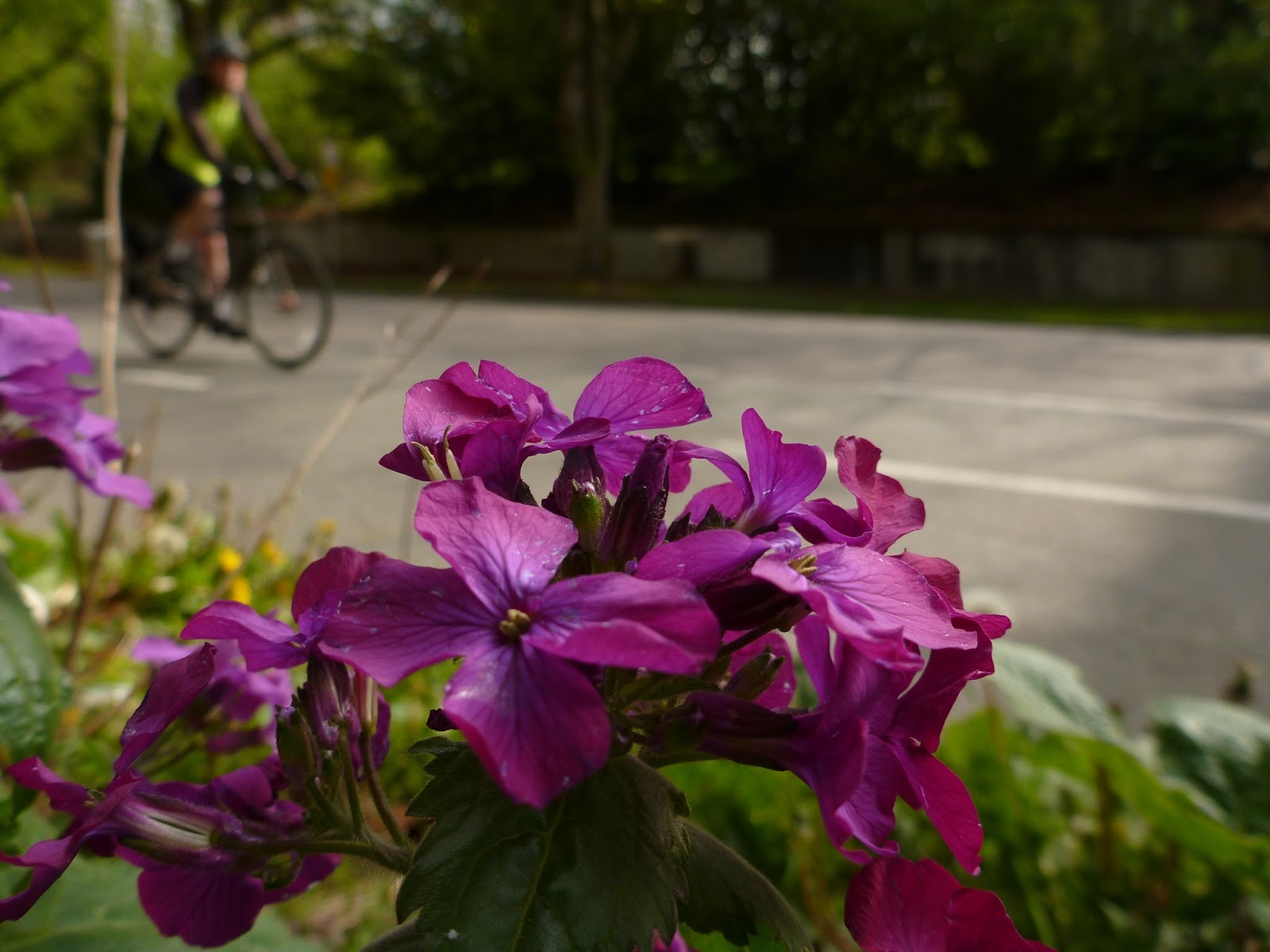
What: Lunaria annua (Money Plant)
Family: Brassicaceae
Where: Fremont Avenue North
When: 4/15/13
Notes: Purple flowers are followed by ghostly white seedpods that form the basis of many of the plant’s common names: Money Plant, Silver Dollars, Chinese Coins, etc. The generic name means “moon-like,” also referring to the seedpods.
Lunaria annua (Money Plant)

What: Plantanus sp. (Sycamore)
Family: Plantanaceae
Where: 9th Avenue between Lenora Street and Virginia Street.
When: 5/3/13
Notes: The “Beebe and Runyan Furniture Northwest” refers to a company that occupied the building. According to Seattle.gov “[b] By 1936 at least until 1955, the building housed the Northwestern Furniture Sales Company and, subsequently, was the home of Beebe and Runyon Furniture.”
Plantanus sp. (Sycamore)

What: Trifolium incarnatum (Crimson Clover)
Family: Fabaceae
Where: Near Stone Way North and North 41st Street.
When: 5/9/13
Notes: This clover is another one of those plants that stops me in my tracks when I see it and I wonder why I don’t have some.
Trifolium incarnatum (Crimson Clover)

Sunday, August 18, 2013

Whipped Cream and Other Delights – Album Cover Parodies

Whipped Cream and Other Delights – Album Cover Parodies

Herb Alpert’s Tijuana Brass Whipped Cream & Other Delights album cover is one of the most parodied (spoofed) album covers. We knew of a couple of parodies of the cover – involving spaghetti, clam dip, and sweet cream – but were surprised to find a few more that we didn’t know about. The album was originally released in 1965. Its cover features a women sitting in cream (I think it was actually shaving cream from what I remember reading), holding a rose and a finger to her lips to taste the “whipped cream”.

Here we include parodies that show some kind of food-like substance and/or are similar in pose to the original. The Bryant’s Cocktail Lounge is not an actual album, but a place in Milwaukee. There are other parodies that go beyond what we include here, including Dave Lewis, Dave Lewis Plays Herb Alpert & the Tijuana Brass [1967]

Peter Nero, Peter Nero Plays a Solute to Herb Alpert and Tijuana Brass [1971].

The parodies we show here include:

Thursday, August 15, 2013

Binomen Art – Actinidia deliciosa (Kiwifruit)

Left: Kiwifruit Binomial Name Spelled With Seeds; Right: Kiwi Seeds Up Close, Remnants of Pollen Tubes Connecting Seeds to Central Axis
Kiwifruit Binomial Name Spelled With SeedsKiwi Seeds Up-Close, Connected to Styles
In May of this year (2013), we were in Piemonte driving near Saluzzo when we once again encountered the fields of kiwifruit, Actinidia deliciosa commonly grown in this area. When we were here in 2008, it was winter and we came upon some naked vines on a hillside behind Saluzzo and were amazed to find the ground littered with kiwi. This time, we were able to see the vines with their leaves. In a quick glance, the kiwi vines look similar to grape vines. The trick is to look at the leaves: rounded leaves means it's a kiwi.

According to fruit-crops.com, commercial cultivation of kiwi began in New Zealand in 1930 and eventually spread to other countries like Italy, France, United States, Chile and Japan.

The Food and Agricultural Organization of the United Nations gives the harvest area of kiwi in Italy at 1894 Ha in 1984. By 2011, the give the area as 24,930 Ha. That’s more than a 10 x increase. You can read more about kiwis in Italy in the story in the LA Times, Italy’s fuzzy logic pays off. The article (written in 2008) states that more that 80% of Italy’s kiwi production is exported. Kiwi production can leverage the grape-growing infrastructure already in place, yet earn more profit.

And to think that Italians have taken to the kiwi because the green color reminded them of the Italian flag! Speaking of color, the kiwi that is green inside (pericarp) that we typically see in the store is the Hayward variety. Kiwis come in other colors, but don’t seem to be as common at the Hayward.

Kiwi is in the Actinidiaceae family, also called the Chinese Gooseberry family. The family contains mostly temperate and subtropical woody vines, shrubs, and trees native to Asia, Central America, and South America. Quattrocchi says of the generic name:

Greek aktin “ray”, in allusion to the radiating styles.

If you cut the kiwi length-wise, you won’t see the “radiating” styles. A “style” is the middle part of the female part of a flower. It connects the ovary to the stigma.

Geek Part: In female kiwi flowers, the ovary is formed by the fusion of 26 - 41 carpels with each housing up to 40 ovules with an estimated total of 1400 - 1500 ovules per pistil. [1]. The more fertilization that occurs, i.e., pollen reaching ovules, the bigger the fruit. [2]. Go to the paper Pollen Tube Distribution in the Kiwifruit (Actinidia deliciosa A. Chev. C. F. Liang) Pistil in Relation to its Reproductive Process [3] to learn about pollen tubes, pollen tube distributor caps, and the effects of over and under pollination.

[1] Hopping ME. 1976. Effect of exogenous auxins, gibberellins, and cytokinins on fruit development in Chinese gooseberry (Actinidia chinensis Plunch.). New Zealand Journal of Botany 14: 69-75. online
[2] Guédés M, Schmid R. 1978. The peltate (Ascidate) carpel theory and carpel peltation in Actinidia chinensis (Actinidiaceae). Flora (Jena) Abt. B 167: 525-543
[3] Howpage, D, Vithanage V., Spooner-Hart, R.1998. Pollen Tube Distribution in the Kiwifruit (Actinidia deliciosa A. Chev. C. F. Liang) Pistil in Relation to its Reproductive Process. Annals of Botany 81: 697-703. online

Left: Kiwifruit Binomial Name Spelled With Seeds; Right: Generic Name, Actinidia
Kiwifruit Binomial Name Spelled With SeedsGeneric Name, Actinidia

Left: Kiwifruit End Showing Pollen Tubes Entering Ovary (the Cup); Center: Radiating Locules From Central Axis; Right: Setup for Extracting Seeds


Left: Saluzzo 2008, With Kiwi Vines; Right: View from Saluzzo 2013, Looking Southeast Over the Plain (with Kiwi Vines)
Saluzzo 2008, With Kiwi VinesView from Saluzzo 2013, Looking Southeast Over the Plain (with Kiwi Vines)

Sunday, August 11, 2013

Mount Rainier National Park, Summerland – Panhandle Gap Hike

Left: Little Tahoma Looms Ahead; Right: Cistanthe umbellatum (Pussy Paws) in the Scree
Little Tahoma Looms AheadCistanthe umbellatum (Pussy Paws) in the Scree
The trail to Panhandle Gap is a section of the much larger, 93 mile Wonderland Trail which encircles Mount Rainier. From the trailhead on Sunrise Road at Fryingpan Creek, you walk just a few minutes before joining the Wonderland Trail. The Washington Trails Association page for this hike lists the round-trip miles at 12 with an elevation gain of 2,950 feet.

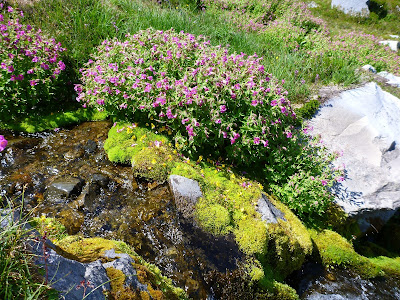
The scenery on this trail was probably some of the best we’ve seen this season compared to our three previous hikes (Goat Mountain, Blanca Lake, and Beckler Peak). From dappled-light old-growth, to alpine meadows, to scree slopes and rock fields, you can see quite a bit of flora. When we got back home and started looking through the pictures, we realized how many different plants and plant families we observed. The stand-out plants for us this time were in the scree areas.The Cistanthe umbellatum (Pussy Paws, Pussy Toes), in particular, was a pleasant find and it’s always pleasing to see trickling streams with mossy banks and Mimulus lewisii (Monkeyflower).

At this time of the season, we were able to catch just a few Erythronium montanum (Avanlanche Lily) still in bloom; most of them have set seed. For a overview of wildflowers you might see in the park, see Mt. Rainier Area Wildflower Guide. To make the identifications here, we also used the following sources:

  • Turner Photographics – www.pnwflowers.com site. (Also, the IOS application is handy and much appreciated.)
  • Plants of the Pacific Northwest Coast (Washington, Oregon, British Columbia & Alaska), compiled and edited by Pojar & Mackinnon
  • Trees & Shrubs of Washington by C.P. Lyons
  • Mac’s Field Guide to Pacific Northwest Wildflowers
  • Washington State Trees & Wildflowers by C.P. Lyons
  • And, of course just POS (plain-old-searching) on the Internet

Left: Trail From Summerland Camp Up to Panhandle Gap, Pass Two Small Lakes; Right: Mimulus lewisii (Monkeyflower)

Trail From Summerland Camp Up to Panhandle GapMimulus lewisii (Monkeyflower)

Some of the Plants We Saw on the Wonderland Trail to Panhandle Gap

Adoxaceae
Sambucus racemosa (Red Elderberry)

Asteraceae (Sunflower Family)
Achillea millefolium (Yarrow)
Erigeron corymbosus (Fleabane)

Berberidaceae (Barberry Famil)
Achyls triphylla (Vanilla Leaf).

Boraginaceae (Borage Family)
Mertensia paniculata (Merten's Bluebells, Tall Lungwort)

Crassulaceae (Stonecrop Family)
Sedum divergens (Cascade Stonecrop)

Ericaceae (Heather Family)
Chimaphila umbellatum – (Pipsissewa, Prince's Pine)
Orthilia secunda (One-Sided Wintergreen)
Phyllodoce empetriformis (Pink Mountain Heather)
Rhododendron albiflorum (White-Flowered Rhododendron, Cascade Aazalea)

Fabaceae (Pea Family)
Lupinus lepidus var. lobbii (Dwarf Lupine )
Lupinus spp.

Gentianaceae (Gentian family)
Gentiana calycosa (Mountain Bog Gentian)

Liliaceae (Lily Family)
Veratrum viride (Green Corn Lily, False Hellebore)
Erythronium montanum (Avanlanche Lily)

Orchidaceae (Orchid Family)
Goodyera oblongifolia (Western Rattlesnake Plantain) - not in bloom

Plantaginaceae (Plantain Family)
Veronica cusickii (Cusick's Speedwell)

Polygonaceae (Buckwheat Family)
Eriogonum umbellatum (Sulfur Buckwheat)
Polygonum bistortoides (American Bistort)
Polygonum newberryi (Alpine Knotweed)

Portulacaceae (Purslance Family)
Cistanthe umbellatum (formerly Calyptridium umbellatum) (Pussy Paws, Pussy Toes)

Ranunculaceae (Buttercup Family)
Anemone occidentalis (Western Pasqueflower)

Rosaceae (Rose Family)
Luetkea pectinata (Patridgefoot)
Rubus spectablis (Salmonberry)

Saxifragaceae (Saxifrage Family –“Rock Breakers”)
Elmera racemosa (Yellow Coralbells)
Leptarrhena pyrolifolia (Leatherleaf Saxifrage)
Parnassia fimbrata (Fringed Grass-of-Parnassus)

Scrophulariaceae (Figwort Family)
Mimulus lewisii (Lewis's Monkeyflower)
Mimulus tilingii (Mountain Monkeyflower)
Pedicularis contorta (Coiled-Beak Lousewort)
Pedicularis ornithorhyncha (Bird's Beak Lousewort)
Pedicularis racemosa (Sickletop Lousewort)
Penstemon davidsonii (Davidson's Penstemon)
Penstemon procerus (Small-flowered Penstemon)

Our Hike Notes

Length: About 11.5 miles round-trip by our GPS.
Duration: Just under 7 hours. We left the trailhead at 8:30am and arrived back at 3:15pm. We sat down at the gap at 11:30 pm for lunch and left the peak at 12:00 pm to head back.
Elevation Gain: 2,837 feet. The trailhead is at 4,018 feet and the highest point we reached was 6,829 feet.
Location: Mount Rainier National Park, Sunrise / White River.

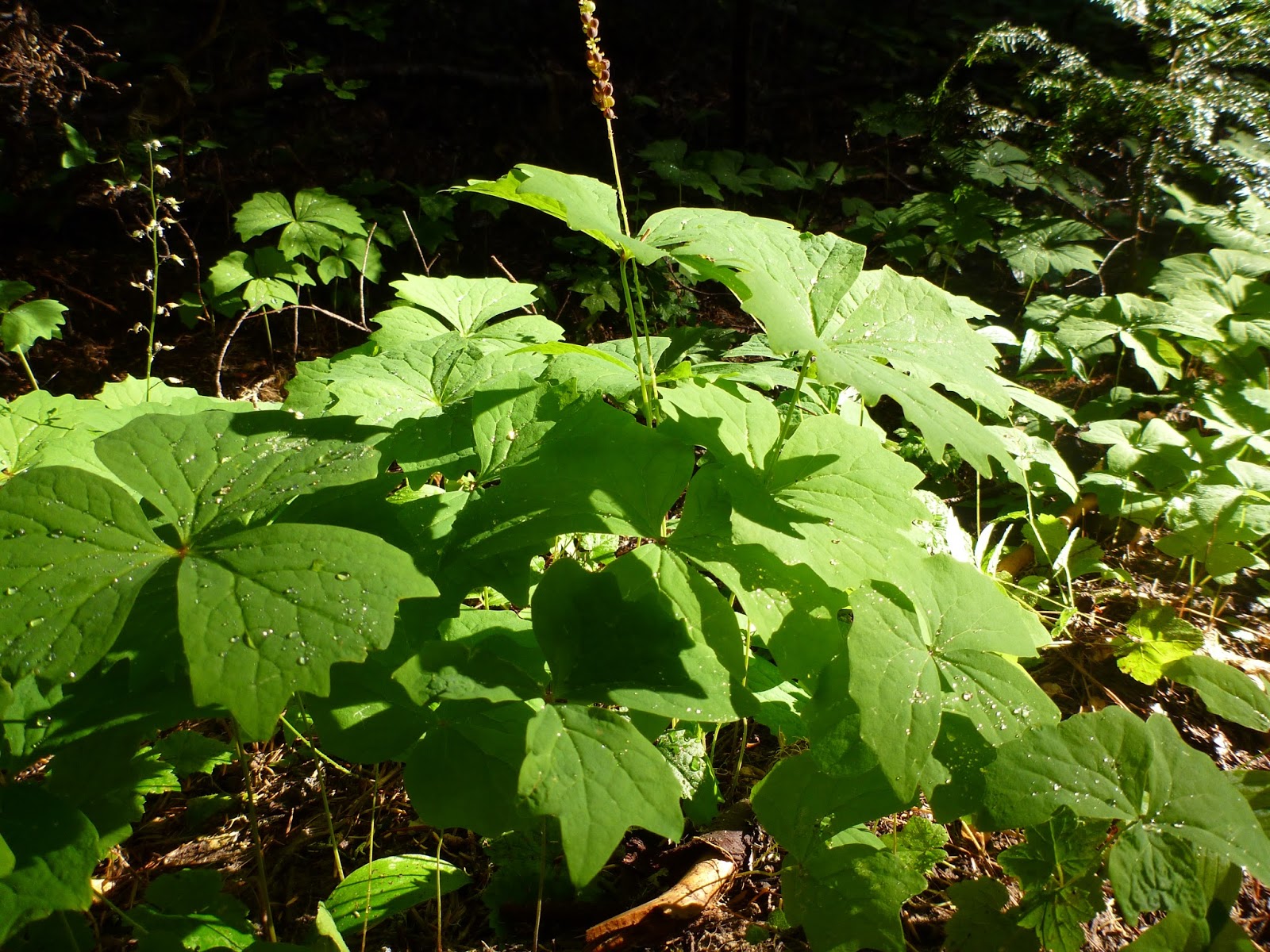
Left: Achyls triphylla (Vanilla Leaf); Right: Rubus spectablis (Salmonberry)
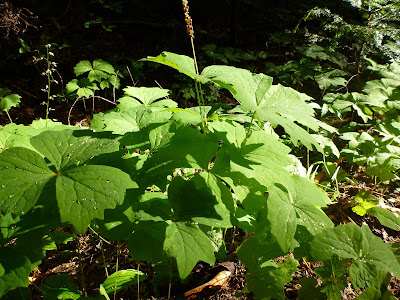
Achyls triphylla (Vanilla Leaf);Rubus spectablis (Salmonberry)

Left: Sedum divergens (Spreading Stonecrop) Overlooking Fryingpan Creek; Right: Erythronium montanum (Avanlanche Lily) – One of the Last Few Blooming at this Time in August
Sedum divergens (Spreading Stonecrop)Erythronium montanum (Avanlanche Lily)

Left: Marmota caligata (Hoary Marmot) Cools Itself on the Trail; Right: Alpine Summerland Meadow Creek with Monkeyflower
Marmota caligata (Hoary Marmot)Alpine Meadow Spring with Monkeyflower

Left: Hoverfly on Erigeron. Look at those wings! Right: Mertensia paniculata (Tall Lungwort) with Bee.
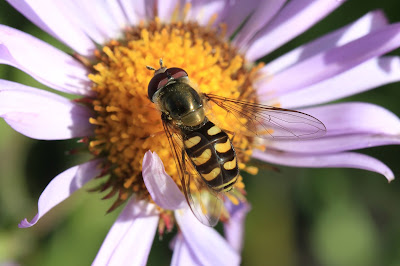
Hoverfly on ErigeronMertensia paniculata (Tall Lungwort) with Bee

Left: Lupinus lepidus var. lobbii (Dwarf Lupine) Among the Rocks; Right: Dwarf Lupine
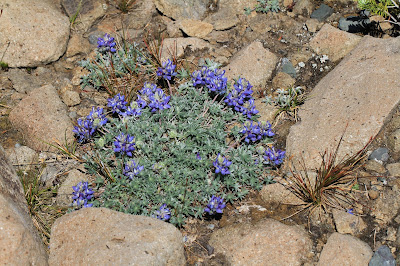
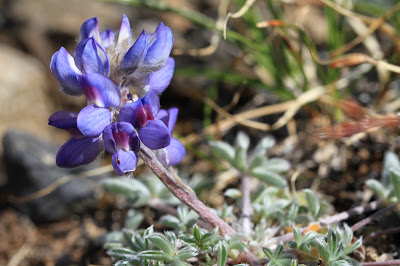
Lupinus lepidus var. lobbi (Dwarf Lupine) Among the RocksDwarf Lupine Flower Head

Left: Veronica cusickii (Cusick’s Speedwell) Flower; Right: View From Panhandle Gap Looking South
Veronica cusickii (Cusick’s Speedwell) Flower View From Panhandle Gap Looking South

Left: Leptarrhena pyrolifolia (Fireleaf Leptarrhena) Red Calyxes; Right: Cistanthe umbellatum (Pussy Paws, Pussy Toes) Spread Flat in the Rocks
Leptarrhena pyrolifolia (Fireleaf Leptarrhena) Red CalyxesCistanthe umbellatum (Pussy Paws, Pussy Toes) Splayed-Out in the Rocks

Left: Summerland Meadow Stream; Center: Parnassia fimbrata (Fringed Grass-of-Parnassus) Flower; Right: Gentiana calycosa (Mountain Bog Gentian) Flower Opening
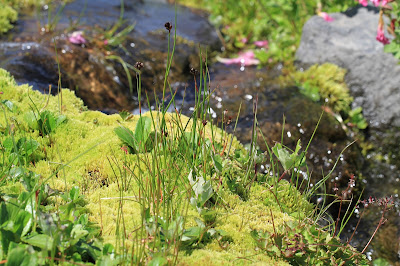
Summerland Meadow StreamParnassia fimbrata (Fringed Grass-of-Parnassus) FlowerGentiana calycosa (Mountain Bog Gentian) Flower Opening

Left: Elmera racemosa (Yellow Coralbells) Following a Rock Crevice; Center: Polygonum bistortoides (American Bistort) Alongside a Small Lake of Fryingpan Glacier Melt Water; Right: Monkeyflower and Summerland Meadow Stream
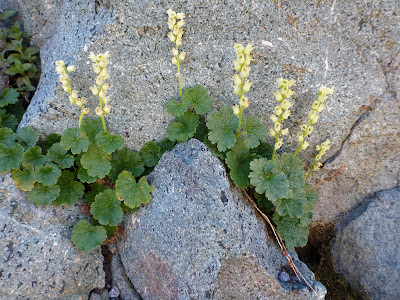
Elmera racemosa (Yellow Coralbells) Following a Rock CrevicePolygonum bistortoides (American Bistort) Alongside a Small Lake of Fryingpan Glacier Melt WaterRight: Monkeyflower and Summerland Meadow Stream

Left: Rhododendron albiflorum (White-Flowered Rhododendron, Cascade Aazalea); Right: Veratrum viride (Green Corn Lily, False Hellebore)
Rhododendron albiflorum (White-Flowered Rhododendron, Cascade Aazalea)Veratrum viride (Green Corn Lily, False Hellebore)

Left: Little Tahoma View from Summerland Meadow; Right: Ice Patterns on the Way to Panhandle Gap
Little Tahoma View from Summerland Meadow Ice Patterns on the Way to Panhandle Gap

References

The following images are some of the references we used to identify flowers and other flora for this hike and others in the Northwest.  The Mac’s Field Guide and the Washington State Trees & Flower Guide are laminated and are easy to take on the hike.

Books, Left to Right:  Plants of the Pacific Northwest Coast, Trees and Shrubs of Washington, Wildflowers of Washington, and Mac’s Field Guide to Pacific Northwest Wildflowers

Plants of the Pacific Northwest CoastTrees and Shrubs of WashingtonWildflowers of WashingtonMac’s Field Guide to Pacific Northwest Wildflowers

Left: Washington Wildflowers Application; Right: Washington State Trees & Wildflowers Fold-Out Quick Reference Card
Washington Wildflowers ApplicationWashington State Trees & Wildflowers Fold-Out Quick Reference Card

Topographic Maps

The following two images show the terrain of the hike and the location of the hike relative to Seattle. Both maps are from maps.google.com.