Tuesday, March 13, 2012

Binomen Art - Camellia

Camellia japonic petals
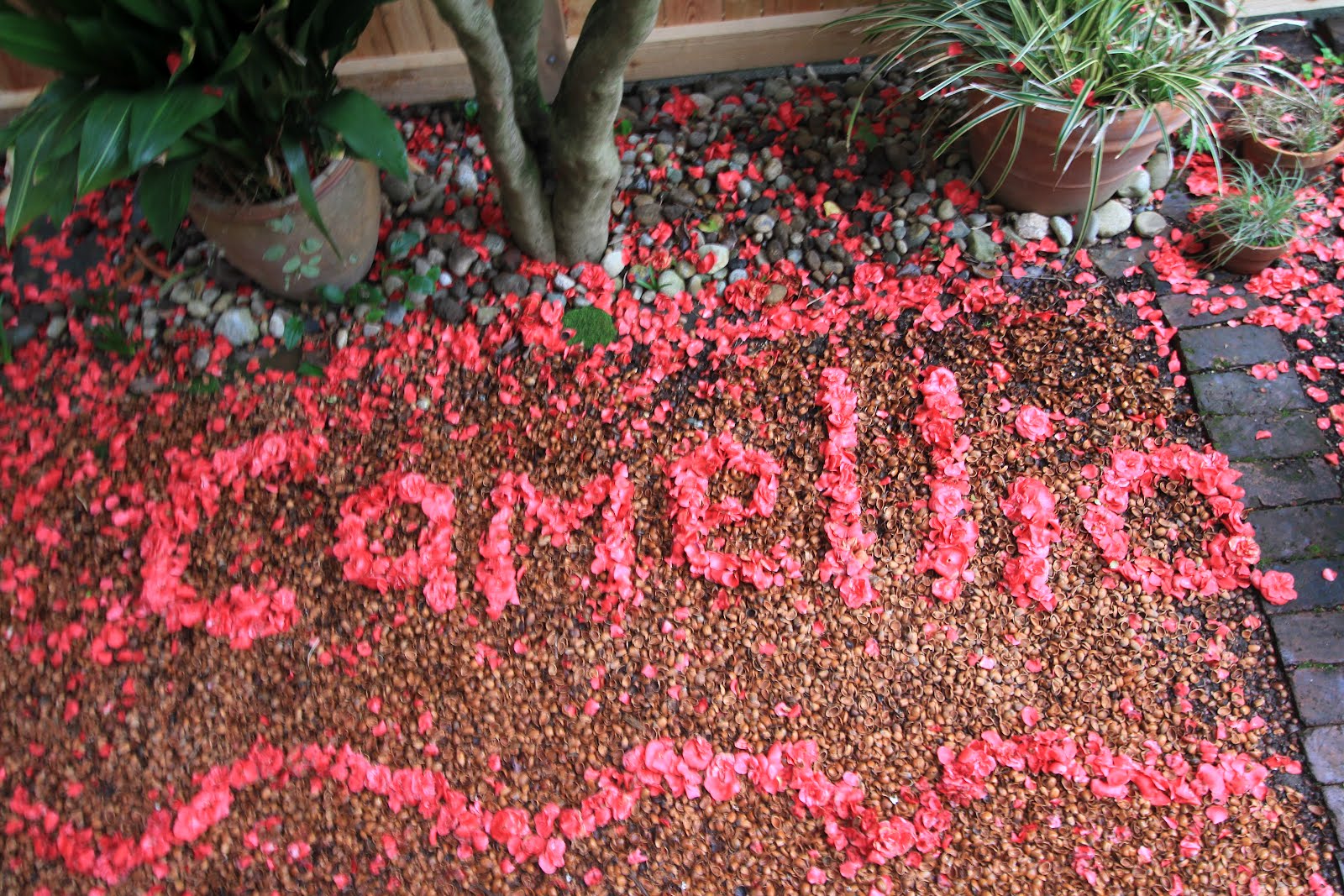
There is never a dull moment from February onward at Travelmarx headquarters. From sarcococca, azara, pieris, to bulbs of all kinds, and now, camellia. From February to March it’s time for our camellia to spring into action. Our camellia tree creates lots of blooms that drop and create a carpet of pink-purple on the ground. And wouldn’t you just know it that we went out one day and the blossoms - as if by magic - spelled “Camellia”!

The etymology of the genus Camellia is that it honors the “Jesuit missionary Georg Joseph (Georgius Josephus) Kamel (Camellus, Camel, Camelli), 1661 - 1706, born at Brno in Moravia, pharmacist, traveler in Asia, plant collector in Luzon, Philippines.” Carl Linnaeus named the Camellia after Kamel in 1735.

The particular plant pictured here is one that was here when we moved in. We estimate the age of the Camellia tree at least greater than 40 years old, about 16 feet high and 12 feet wide. Its blossoms are semi-doubled blossoms with no scent that we can detect. It is likely C. japonica - or common camellia.

Camellia Blossoms on Hazelnut Shells
Camellia japonic petalsCamellia japonic petals
Camellia japonica blossoms Up Close
Camellia japonic petals

Camellia Blossoms on a Branch
Camellia japonic branch

Camellia Binomen Art – Reprise
Camellia japonic Binomen Art

Monday, March 12, 2012

Binomen Art - Pieris japonica

Pieris japonica - binomen art

The genus Pieris is named for the Greek Muses, the Pierides, a cult introduced into Pieria near Mount Olympus. Pieris was a daughter of Pierus a Muse. [Quattrocchi] Etymologically, this sounds fascinating, but, after a little investigation it seems that there was no information we could find as to why this particular daughter was chosen. Did she have some attributes that this plant represents? Back in the world of mortals, we do know that Pieris is a shrub in the Ericaceae family (the heath/heather family). They have the characteristic bell-shaped flowers and leathery texture that is common for many plants in this family.

In Seattle, Pieris is relatively common. The specimen pictured here (P. japonica D.Don ex G.Don we believe) is less showy than you typically see in that it never develops very deep red-colored young leaves. P. japonica is native to Eastern China, Japan (hence japonica), and Taiwan and grows easily in Seattle. We estimate the age of this specimen at least 30-40 years old. It grows on the north side of our house and is a welcome sign to see blooming in February and March. The blossoms don’t have a scent that we can detect but are relatively long lasting. 

The generic name is spelled with dried seed capsules. The specific name is spelled with little twigs from the shrub.

We noticed when taking the photos that the woody seed capsules seem to turn upward whereas the flowers are pointed downward. Also, on the subject of seeds: in all the years we’ve lived with this shrub (17 or so years) we’ve never once seen a spontaneous start of P. japonica. That is something to muse about.

Binomial Fun Looking Out Our Entry Hall Window at the Pieris Shrub
Pieris - binomen artPieris japonica - binomen art

Pieris japonica Seed Capsule and Flower Under Loupe
Pieris japonica - dried seed capsulePieris japonica - flower

Pieris japonica Racemes
Pieris japonica - racemePieris japonica - raceme

Pieris japonica Dried Capsules and Flowers

The Specimen

Wednesday, February 29, 2012

Binomen Art - Trachycarpus fortunei

Trachycarpus fortunei Spelled Out (Left) and with Digital Overlay (Right)
Next up in the Binomen Art series is Trachycarpus fortunei, commonly called Chusan Palm or Windmill Palm. We’ve always used the latter common name. This palm is native to central China. From Quattrocchi: the generic name comes from the Greek trachys meaning “rough” and karpos meaning fruit and refers to the rough surface of the fruits. The specific name honors Robert Fortune, a 19th century Scottish botanist and plant hunter.

The Specimen

We’ve had this particular palm for over 20 years. For many years it was in a pot where it did not flourish. Only when we put in the ground and ignore it, did it take off. We have yet to see it produce flowers or fruits so we can’t confirm the trachys part of the name. It seems to do well in the Seattle climate with the occasional snow as shown from one of the pictures. T. fortunei is known to be pretty hardy.


The Installation

We hung the letters from the petioles of one fan. We fastened each of the letters with a single thread taken from the fibrous stem (not a trunk because it lacks true wood structure?). We threaded a needle with a single fiber and made a hole through each letter to suspend it. Weeks later, the “R” and “A” still remain while the other letters have fallen apart.

Trachycarpus fortunei with Snow – Jan 2012


Planning The Spelling

Trachycarpus fortunei Stem-Trunk Fiber
Trachycarpus fortunei Stem-Trunk FiberTrachycarpus fortunei Stem-Trunk Fiber

Tuesday, February 28, 2012

Travelmarx Music Picks – Winter 2012

Travelmarx Music Picks – Winter 2012

Music we’ve listened to at the end of 2011 and the beginning of 2012. Spotify playlist: Travelmarx Winter 2012.

1. Rickie Lee Jones (Pirates) - After hearing Rickie at the Jazz Alley, we went back to some of the albums with tracks she performed, including Pirates (1981) and the track Living It Up - musical story telling at its finest.

2. Fraser, Budd, Guthrie, Raymond (The Moon and the Melodies) - Memory Gongs played when you need to take it down a notch or two.

3. Augie March (Moo You Blood Choir) - The track Honey Month oozes lushness into our ears. We don’t know what it all means really. For a long time, we misread the track title as Honey Mouth - which could equally apply to the songs on this album.

4. Jóhannsson, Jóhann (Fordlandia) - A minimalist composition inspired by the failure of Henry Ford’s Brazilian rubber plant of the same name. Music to think by.

5. k.d. Lang and Siss Boom Bang (Sing It Loud). Play it loud and often. We like the title track Sing It Loud.

6. Max Richter (Infra) - We have a soft spot for Max Richter and his haunting music.

7. Feist (Metals) - Darker than past albums.

8. Slow Train Soul (Illegal Cargo) - Behind this funky effort is ½ of the Puddo Varano, Morten Varano. You might recognize a number of tracks if you’ve listened to any of the Hotel Costes series before.

9. M. Ward (Hold Time) - Great hooks and lyrics makes you want to listen again and again.

10. Bjork (Biophilia) - With iPad app. We are still trying to make sense of it all.

11. Rinocerose (Guitar Organisation) - A guilty pleasure.

12. Francois Poulenc - (Gloria) - Composed in 1959. We once sang Laudamus te in chorus and we keep coming back to it.

13. The Great Lake Swimmers (Ongiara) - Yes, it is still in heavy rotation in our headphones at work. There is a peaceful and easy feeling about this album. I think I Became Awake will be our 2012 theme song.

14. Uakti and Philip Glass (Aguas da Amazonia) - Two favorite artists, together.

15. Andrew Bird (Useless Creatures) - Please play at our funeral.

16. Finley Quaye (Vanguard) - We came to this album through the track Calendar.

17. William Orbit (My Oracle Lives Uptown) - Radioharp - some tracks are good, others a tad too sweet.

18. Jun Miyake (Stolen From Strangers) - After seeing the movie Pina which featured music from Miyake we just had to get this and we aren’t sorry.

19. Pina Soundtrack - The soundtrack to the Wim Winders film about Pina Bausch. Excellent movie and soundtrack.

20. Devendra Barnhart (Smokey Rolls Down the Canyon) - What can one say about this release? We love it. Shabop Shalom alone is worth it.

21. Cocteau Twins (Snow) - The Cocteau Twins do Frosty the Snowman? It was a big disconnect when we hear in Banana Republic of all places.

22. Wilco (The Whole Love) - We always start off saying “oh” another Wilco release and then we can’t stop listening to it.

23. Carmen Consoli (Elettra) - Love the waltz Sud Est.

24. Melody Gardot (My One and Only Thrill) - The whole album is great. To think we learned about this album in a spin class! Okay, it was a song used for stretching at the end.

25. Kate Bush (50 Words for Snow) - We were excited when we came upon the Director’s Cut earlier this year. Now this? Say it isn’t so. 

Thursday, February 23, 2012

McCoy Schering Mortar and Pestle Cups and Holly, Ilex aquifolium

McCoy Schering Mortar and Pestle Cups and Holly, Ilex aquifolium
This installment in the pots and plants series features sort-of-a-pot - really a cup - with holly, Ilex aquifolium. These cups represent mortar and pestles, the traditional symbol of the pharmacy. The handle is the pestle and the cup is the mortar. The cups here were produced in 1965 by McCoy Pottery for the Schering Corporation. The Schering Corporation is now part of Merck but has roots going back to 1851 when it was founded by Ernst Christian Friederich Schering in Germany.

You can read a detailed story of these mortar and pestles in this article Schering Mortar & Pestle Series. In a nutshell, the Schering Corporation started producing these cups (in several different materials besides ceramics shown here) and other items (e.g. cufflinks, note pad and pen set, swizzle sticks!) in 1963 as promotional items.

The writing and imagery on the cups can be decoded as follows:

- On the handle, the word “Coricidin ®” refers to the drug, Coricidin

- On the base of the cup, the words “secundum artem” mean “according to the arts” - the techniques used and known only by pharmacists for compounding

- On the rim of the cup, the phrase “Galen 131-201 A.D.” refers to the accomplished medical figure of antiquity, Claudius Galen

- On the bottom of the cup the name of the company “Schering” is written, arching over a stylized mortar and pestle

- On one side of the cup is a bust of Galen and on the other side, the common pharmacist’s symbol “Rx”

We will never look at these cups the same after finding out this information in the process of preparing this post. We do use them in our medicine cabinet to hold various tubes and toiletry odds and ends.

On to the plant, it is holly - well to be more specific, our neighbor’s holly. Didn’t think they would miss a few leaves. Holly’s binomial name is Ilex aquifolium. Quattrocchi says that the generic name is from the Latin ilex (elex), icis, the ancient name for the holm oak tree, Quercus ilex. Perhaps due to the similarity in leaves? Curiously, the specific name, aquilfolium, means Holly-like leaves. Names can be confusing at times if you read too much into them without knowing how the name got applied. The name of the family is Aquilfoliceae.

Ironically, holly seems to be rarely used medicinally.

McCoy Schering Mortar and Pestle Cups Showing Bottom Mark
McCoy Schering Mortar and Pestle Cups and Holly, Ilex aquifolium

Sunday, February 19, 2012

Spectral Light and Ushnu at Huanaco Pampa

Step 1: Light Comes Through WindowArcheoastronomy - Step 1, Light Comes in Window
Step 2: Light Reflects off Plastic Cover
Archeoastronomy - Step 2, Light Reflects on Panel
Step 3: Spectral Light Appears on Door
Archeoastronomy - Step 3, Light Shines on Door
The “spectral light” in the title of this post is an event that occurs every January 31st at our house. The event reminder pops up on our calendar as “Spectral Light on Bathroom Door”. It sounds spooky, but is quite simple. The angle of the sun on this day is such that it comes through an east facing window in early to mid-morning, bounces off a security panel plastic cover in an inner hall way and displays a ghostly light pattern on our bathroom door for a few minutes. The bathroom is on the north side of the house and does not receive direct sunlight. The event is one that lets us think of our house as a big calendar of sorts, our little bit of archeoastronomy in action.

There are several points to mention about this light. First, there must be corresponding event in late November but we have never recorded this event. Second, given that in Seattle the number of days of sun per year is not that great, that our spectral light appears magically in winter is all the more amazing. Third, last summer I was unfortunately only able to spend a hurried morning at the British Museum on the tail end of my Wainwright Coast to Coast Walk, but one display that stuck in my mind was a diagram of the Ushnu at Hunacopampa which showed the position of the rising sun on key dates in the year. In the diagram, the June Solstice, Equinox and the December Solstice are shown. Unfortunately or fortunately, our house was not built around key calendar times, so January 31st is what we are left with as a house-calendar date.  (Update: 2012-11-08 - we just saw it again today, approximately 42 days before the Solstice.)

Entrance to the British Museum and the Ushnu at Hunacopampa ExhibitEntrance to the British MuseumUshnu at Hunacopampa - British Museum

An ushnu is a pyramid-shaped, terraced structure that the Incas used for ceremonial purposes. Sort of a stage and throne rolled into one. Huánuco Pampa (in Spanish) is an Incan site that dates from 1470 to 1532 AD. The Huánuco region is in central Peru and served as an Incan administrative center. The role of astronomy at ushnu at Huánuco Pampa is discussed at the Universidad Nacional Mayor de San Marcos - Universidad del Perú web site.

Our house was remodeled in 2005-2006. Two changes we made make the spectral light event possible: a small bump out where the east-facing window is and the enlargement of a passage way. What if we had taken archeoastronomy into account when we were remodeling? The four most expensive words in remodeling: “While we’re at it…”
The Light Path Through the House
House Floor Plan for Remodel

Saturday, February 18, 2012

Weller Clinton Ivory, Peters and Reed Moss Aztec Vases and Dryopteris

Weller Clinton Ivory Vase - Dryopteris
In this installment of the pots and plants series we have a Dryopteris - wood fern - with two different vases: a Weller Clinton Ivory Vase and a Peters and Reed Moss Aztec Vase. We cut the Dryopteris a week earlier during some yard cleaning which explains its dried look in the photos. Wood ferns are common in the Northern Hemisphere.

First, a confession. We thought his was Polystichum polyblepharum - Tassel Fern - for the longest time. The ends of the pinnae and the blade itself have what look like “tassels” to us – hence the confusion - but really, the form is called cresting. (There is a good explanation of fern structures and what you call the parts of a fern at Native Plants for Georgia: Part 2 - Ferns.) We take comfort in the 1906 publication Gardeners’ chronicle, horticultural trade journal where, on page 27, we see the reference to tassels at the tips. Phew.

Anyhow, from our new best friend Quattrocchi [CRC World Dictionary of Plant Names - Who is Umberto Quattrocchi?] we were going to say that the generic name Polystichum comes from the Greek polys “many” and stichos “a row, series” referring to the sori (singular sorus) in many rows. The specific name ploybelpharum means many eyelashed, many fringed [DG] and refers to the bristly scales located along the mid-veins and pinnules. (Now, blepharitus, the inflammation of the eyelash follicles has a whole new significance.) The common name comes from the appearance of the fronds as they unfurl, looking droopy like tassels.

The last bit about the unfurling of the fronds giving rise to the common name Tassel Fern was the first hint that maybe it wasn’t P. polyblepharum. That tidbit along with the generic naming referring to rows of sori made us pause. (The arrangement of the sori is a key identification feature of ferns.) So the doubt entered our minds, we went to see Pina (the Wim Wenders movie about Pina Bausch (1940 - 2009)), came home, and realized it was Dryopteris. Pina helped us understand the pinna - so to speak. Case closed, or sort of. What species is it? (Boy is our record keeping spotty!) By the looks of it, it looks pretty close to Dryopteris affinis ‘Cristata’

Dryopteris Rachis FrondDryopteris Rachis Frond - LabeledPina Bausch

Other terms to keep in mind when thinking about ferns are ramenta and pinnules. Ramenta are the yellow-brown scales on the rachis (part of the stem of the frond). Wood ferns like D. affinis have ramenta as shown here. The pinnules are a secondary division of the pinnae - a leaflet of sorts. In D. affinis they are broadly rectangular with slightly serrated edges.

The specimen that the fronds in the photos come from is grown in a large clay pot under the cover of pear trees with sun-dappled shade. It has what seems to be called a ‘shuttlecock’ type of growth pattern that looks like a badminton birdie. It reaches several feet in height and width. The fronds are usually trashed by mid-winter so we typically remove all the fronds and let it start from scratch.

Okay, so back to Quattrocchi, where we find that Dryopteris comes from the Greek dryopteris (drys “oak, a wood” and pteris “fern”) given to the genus by Dioscorides to a black oak-fern, Asplenium onopteris. And, from Latin dryopteris for a plant similar to dryophonon “a sort of fern” a name given by Plinius. We decided to see if we could confirm this last tidbit of information. We found a copy of the reference Michel Adanson (1727 - 1806), Familles de plantes 2:20 at the Internet Archive (www.archive.org) and tried to look it the fact. Well, we found Dryopteris on page 20, but it’s not until you go to a table of names in the second part (2:560) that you see a mention of Plinius but under a different plants Gale (Myrica gale?). It was confusing to tease apart and figure out how Quattrocchi arrived at the statement, so let’s get on with this post and talk about pots. (Affinis means related to or like another species.)

Weller Clinton Ivory, Peters and Reed Moss Aztec Vases and DryopterisPeters and Reed Moss Aztec Vases - Dryopteris

The vases are thematically related in that they both were made by pottery companies at the beginning of the 20th century in Zanesville, Ohio. (There must be Dryopteris in Ohio?)

The Weller Clinton Ivory Vase we purchased a few years ago in an antique mall in Connecticut. It is about 9” tall and 4 ½” across at the top. It is an ivory color and is not signed. The Weller Pottery of Zanesville, Ohio was a prolific creator of high-end art pieces and functional commercial ware. This vase seems to be from the “middle” period of the Clinton Ivory line, circa 1915.

The Peters and Reed Moss Aztec vase we purchased a dozen or so years ago in a Pioneer Square antique shop. It was described to us as being made between 1905 and 1912, 7 ½” tall, 4 ½” across at the top. The vase is brown and moss green finish and the bottom is not signed. Peters and Reed Pottery (1897 - 1919) was bought out in 1920 and renamed Zane Pottery of Zanesville, Ohio.

Sori on the Back for a Dryopteris Frond and Excerpt from Gardeners’ chronicle, horticultural trade journal, 1906
 

Dryopteris affinis ‘Cristata’ Frond Parts Up Close (No Sori), Ramenta 
Fern Crests – Dryopteris
 

Friday, February 10, 2012

Binomen Art - Scalesia


When we first saw the generic name Scalesia we pronounced it as “Ska-LESS-ia”. After some rooting around on the web for another issue, we ran across this post from BirderNaturalist about a Galápagos cruise. In the post, the author points out that
“Presumably Darwin was the first to collect species from this genus, as it was named by his good friend Joseph Dalton Hooker. And presumably Hooker named it after a Mr. Scales, as that -ia ending is added to a proper name in order to coin plant genera. (Fuchsia was named after Leonhart Fuchs, Poinsettia was named after Joel Roberts Poinsett, etc. I just haven't been able to find out who Scales was, as internet searches always turn up other uses of that common English word.) Keep this in mind when pronouncing "Scalesia," so as to keep the one-syllabled name Scales intact – please, not sca-LEE-sia, which sounds more like a disease or an obscure country north of the Caucasus.”
Point taken. Joseph Dalton Hooker (1817 - 1911) read the paper An Enumeration of the Plants of the Galapagos Archipelago; with Descriptions of those which are new on March 4th, May 6th, and December 16th, 1845 and On the Vegetation of the Galapagos Archipelago, as compared with that of some other Tropical Islands and of the Continent of America on December 1st and 15th, 1846. Both appear in The Transactions of the Linnean Society of London, Volume XX.

Joseph Dalton Hooker’s Galápagos Papers
An Enumeration of the Plants of the Galapagos Archipelago; with Descriptions of those which are new - HookerOn the Vegetation of the Galapagos Archipelago, as compared with that of some other Tropical Islands and of the Continent of America - Hooker
In the An Enumeration… paper, Dalton states “The species of Scalesia form a very natural genus, and all those now to be described agree in every essential particular with the generic character, drawn up by Arnott from an examination of S. atractyloides alone.” Arnott refers to George Walker Arnott (1799 - 1868). While we are not 100% certain how this might have worked, it seems that Hooker deferred to an existing name, and that perhaps, Mr. Scales was a friend of Arnott?

Well, the idea that there might have been a Mr. Scales prompted us to dust off the William T. Stearn (1911 - 2011) classic Botanical Latin, first published in 1966. In Chapter XX, Formation of Names and Epithets in Latin, there is the section Names Commemorating Persons that lists the International Code for Botanical Nomenclature recommendations which include commemorating a person whose (sur)name ends in a consonant. In this case the letters ia are added, except when the name ends in er, when a or ia is added. Here’s are the relevant recommendations online: 20A.1 and 60B.1. Mr. Scales it just may be. But, we still think that the older, dead leaves do look like “scales” flattened against the trunk. Maybe someone didn’t follow the rules when naming the genus?

UPDATE 2012-03-28:  A reader (see comments) has kindly pointed out that the generic name Scalesia was meant to honor the Scottish botanist, William Alexander Stables (1810-1890) but the name got mangled. In a note in the Archives of Natural History the sleuthing that uncovered the etymological blunder is revealed. Thanks Anonymous.

Scalesia Binomen Art at Campo Duro
t

We are not exactly sure of the particular Scalesia shown here. Our guide claimed it was S. gordilloi, but we doubt that since that species seems to be found only on San Cristóbal Island, Galápagos. By the leaf alone, it looks more like S. cordata which is present on Isabela and is where this photograph was taken. This stand of Scalesia was photographed at Campo Duro in the Isabela highlands (lat -0.8723, long -91.0150 or 0d 52’ 20’’ S, 91d 0’ 54” W). The name was spelled with dried leaves found on the ground. The same guide said that some dried Scalesia leaves were used like tobacco.

Scalesia is part of the Asteraceae family and is endemic to the Galápagos Islands. The arborescent behavior - or tree-like behavior - is rare in the Asteraceae family. The species of Scalesia in the Galápagos Islands can be big flower trees! Scalesia are referred to as the Darwin’s finches of the plant world because they demonstrate the process of adaptive radiation. In short, adaptive radiation is the evolution of many species form a common ancestor. More specifically, adaptive radiation is a consequence of alliopatric speciation or geographical speciation. Speciation is the process by which a new species arise.

A species is a biological classification that refers to a group of organisms capable of interbreeding and producing fertile offspring (the main criteria). When a splinter-population of a species gets separated from the main (parental) population so they cannot interbreed anymore with the main population then the splinter population can give rise to a new species. In the case of Scalesia, you can think of seeds that floated, hitched a ride on a bird, or otherwise made their way to Galápagos Islands a few million years ago. In the new niche, the daisies evolved from a single or a few ancestors to fill the island niches, including moist uplands and arid lowlands. It’s unclear to us why in the moist uplands the Scalesia grow so tall. Is it because of the need to compete for light and/or gather the garúa mist and critical moisture during the dry season?

In Jackson’s Galápagos: A Natural History (Chapter 3) there is a good overview of evolution in the Galápagos. The splinter populations (or colonizing populations as he refers to them) that arrive are not usually a representative selection of the parent population, an effect referred to as the “founder effect”. Therefore, the colonizing population is different right from the start. Also, the colonizing population doesn’t have the inertia of the larger parent population to change and is subject to “genetic drift” which means that significant change can happen in just a few generations. And finally, when you think about it, if the colonizers are good long-distance colonizers, like mangrove, then it’s not likely that a new species will form in the new environment. Rather, it’s the plants and animals at the edge of their dispersal capability that give rise to the new races or species. So the daisy family gave rise to a new genus, Scalesia, and the mangroves didn’t.

Collecting Dry Scalesia Leaves to Spell Out the Generic Name and the Leaves Up CloseCollecting Scalesia cordata leavesScalesia cordata leaves