Monday, December 11, 2017

The Sellaronda - The Sequel

Skiing near Passo Pordoi, with a vew toward Sassolungo and Sassopiatto.View from Nature Hotel Delta.
Left: Skiing near Passo Pordoi, with a vew toward Sassolungo and Sassopiatto. Right: View from Nature Hotel Delta.

The Feast of the Immaculate Conception is a public holiday celebrated on December 8 in Italy and – to many – that’s come to mean the possibility of a three-day ski weekend. It just so happens that most ski resorts open right around this date. In 2016, December 8th was a Thursday, which was perfect for a four-day weekend.  In 2017, the 8th fell on a Friday, for a three-day weekend. In 2018, it falls on a Saturday, which is not good at all.  However, it won’t matter because our little group of the last two years (2016 and 2017) swore off making the trip to the Dolomites in 2018. Why? The traffic was so bad getting back from Val Gardena to anywhere south of Trento. Sunday, the 10th as we drove back, it was snowing, and the roads were packed and treacherous. Compounding the problem is that many people use the long weekend to visit the Christmas markets in Trentino-Alto Adige, which typically open in late November and early December.  Busloads of visitors from places far south of this region are all heading back home on that Sunday as well.

Given the travel nightmare getting home, we experienced great skiing because there was much more snow in 2017 than in 2016. In 2016, we were skiing on toilet-paper slopes. (See Alta Badia Dolomites Weekend and Skiing the Sellaronda.) Beautiful white, man-made strips of snow surrounded by an autumn brown landscape with now snow cover.

In 2016, our friends guided us around the slopes and navigated the Sellaronda. This year, we had our big boy ski pants on and did ourselves. How lost can you get, right? You just follow the orange (clockwise) or green (counter-clockwise) arrows. Yet, somewhere we missed a sign and ended up somewhere off track near Ciampinoi. It was easy to backtrack and find the right route.


Hot chocolate at La Ütia.Dessert at Sotciastel.Kaiserschmarrn at Mesoles.
Left: Hot chocolate at La Ütia. Center: Dessert at Sotciastel. Right: Kaiserschmarrn at Mesoles.

"Tutres" as Maso Runch."Panicia" - barley soup at Maso Runch. Polenta and meat dish at Maso Runch.
Left: "Tutres" as Maso Runch. Center: "Panicia" - barley soup at Maso Runch. Right: Polenta and meat dish at Maso Runch.

Skiing on the slopes east of Sella Massif, north of Arabba, with a view south.Skiing above Corvara in Badia.
Left: Skiing on the slopes east of Sella Massif, north of Arabba, with a view south. Right: Skiing above Corvara in Badia.

Skiing near Arabba with the Sella Massif in the background.

Friday, December 1, 2017

Bergamo – Street Sign Language Lesson XXII

previous lesson | this lesson | next lesson

In this installment of Street Sign Language Lesson, we deal with a couple of cases of sic erat scriptum, learn where the best anchovies come from, and find out where to go for a good pizza and a glimpse of an old prison in Bergamo's Città Alta.

Broken down car with a I'm sorry note in the window. Condominium warning: put trash in the right bin or else!Anti-vaccination activist who can't spell.
Left: Broken down car with a I'm sorry note in the window. Center: Condominium warning: put trash in the right bin or else! Right: Anti-vaccination activist who can't spell.

Guasta! Scusate – "broken, apologies"
A polite note to let people know that this car wasn't intentionally left in the street blocking traffic without a good reason. But then again, maybe it was just a clever ruse to prevent someone from calling the police while double-parking? La macchina is feminine so it's guasta not guasto.

Queste schifezze non si mettono nell'umido – "this crap doesn't go in the compost"
Like the note in the car window above, I especially like handwritten signs. They are more telling and personal than a street sign or official notice. In this case, there is a hint of anger in the note about misdirected waste in our apartment building. We have bins for recycling different materials, be it paper, plastic, glass or umido, which is short for rifiuto umido or organic waste. Not only is it annoying to find the wrong type of waste in a bin, there is also a potential fine for misdirected waste.

No ai vaccni [sic] – "no to vaccines"
I remember first walking the streets of Bergamo and seeing Atalanta scrawled on the side of building and thinking how silly it was that someone misspelled Atlanta. Little did I know it referred to the soccer team not the US city. Here, this graffiti (on the side of a church on via Pignolo) is truly a misspelling. It should be vaccini. Yes, Italy is in the grip of the scientifically unfounded anti-vaccination fervor as well.

Sign indicating that the flu vaccinations are available.A brand of grapes playing with the word birichina.Poster from the exhibition Fame: oggi non so se mangerò'.Hallway in the ex prison Sant'Agata in Bergamo.
Left: Sign indicating that the new flu vaccinations are available. Center left: A brand of grapes playing with the word birichina. Center right: Poster from the exhibition Fame: oggi non so se mangerò'. Right: Hallway in the ex prison Sant'Agata in Bergamo.

E' disponibile il nuovo vaccino anti influenzale – "The new flu vaccination is available"
After seeing the previous anti-vaccination graffiti, we immediately ran out to get a flu shot. Two points come to mind with this sign we saw in our local pharmacy:

  • In English, we use flu commonly and almost never think of the word it is a stand in for: influenza, which is the same in Italian. Be careful though, because influenza in Italian also means influence.
  • The E' (capital letter e followed by an apostrophe) is a stand in for È.
La birikina [sic] – a play on the word birichina – little rascal (feminine)
This is a brand name of grapes we saw at our local fruttivendolo. I felt oh so proud that I could recognize this as a play on words. Birichino/a is a little rascal or imp.

Oggi non so sei mangerò, chissà? [sic] – "Today I don't know if I will eat, who knows?"
This phrase appears on a poster for the Sabine Delafon exhibition Fame (or "hunger") at the Ex Carcere Sant'Agata in Bergamo Città Alta. Photographs of signs Delafon bought from homeless people are the subject of this exhibition. The phrase above incorrectly uses sei ("six") instead of se ("if") - the two words sound the same and it's easy to confuse them. I stared at the sign for 10 minutes trying to make sense of it as it is spelled and couldn't.

The setting of the exhibition, the ex-prison (carcere), is fascinating. The wall that the Romans built in Città Alta runs along the north side of the building (via del Vagine). The location of the ex-prsion has had buildings on or near it since the 9th century. A convent started up in the 16th century only to be re-purposed as a prison by Napoleon at the end of the 18th century. The prison officially closed in 1978. If you go to the Circolino Città Alta, besides getting a good pizza and dining in a room with a frescoed ceiling from the convent's time, you can also get a glimpse of the prison through the windows.

Sign explaining Cantabrian anchovies.Bread made from a starter and baked in a wood-fired oven.
Left: Sign explaining Cantabrian anchovies. Right: Bread made from a starter and baked in a wood-fired oven.

Acciughe del Cantabrico – le acciughe più buone del mondo – "Cantabrian anchovies – the best anchovies in the world"
I like signs that introduce new information to me like this example seen in the fish store Orobica Pesca. Mar Cantabrico (Cantabrian Sea) is the coastal sea of the Atlantic Ocean north of Spain and southwest of France. And now, I also know the ingredients for the perfect bruschetta: 4 fette di pane, 2 mozzarelle di bufala, 8 acciughe sottolio, Cantabrico, 1 rametto di timo, e olio extra vergine di oliva. By the way, English speakers usually pronounce bruschetta as BRU-SHET-TA whereas it's really BRUS-KET-TA, a hard "c".

Lievito madre, forno a legna – "sourdough starter, wood-fired oven"
Perfect for the bruschetta recipe above. Note, it's legna, not legno. Legno is wood in general, whereas legna is wood specifically used to burn.

Bergamo – Street Sign Language Lesson XXI - Pastas of Bergamo

previous lesson | this lesson | next lesson

In this installment of the Street Sign Language Lesson, we careen between a thousand nails, pastas of Bergamo, and a request to keep the tennis court clean. Let's begin...

Millechiodi glueTwine by CukiTypes of pastas typical of Bergamo.
Left: Millechiodi glue. Center: Twine by Cuki. Right: Types of pastas typical of Bergamo.

millechiodi – "a thousand nails"
This is the name of a glue (colla di montaggio). The name is catchy implying that this glue is so strong that it's like a thousand nails. This photo was taken in PAM, a supermarket chain that was founded in 1984 with headquarters in Venice. I mention that because I was sure it was not Italian-based.

spago - "twine"
I like this word because it's short and easy to pronounce. No sdrucciola here. Cuki is the brand.

pizzoccheri, casonsèi, scarpinòcc  - "pizzoccheri, casonsèi, scarpinòcc"
These are three types of pasta that, living in Bergamo, you get to know very well.  This photo is of a display of pasta in PAM.
  • Pizzocheri are a type of tagliatelle of buckwheat flour and typical of the Valtellina valley north of Bergamo. The name of the pasta is universally used to refer to the traditional dish featuring the pasta with cabbage, potatoes, and cheese.
  • Casonsèi is the dialect for casoncelli, which are the typical stuffed pasta of Bergamo and Brescia. Casoncelli are typically half-moon shaped and stuffed with a filling based on meat, parmigiano or grana padano, and spices.
  • Scarpinòcc are a pasta typical of Parre, in the Val Seriana about 30 km northeast of Bergamo. They are casoncelli without the meat in the filling. If you look closely at the photo you can see written on the packaging scarpinòcc di Par with Par being Parre in bergamasco.

Sign for table linens.Touch-screen for payment.List of prices for a haircut.
Left: Sign for table linens. Center: Touch-screen for payment. Right: List of prices for a haircut.
teleria casa – "table linens"
This is where you go to get table cloths, napkins and other things related to setting a table. And just to set the record straight: we would never buy table linens let alone pizzoccheri, casonsèi, or scarpinòcc in PAM. Millechiodi or spago, yes, for sure those are allowable PAM purchases.

toccare lo schermo – "touch the screen"
Toccare is one of those verbs that is easy to remember, maybe because is it close to "touch" in English. In this photo, we were getting ready to pay for a visit to the Papa Giovanni XXIII sports clinic.

listino prezzi – "price list"
This is the price list for different services at hair salon Giacomo's Team in Bergamo. A man's cut is taglio uomo at 25 euros. For women, the closest term is taglio + piega for 30 euros. Piega is used to refer to anything done after the cut and shampoo, like combing out, drying and maybe some light styling. So taglio + piega would be cut and style. It's easy to read this literally as a cut and a fold since piega comes from the verb piegare to crease or fold. Piega is really short for messa in piega, which here can be read as "get your hair done".

Sign reminding people to brush the tennis court after playing.Electronic cigarette ban notice even in rooms with windows.
Left: Sign reminding people to brush the tennis court after playing. Right: Electronic cigarette ban notice even in rooms with windows.

al termine di gioco si prega di tirare il campo per la manutenzione – "after playing please maintain the court"
We met a friend at the Tennis Club Bergamo and encountered this sign. I got hung up on the tirare il campo part trying to read it too literally as "pull the court". What it means here is to maintain the court by leveling it with a mat, boom or brush pulled up and down the court. You can see such a device in the upper right of the photo. Nod to this post Tirare il campo for clarifying.

vietato l'utilizzo delle sigarette elettroniche – "use of electronic cigarettes is prohibited"
This sign was seen in the library Biblioteca Angelo Mai. It's a pretty standard sign, nothing out of the ordinary until you get to the last line: il divieto è in vigore anche se i locali sono dotati di finestre or "the ban is applicable even if the spaces have windows". In Italy, you need that sentence to remind people that smoking in a room with the windows open, or smoking leaning out the window is not the same as smoking outside.


Saturday, October 28, 2017

Lo Stampatello: How Italians Write

The word stampatello in Italian translates as block letters, but is better interpreted as writing that looks like it was typed. There are two types: stampatello minuscolo (lowercase block letters) and stampatello maiuscolo (uppercase block letters). Stampatello's showy brother is corsivo or cursive lettering.

When I write, I tend to use a combination of lowercase block letters and cursive, as I believe many Americans do. What I find fascinating in Italy is the preference for stampatello maiuscolo or uppercase block letters when writing. I often ask people to write in my little black notebook and almost always they do so using uppercase block lettering. (Yeah, I'm that kind of person who shoves a notebook in front of you and asks you to write something down.)

Here are six examples from the last few months.

Sample 1
Who: Middle-aged man
Where: Udine
Context: We ate at an enoteca called Fred in Udine, and one of the staff wrote the name of a particular garlic we tasted called Aglio di Resia from Tarvisio.
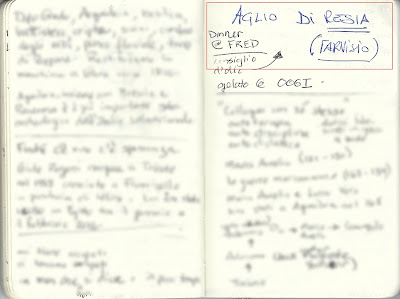
A sample of Italian writing, stampatello.

Sample 2 
Who: Older woman
Where: Bergamo
Context: One morning, in our local café, Bar Papavero, I was talking with a friend whose family is from Basilicata and she was listing places to see there including: Craco, Tricarico, Venosa, and La Certosa di Padula.
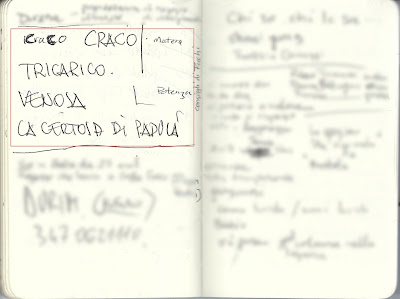
A sample of Italian writing, stampatello.

Sample 3
Who: Middle-aged woman
Where: Outskirts of Bergamo
Context: After lunch one day at Trattoria all'Alpino (great walk from Bergamo, see here), we were talking to the owners and told them that we would be going to Friuli-Venezia Giulia in a few days. They wrote down a few suggestions that might be of interest to us. They were: Maniago – a city known for its production of steel blades, Vajont – location of the disaster that killed over 1,900 people in 1963, and the Sequals, the home town of the Italian boxer Primo Carnera.
A sample of Italian writing, stampatello.

Sample 4 (two samples)
Who: Middle-aged woman and a female teenager
Where: Bergamo
Context: In Bar Papavero, I first asked Eleonora for her telephone number, which she wrote down. Next, I asked the granddaughter of one of the café regulars to write down a saying we were talking about. That saying is: prendi l'arte e mettila da parte – basically meaning, learn what you can, because you'll never know when you'll need it.
A sample of Italian writing, stampatello.

Sample 5
Who: Middle-aged man
Where: Cuneo
Context: Talking with one of our "cousins" we got a suggestion on something to visit while staying in Piedmont. He wrote: Ormea / Alto / Caprauna / [undecipherable] / Cantarana / Upega / Ponte di Nava – all towns in the Cuneo Province of Piedmont, close to the French border.
A sample of Italian writing, stampatello.

Sample 6 (two samples)
Who: Two different middle-aged women
Where: Bergamo
Context: One sample is during a discussion at Café Bar Papavero when I was talking with a woman about the Italian writer, translator, and journalist Fernanda Pivano. The second sample is from a woman who was on a guided tour of Bergamo's iconic Roccolo di Castagneta (Tavernella).

A roccolo is basically a big bird trap. For more information on roccoli, see A Walk from Albino to Bergamo via Monte Misma. During the visit of the Roccolo di Castagneta, the guide described wooden instruments that were thrown to simulate a bird of prey so that smaller birds would be frightened and hopefully fly into a waiting net. The device is called a spauracchio in Italian. The woman I asked thoughtfully wrote it in Bergamasco dialect as well – sboradur – always in capital letters.
A sample of Italian writing, stampatello.


Many other samples
Who: Various
Where: Bergamo
Context: See the series on Street Sign Language Lessons, for example, Bergamo – Coronavirus – Street Sign Language Lesson XXXI. Many of the signs are in all caps, from friendly to not-so friendly signs.

This Italian expert in the study of handwriting and criminology discusses some ideas about why Italians use stampatello. The author suggests wide-ranging reasons including hiding one's tender side (cursive being more vulnerable?), avoiding being judged by other (bad writing?), looking for independence and asserting oneself (by adopting what everyone else does?), or just wanting to be legible (and sort of a conformist?).

These may be all valid reasons, but we add two other possible reasons. The first is that Italy, a country with many dialects and languages, still struggles to achieve unification in the sense that other European countries have and maybe stampatello is one small way of being unified. It was Massimo D'Azeglio who said of the unification of Italy in 1861: "Fatta l'Italia, bisogna fare gli italiani", meaning "Italy is done, the Italians need to be made".  He was referring to the separate cultures, traditions, and languages (dialects) between the newly united regions.

The second reason for stampatello use is that the Italian alphabet derives from the Latin alphabet and the latter started out as roman square capitals. Many roman inscriptions with square capitals adorn buildings and monuments evoking authority. Could it be that Italian's use of capital letters derives from this history?

Thursday, October 26, 2017

A Hike from Clanezzo to Monte Ubione and Back

GPS tracks for round-trip hike from Clanezzo to Monte Ubione and backView from Monte Ubione, northwest into Valle Imagna on a hazy day.
Left: GPS tracks for round-trip hike from Clanezzo to Monte Ubione and back. Right: View from Monte Ubione looking northwest into Valle Imagna on a hazy day.

Overview


Length: 11 km (6.8 mi)
Duration: 3.3 hours, includes 10-minute break on Monte Ubione
Elevation: 258 m (846 ft) @ suspended bridge over the Brembo River , 895 m (2,936 ft) @ Monte Ubione. Total elevation gain of 772 m (2,533 ft).
Location: Italy, Province of Bergamo, Clanezzo

The Hike


To reach the starting and ending point of this hike, take any bus heading to Valle Brembana (B lines, usually signed as San Pellegrino Terme, Zogno, or Piazza Brembana) and get off at the last stop before the bus enters the valley. The stop is here. Warning: it's a bus stop on a busy, ugly road. Fortunately, you only have to walk about 100 m on said road.

Overall, I wouldn't call this the prettiest hike we done or the most serene. First, the woods you pass through are very "disturbed" and not all that pretty. Disturbed here means lots of ivy and weed trees. Second, the sound from the traffic in the valleys (both Brembana and Imagna at one point) is always present. These valleys are like that, limited access and busy roads during the day.

Negative aspects aside, it's a nice little hike for a number of reasons. First, you'll work up a sweat getting up to Monte Ubione. A chance for exercise is always welcome, right? As well, once on top of Ubione, it's a pretty view on a clear day. We had lots of haze (foschia) today so it was a little surreal looking.

The most interesting aspect of this hike though is that it passes by three different historic bridges. Below Clanezzo you find two of them. One is a suspended bridge across the Brembo River dating from 1878. Its called La Passarella or Ponte sospeso, is 74 m long, and dances about as you walk over it. The second bridge, nearby, is an old stone dating from the 10th century that crosses over the Imagna River. This bridge is called the Ponte di Attone and is about 25 meters.

At one time, these two bridges were the only convenient means to get to Bergamo from the Val Brembilla situated north of Clanezzo. Where there is a need, there is someone there to profit from it. At one end of the stone bridge there was a customs point for the Republic of Venice as these bridges were once the border between the Republic of Venice and their rivals the Visconti (Milan).

The Imagna River merges with the Brembo River below Clanezzo, both rivers draining their respective valleys. In fact, Monte Ubione and this hike (Sentiero 571) follows the watershed divide (spartiacque) between the two valleys. Before reaching Monte Ubione, you'll wander on a huge empty reservoir (serbatoio) half-carved in the mountain that was at one time used to store water for hydro-electricity.

After visiting the two bridges, we start climbing toward Monte Ubione, always following indications for Sentiero 571. At Monte Ubione, we rested for a bit and then continued more or less north until we hit the intersection with Sentiero 584, which took us down toward Strozza.

It's at Strozza, that you find the third interesting bridge of this hike, the Ponte del Chitò, built in 1897 and named after the engineer who designed. It's a bridge-canale that at one time brought water from the Imagna River to Clanezzo. Today, there is a modern steel passageway on top of the aqueduct that allows passage across.

From the Ponte del Chitò back to Clanezzo, there is an old canal running more or less level. On top of the canale is a walking-cycling path that we took back to the start of this hike.

Ponte del Chito - Entrance from Strozza side of Imagna River.Ponte del Chito - Cutout for taking photos from the midpoint of the bridge.Ponte del Chito - Modern walkway atop 1897 stone structure.
Views of and from Ponte del Chitò, a bridge-canal near Strozza, Italy. Left: Entrance from Strozza side of Imagna River. Center: Cutout for taking photos from the midpoint of the bridge. Right: Modern walkway atop 1897 stone structure.

View of Ponte del Chitò with flanks of Monte Ubione in the background.Sign describing walking and biking routes of Valle Imagna.
Left: View of Ponte del Chitò with flanks of Monte Ubione in the background. Right: Sign describing walking and biking routes of Valle Imagna. Today's hike is described on the sign.

Suspended bridge over the Brembo River, below Clanezzo. The bridge is just over 74 meters long.Suspended bridge over the Brembo River, below Clanezzo. The bridge is just over 74 meters long.
Suspended bridge over the Brembo River, below Clanezzo. The bridge is just over 74 meters long.

The stone bridge of Clanezzo (Ponte di Attone), at one time a point for collecting customs. The bridge allows passage over the Imagna River. In the background, the Brembo River.The stone bridge of Clanezzo (Ponte di Attone), at one time a point for collecting customs. The bridge allows passage over the Imagna River. In the background, the Brembo River.
The stone bridge of Clanezzo (Ponte di Attone), at one time a point for collecting customs. The bridge allows passage over the Imagna River. In the background, the Brembo River.

The old canal turned walkway near Clanezzo.A roccolo that Sentiero 584 passes through.
Left: The old canal turned walkway near Clanezzo. Right: A roccolo that Sentiero 584 passes through.

Start and end of the hike near state route 470.View of the Brembo River looking toward Bergamo. A sign describing another route on Monte Ubione called the Sentiero della Libertà.
Left: Start and end of the hike near state route 470.  Center: View of the Brembo River looking toward Bergamo. Right: A sign describing another route on Monte Ubione called the Sentiero della Libertà.