Saturday, May 10, 2014

The Spider Dance and the Spiderlings

October 2013: A male Araneus diadematus does the mating dance with a female.


We’ve talked about Araneus diadematus (European Garden Spider or Cross Orb-Weaver spider) before in Garden Orb Weaver Spider and One Plump Spider. Well it’s spring here in Seattle and it seems the little cluster balls of baby Cross Orb-Weavers are everywhere. I suspect these babies - recently hatched - come from an egg sac that was created in the autumn and has over-wintered for several months. Mom is long gone, and so is dad, possibly eaten by mom. However, these kids have no time for counseling to get over a traumatic family situation because they probably have less than a year to survive and need to hop to it. And indeed, a day after the spider ball picture here broke up, the little baby spiders set up shop (aka webs) nearby.
 
October 2013: A male Araneus diadematus does the mating dance with a female.

May 2014: What comes after the mating dance: a ball of spiderlings. These spiderlings were found nearby to where the dance took place.

Monday, May 5, 2014

Oasis Date Gardens

Left: Date Shake at Oasis Date Gardens; Right: Entry to Oasis Date Gardens with Date Palms
Date Shake at Oasis Date GardensEntry to Oasis Date Gardens with Date Palms

We finally got a chance to stop at Oasis Date Garden instead of speeding by as we usually do. (My date crown wouldn't be complete without a med-jewel from here.) It isn’t quite the production as Shields or Hadleys (see Date Shake: Shields v. Hadley), but we thought the date shake to be quite good. Maybe it is because we split ONE between several of us! Alas, you can’t go back and stroll among the trees. When I think garden, I think up and close with plants. (For a close up of date trees see Binomen Art – Phoenix.)

Left: Oasis Date Gardens Sign; Right: A Peak into the Date Grove
Oasis Date GardensA Peak into the Date Grove

Oasis Date Farms Brochure
Oasis Date Farms BrochureOasis Date Farms Brochure

Oasis Date Gardens Story
Oasis Date Gardens StoryOasis Date Gardens Story

Sunday, May 4, 2014

A Sample of Seattle Spring Flowers in Our Yard


Left: Five Small Vases of Spring Flowers; Right: Closeup of Borago, Corydalis, Heuchera, and Convallaria
Five Small Vases of Spring Flowers Closeup of Borago, Corydalis, Heuchera, and Convallaria
It amazes us how many different types of flowers are in our postage stamp-sized yard, here in Seattle. In the list below, we leave out lavender, iris and many more. Many of the plants in the list have been in the yard long before we purchased the property. Links to pronunciation are given for family names.

[Asaparagaceae pron] Convallaria majalis - Lily of the Valley
This plant (like Coral Bells below) has been in our yard for at least 20 years, if not much longer. It hasn’t been prolific, but seems to carry on, year to year, and treat us to a few spikes of white, delicate sweet-smelling flowers.

[Asaparagaceae] Hyacinthoides hispanica – Spanish Bluebells
As pretty as these are, they are quite invasive. We seem to rip them up (bulbs and all) and there never is a shortage of them! Bluebells were here long before we bought the house and will be here long after we are gone!

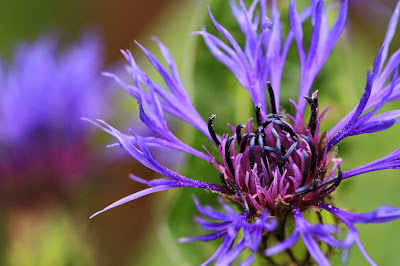
[Asteraceae pron] Centaurea montana – Perennial Cornflower, Bachelor’s Button
Here’s another plant that we are not sure of its origin. C. montana has claimed a two by two square foot of our front yard, and that is fine by us. It will look lush for a few weeks, die out, and then return in the fall.

[Asteraceae] Leucanthemum vulgare – Ox-Eye Daisy
The white rays and yellow discs are pleasing to look at, but the smell of these flowers is not something that will want to make you cut them and bring them in the house often. As you can see here, we cut them early, hence no smell. This plant is another plant that came along with the house, oh so many years ago.

[Berberidaceae] Epimedium x versicolor 'Sulphureum' – Bicolor Epimedium, Bishop’s Hat
Finally, a plant we actually introduced into the yard! And a nice plant it is. We just have to remember to cut the old leaves off mid-Winter to be able to enjoy the delicate yellow flowers, which look like a bishop’s hat.

[Boraginaceae pron] Borago officinalis – Borage
Borage claims the areas in our yard where we don’t go that often, and we are okay with that, because in the deal we get pretty blue flowers which are edible and perfect in a salad or on top of a dessert.

[Cyperaceae pron] Carex pendula – Weeping Green Sedge
This sedge is quite hardy. It spreads easily and we remove many starts of it each year. A couple of catkin-like flower spikes from this sedge are pictured here.

[Cyperaceae] Carex morrowii
A couple of flower spikes from this sedge are in the arrangements.

[Juncaceae pron] Luzula nivea – Snowy Woodrush
In places where it’s hard to keep plants growing (like our median strip), this plant is quite happy to take over.

[Lamiaceae pron] Ajuga reptans – Bugle
We introduced this plant as ground cover many years ago and it did dismally. Later, after major landscaping and much moving around of dirt, it resurfaced on its own and found its niche in a couple of unobtrusive locations.

[Papaveraceae pron] Corydalis lutea – Yellow Corydalis
At one time, we planted this in one location in our yard, but now it has found its niche elsewhere, favoring cool, shady areas. The lacy leaves and little clusters of yellow flowers last a few months before the summer hits.

[Papaveraceae] Dicentra formosa – Western Bleeding Heart
We never planted Bleeding Heart, but its lacey foliage and delicate flowers show up faithfully on the margins of the yard. The generic name dicentra comes from the Greek dís "twice", kéntron "spur" referring to the shape of the flowers, which also look like little pink hearts.

[Saxifragaceae pron] Heuchera – Coral Bells
This plant has been in our yard for at least 20 years, if not much longer. Another, pre-Travelmarx yard plant. Its coral-colored flowers are a beautiful sight.

Left: Flowers in the Sample; Right: Flowers Annotated
Flowers in the SampleFlowers in the Sample Annotated

Five Vases of Spring Flowers
Five Vases of Spring FlowersFive Vases of Spring Flowers

Centaurea montana
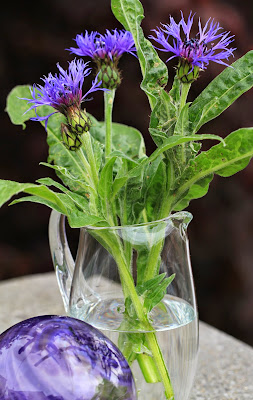
Centaurea montanaCentaurea montana flower

Kahler Vase and Geranium

Kahler Vase and GeraniumKahler Vase and GeraniumKahler Vase and Geranium
In this POTS and PLANTS episode, we pair Kähler Keramik vase and two geraniums. See the Kähler and Colchicum post for background about Kähler pottery. This vase is just under five inches tall. It has a beautiful blue glaze that has a spiral pattern on it.

I would like to say that the whiter geranium is Geranium macrorrhizum 'White Ness' and the pinker geranium is Geranium x cantabrigiense - 'Biokovo', but I would probably be wrong. I know we have these two cultivars for sure, but truth be told, our geraniums are so mixed up in our yard. They propagate quite easily and I fear that the pink flowered plants were ones I gathered up and planted to fill in an empty patch of ground. And given that cultivars are not necessarily true to their parents, who knows what we have. Sigh.

Imperial Valley Jaunt: Plants

Date Palms (Phoenix dactylifera)
Left: Thinned out inflorescence, notice spacing of green dates. Right: Inflorescence not yet thinned?
Thinned out inflorescence, notice spacing of green daInflorescence not yet thinned

On this trip to the “valley”, we observed these plants:

[Aizoaceae] Sesuvium verrucosum - Western Sea-Purslane
From the Wikipedia entry: “It grows in many types of saline and alkaline habitat types on the coast and inland, including salt marshes and other saline wetlands, alkali flats, and drying desert washes.” Surprise!

[Amaranthaceae] Atriplex lentiformis - Quailbrush / Saltbrush
Plants in the genus Atriplex go by the common name of saltbush because many plants in the genus are halophytes, that is, plant adapted to growing in waters with high salinity. The ground where we observed most of these plants (Upper Imperial Valley) is quite alkaline.

[Amaranthaceae] Kali tragus - Prickly Russian Thistle,
Many plants may become tumbleweed, but this introduced plant in the Amaranth family is the most common.

[Arecaceae] Phoenix dcatylifera – Date Palm
Our fascination with the Data Palm continues (see Binomen Art – Phoenix) and we were able to examine some trees up close after workers had gone through and thinned dates. Date Palms are marginal halophiles.

[Fabaceae] Pithecellobium dulce – Guamuchil
We saw this tree while dining at the Garden Café in Yuma. This pea family tree produces pods that are a delicacy for those in the know. We only observed a couple of unripe pods, but still an impressive tree.

[Polygonaceae] Eriogonum deflexum - Wild Buckwheat, Skeletonweed
This plant is quite common. We happened to snap a photo of this one at the Museum of History in Granite in Felicity, California (in Imperial County). The plant looked very lonely amongst all the red granite panels.

[Lythraceae] Punica granatum – Pomegranate
A lonely P. granatum growing next to an abandoned satellite dish.

Left and Right: Atriplex lentiformis
Atriplex lentiformisAtriplex lentiformis

Left: Trying to botanize in 50 mph gusts of dirt and sand! Right: One of many solar fields. This one doesn’t have panels yet.
Trying to botanize in a 50 mph gusts of dirt and sand One of many solar fields. This one doesn’t have panels yet.

Left: My lovely assistant launches a tumbleweed. Right: And then tries to outrun it.

Left: Tumbleweed (Kali tragus) in a check. Right: Pomegranate (Punica granatum) and satellite dish.
Tumbleweed (Kali tragus) in a checkPomegranate and satellite dish

Date Palms (Phoenix dactylifera): Method of tying inflorescence to branches.Date Palms (Phoenix dactylifera): Method of tying inflorescence to branchesDate Palms (Phoenix dactylifera): Method of tying inflorescence to branches

Guacmuchil (Pithecellobium dulce) pods and tree
Guacmuchil (Pithecellobium dulce) pods and treeGuacmuchil (Pithecellobium dulce) pods and tree

Left: Guacmuchil (Pithecellobium dulce) flowers. Right: Eriogonum deflexum.
Guacmuchil (Pithecellobium dulce) flowersEriogonum deflexum

Sesuvium verrucosum: Plants, leaves, and flower.
Sesuvium verrucosumSesuvium verrucosumSesuvium verrucosumSesuvium verrucosum

Imperial Valley Jaunt: Food, Gophers, and Guns

Left: Egg Sandwich at Johnny’s; Right: Special Quesadilla at Dora’s
Egg Sandwich at Johnny’sSpecial Quesadilla at Dora’s
On this trip to the “valley”:

  • Dining: Johnny’s for an egg sandwich and Dora’s for a special quesadilla.
  • Activities: Target practice, pocket gopher (Thomomys species) management, and a bit of botanizing (see Imperial Valley Jaunt: Plants).

Left: Target Practice; Right: A Pocket Gopher “Managed” – Note Pocket for Carrying Food and Nesting Material
Target PracticeA Pocket Gopher “Managed” – Note Pocket for Carrying Food and Nesting Material

Thursday, May 1, 2014

Loveseat and Fire Hydrant

Loveseat and Fire HydrantLoveseat and Fire Hydrant
On the way back from the gym this morning, we spied this loveseat casually positioned next to a yellow fire hydrant. The end of the month brings people moving in and out, and is a good time for indoor/outdoor furniture-spotting. This loveseat was spared an ignoble life on the street: it was gone by the afternoon.