Today we visited Il Battistero, or the baptistery, which is the oldest building on the Duomo complex. It is also called the Baptistery of St. John. Baptisteries can be part of the main church or a separate building as in this case. These spaces or structures reflect the importance of - you guessed it - baptism to Christians. (For the record we have yet to see one being used.) This baptistery is particularly famous for its three sets of bronze doors and its mosaic ceiling. Here is more information than you might possibly want on these items. It’s no accident that the inside of this building “feels” like the Pantheon in Rome.
Wednesday, January 9, 2008
Il Battistero
Today we visited Il Battistero, or the baptistery, which is the oldest building on the Duomo complex. It is also called the Baptistery of St. John. Baptisteries can be part of the main church or a separate building as in this case. These spaces or structures reflect the importance of - you guessed it - baptism to Christians. (For the record we have yet to see one being used.) This baptistery is particularly famous for its three sets of bronze doors and its mosaic ceiling. Here is more information than you might possibly want on these items. It’s no accident that the inside of this building “feels” like the Pantheon in Rome.
La Cavalcata Dei Magi
In Florence, “La Cavalcata dei Magi” or, the Three Wise Men Procession, happens on Epiphany, Jan 6th. It commemorates the Three Wise Men’s visit to Jesus. The procession starts at 2:00pm from Piazza de’ Pitti and ends up on the Piazza del Duomo. This year’s procession was a bit of a challenge due to a drizzly day. We waited in front of the Pitti as the procession started, but suddenly, half of the procession made a mad dash for waiting buses to get ferried over to the Duomo. With the costumes as elaborate as we saw, keeping them dry was probably a good idea. The other half of the procession braved the weather and walked. (Our patience with the whole affair was well compensated for by a very entertaining pair of English ladies. They would not have been out of place in a French & Saunders skit.)
After observing the somewhat uneven procession start, we dropped some groceries off at home then headed for the Duomo. The whole procession ends up inside the Duomo where they ultimately march by Mary and Joseph and the baby Jesus. But not before a round of Christmas carols (at least this year) like “White Christmas”, “Happy Xmas (War is Over)” (By John Lennon), and the rousing gospel “Oh Happy Day” – by a choir of school girls. Interesting. If you want a “front row" seat (everyone stands) then you might want to enter the Duomo before the procession does. Folks did make way for smaller children and their mom's who all sat up front where the action was.
Monday, January 7, 2008
Orsi e Sciamani

This was a free exhibit put on by the Museo di Storia Naturale of the University of Florence. The exhibit highlights the relationship between bears (“orsi”) and shamans (“sciamani”). In particular, the exhibit focused on the Ainu people of Japan and the Laplanders of Northern Europe. The contributions of several key Florentine scientists are highlighted including Fosco Maraini (1912-2004), Arnold Henry Savage Lander (1865-1924), and Stephen Sommier (1848-1922). The exhibit ends on the 29th of February, 2008.
Sunday, January 6, 2008
Opera della Metropolitana
A combined ticket of 10 Euro gets you into the Opera della Metropolitana family of sites in Siena. The ticket is worth it and includes:
- Duomo (which includes the incredible Libreria Piccolomini)
- Museo dell’Opera
- Cripta (“crypt”)
- Battistero (“bapistry”)
While wandering around the Duomo, don’t miss the Piccolomini library. The library is named after the Sienese Enea Silvio Piccolomini (1405-1464) who became Pope Pius II. The frescoes here are incredible, both in composition and brilliancy of color. Another thing to pay attention to in the Duomo is the floor. The marble work and mosaics in the floor are incredible. According to the wikipedia page on the Duomo, parts of the floor are always covered (I guess to protect it) and the whole floor is uncovered only for a short period of time during the year. (On the day we visited, the parts of the floor which were covered were mostly near the crèche scene where there would be a lot of foot traffic.)
The Museo dell’Opera holds many items related to the Duomo such as original statues, the stained glassed window from the main façade, paintings, textiles, and reliquaries. No, it isn’t a museum about opera as I read in one traveler’s review on virtualtourist dot com. (Jeez) Opera is “work” as in architectural or art work. Almost everyone who visits the Museo dell’Opera heads straight for the “Facciatone” – the big façade which you can climb for a nice view of the town. The Facciatone was supposed to be the façade for a huge extension of the church which was never completed. It doesn’t get you as high as the Torre del Mangia, but it is a bit more appealing view-wise.
The Cripta is the original church (pre 1200) which the current structure was built on. It was backfilled with rubble when the current church was built. Only recently did they excavate it and open it up for viewing.
The Battistero was probably the least interesting piece (for us) but it completes the tour.
Torre del Mangia e Museo Civico
We took the train to Siena today. We had both forgotten what a nice feel this town has, especially in contrast to Florence which doesn't have quite the same intimacy.
Of course being the frustrated, earth-bound creatures we are, we sought out the high spot: the tower. A combined ticket of 6 Euros each got us into the tower (Torre del Mangia) and the civic museum. The tower of course is fun to climb if you don’t mind heights. At the top you are rewarded with great views of the town and the country-side. There are a number of narrow steps and it can feel claustrophobic as you climb so beware.
The civic museum is part of the town hall (Palazzo Pubblico). We even caught a wedding party coming in for a ceremony. (Odd, the bridesmaids sang a song to the tune of “For He’s a Jolly Good Fellow” but with the lyric “Lei è brava ragazza….”? – she is a good girl.) The civic museum is notable for the frescoes its various rooms. The frescoes are unusual because they depict secular subjects rather than religious subjects. Some in particular that stood out was the Risorgimento frescoes.
Orsanmichele
Orsanmichele means the “kitchen garden of St. Michael” and after the garden many different things occupied the spot. Today is rather noticeable (at least to my eye) for its very square and fortress-like look.
Friday, January 4, 2008
La Specola – Part II

We went back to the Museo di Storia Naturale Zoologia ‘La Specola’ and picked up where we left off last time. In the previous post I was a bit negative about the lady who shooshed us out of the museum. Well this time she was there again and when we walked in we said “ritorniamo” – we’ve returned – with a devilish smile. She smiled and let us in for free!
We continued from room 14 onwards and to be truthful, still didn’t finish. (We only saw half of the wax models.) The real stars this time were the birds. Incredible displays of birds – almost too much to take in. The picture above is from room 19, the “Grandi Ucelli” – big birds. It’s incredible to think that the diversity displayed in this museum is just a sliver of a sliver.
What we did see of the wax models was also interesting if not a little tough to get into. These models were important for teaching medicine in the 17th century in Florence. From wikipedia, the “collection is very famous worldwide for the incredible accuracy and realism of the details, copied from real corpses.”
Wednesday, January 2, 2008
Florence New Year’s Eve
I’m sure all our audience is dying to know what New Year’s Eve was like here in Florence. Right? First of all, the dinner on the 31st is typically called the “cenone” – literally, big dinner. New Year’s Eve is called “La Festa di San Silvestro” – which as far as we can tell is named in honor of Papa Silvestro I – elected on the 31st of December in 314? January 1st is called “Capodanno” – literally, head of the year: “capo d’anno”.
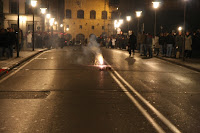
In Florence, many Piazzas put on some form of free public entertainment. ( Of course there are places you can pay to sit and have a nice dinner and entertainment as well.) It seems like folks just wander around the streets going between the different venues. We passed by Santo Spirito around 11:15pm and there was a small crowd and live band. Then we wandered over to Santa Croce where there was a symphony. The symphony was up against the steps of the church and the crowd (standing) was pretty thick. However, the rest of the piazza was full of people (though as if by magic, the center of the piazza was left vacant for people to toss their fireworks into).
To tell the truth, the amount of fireworks being tossed around and their intensity were a bit unnerving. That said, the streets were full of people young and old – the whole town was out – so it wasn’t like it was dangerous, just that we weren’t use to it. We ended up staking a section of rail on the Ponte alla Grazie bridge (one bridge east of Ponte Vecchio) and ringing in the new year there. From that point we could see fireworks from Piazza Michelangelo in the hills and other fireworks around the river. We weren’t alone, many people hung out along the river banks, especially near the Uffizi. There was no specific, city organized fireworks show. There didn’t need to be as folks seemed to have their own arsenals.
When midnight came, corks were popped and champagne was flying (literally) everywhere. After it was all said and done, the streets were a mess with spent fireworks, champagne bottles, and other party things. The culture here seems to be to leave trash as is because it will be picked up. And sure enough, by the next day it was mostly all cleaned up – that’s the way things work around here. It’s a concept we have a hard time with.
Subscribe to:
Posts (Atom)