Friday, December 7, 2012

Flora Resources for Iceland

Flowering Plants and Ferns of Iceland by Hörður Kristinsson (back and front)
Flowering Plants and Ferns of Iceland by Hörður Kristinsson - backFlowering Plants and Ferns of Iceland by Hörður Kristinsson - front

We picked up both of these two flora resources at the Gullfoss Visitor center (after a delicious bowl of lamb soup). One is a book and one is a map.

The first resource is the book Flowering Plants and Ferns of Iceland by Hörður Kristinsson. The book uses a color key system where plants are divided into eight color groups. You choose a group by noting the color of the flower of the plant and then leaf (!) through the group to find an exact match. Several groups (white, yellow and other colors) are further subdivided according the size and shape of their flowers. The author acknowledges that the key is designed to have the most benefit to non-plant experts. The only problem is that in winter it was hard to determine the flower color!

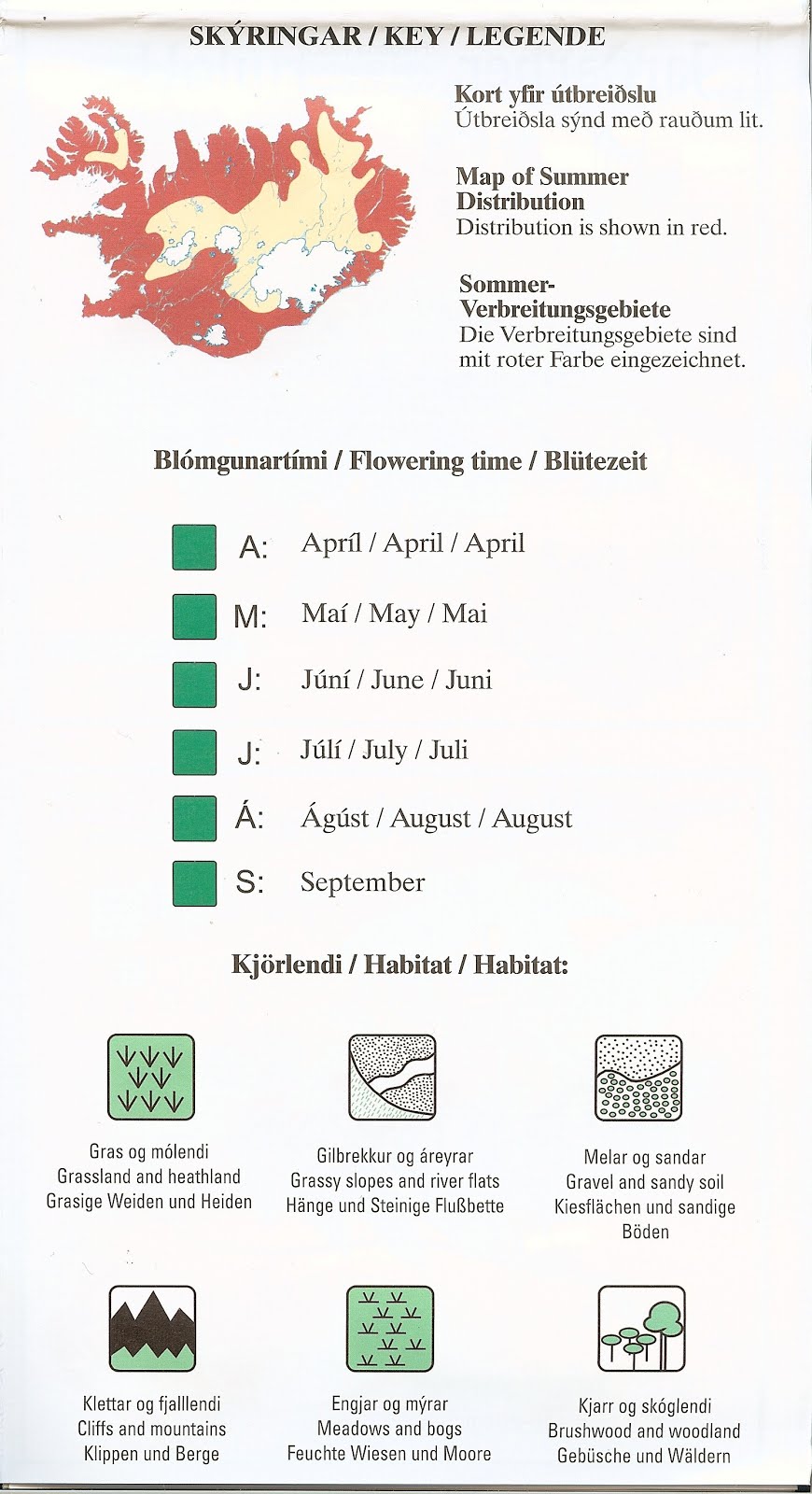
The second resource is a Botanical Map is a map that shows 78 flowering plants, their distribution, and names in three languages. The map folds out like a road map, but it’s not what you expect as one big map of the country. Rather it contains a 6 by 8 grid on one side and a 6 x 5 grid on the other where each square in the grid contains information about one plant including a color drawing, the binomial name, the common name in Icelandic, English, and German, the flowering month, habitat, and distribution of the plant.

Unfortunately, we did not get a chance to really exercise either of these resources given that all plants were out of bloom and we had such a limited time to spend hunting for plants. (When there is so little light at this time of the year, we were more interested in getting from site to site and not spending much time hunting for plants.) Given these limitations, it was surprising how many plants we did see and were able to identify.

Update: We went back in 2015 and were able to "exercise" these resources. Please see Selected Plants from Our Iceland Trip.

Both of these plant resources can be purchased on Shop Icelandic last time we checked so you don’t even have to go Iceland to get them!

Some other resources we used to help us prepare this post include:
Speaking of plants, the glow of a greenhouse (usually growing cucumbers or tomatoes were told) is a site we saw a few times. Something like 80% of Iceland’s energy is geothermal and it makes sense to heat and light the greenhouses to keep the vegetables happy in winter.
 
Iceland Botanical Map
Iceland Botanical Map Iceland Botanical Map
  
Iceland Botanical Map Sample Map Section for Dwarf Birch (Betula nana).
Iceland Botanical Map Sample Map Section for Dwarf Birch (Betula nana)Iceland Botanical Map Sample Map Section for Dwarf Birch (Betula nana)

Greenhouse in Reykholt, Iceland Growing Cucumbers


Woolly Fringe Moss (Racomitrium lanuginosum) with Crowberry (Empetrum nigrum) in Kerið Volcano Crater


Alpine Lady’s Mantle (Alchemilla alpina) – likely - in Kerið Volcano Crater
 

Wild Thyme (Thymus praecox subsp. articus) in Kerið Volcano CraterWild Thyme (Thymus praecox subsp. articus) in Kerið Volcano Crater

Layers in Þingvellir (Thingvellir Park): sod on a wall, Tea-Leaved Willow (Salix pylicifolia) in orange browns, and Woolly Fringe Moss in the background.


Thursday, December 6, 2012

A Few Reykjavík Murals


We simply didn’t have enough time to capture that much street art around Reykjavik being there only two days. Here are a few images we captured around the main shopping street Laugavegur (northwest end of Reykjavik). Most of the these photos were taken in a space between Hverfisgata and Laugavegur between Smiðjustígur and Klapparstígur. From what we can tell, this is just scratching the surface of all the hidden murals and artwork. An article from the Grapevine gives some context to the murals: these are waiting areas “that have been sidelined in the planning process, and handed over to artists and cultural players to create dynamic temporary works and ignite debate about the future of the cityscape. It is the latest of the many ‘meanwhile projects’ that can be seen across town, commissioned by the City of Reykjavík to stimulate otherwise neglected spaces.”


Wednesday, December 5, 2012

Too Many Maps - Iceland Case Study

Do you have this problem? You are touring a new area (country, city, etc.) and you come home with a pile of paperwork. You can’t seem to get rid of it before going home. It might contain valuable information, right? Or so you tell yourself and so you end up with a pile of slips of paper, museum guides, business cards, and maps, especially maps. We were in Iceland for 5 days recently and it seemed like every time we asked someone a question, that person whipped out a map and made an “X” on it and handed it to us before I could say, “but we already have a map”. And so timidness and being slow-to-the-draw resulted in a pile of maps - all of various usefulness. We have a big plastic bin at home that contains maps of places we’ve been. We hardly open that bin when embarking on a trip to a location from which we’ve already collected maps. Sigh.

Each map we collected in Iceland has some particular bent behind it. There are dining maps, auto-rental maps, bus route maps, tour company promotional maps, regional promotional maps, and many more. We purchased the International Travel Maps map of Iceland before we left (www.itmb.com) but didn’t use it much.

For Reykjavík, we used the Big Map the most (www.bigmap.is). In the Golden Circle we used the excellent Uppsveitir Árnessýslu map (www.sveitir.is) and see below. 

Besides the physical maps, we had iPhone and Windows Phone mapping applications and a Garmin Nuvi 270. What we found is that a physical map was still the best used in conjunction with a phone mapping application for a sanity check to make sure you taking the right turns.

Big Map 2012-2013, Left: Inside, Right: Cover


Bus Route Map, Left: Side 1, Right: Side 2 Sponsored by the Saga Museum?


Various Other Iceland Maps

Iceland Excursions Map, Left: inside, Right: Cover

The Most Useful Map for the Golden Circle Area – Upper Árnessýslu Area. This map has all the sites you’ll typically see and a brief description of them.  
What’s On Map of Reykjavik, Left: Inside, Right: Cover


Tuesday, November 13, 2012

Binomen Art - Lantana


Lantana Spelled Out with Berries (left) and Floret and Berries (right)
LantanaLantana
We made me stop were the berries. I never saw Lantana with berries, green (unripe) and blue-black (ripe) berries. Time for a binomen-art project. I believe this is Lantana camara or Lantana montevidensis a plant in the Verbenaceae (Verbena) family. I guess Lantana is quite evasive, however, for this dusty front yard in Henderson Nevada it seemed so innocent and brought some much needed color. Looks can be deceiving.

I plucked a few of the berries (drupes) and arranged to them spell the generic name, Lantana. The generic name origin according to Quattrocchi is: related to the ancient name for viburnum and in spoken Latin it is called lentaginem, from lentus “pliant” (“lenta viburnum”). (I swear I heard someone say lentaginem on the bus the other day.)

The common name of L. camara is Spanish Flag or West Indian Lantana. Because L. camara emits a pungent odor (when you crush the leaves for example), a few local common names reference the smell. My favorite is the Filipino (Tagalog) utot-utot ‘fart’ [flower].

Lantana Spelled Out with Berries (left) and Floret and Berries (right)
LantanaLantana

Lantana Berries
Lantana Lantana

Monday, November 12, 2012

Binomen Art - Opuntia


Opuntia Spelled Out on an Opuntia Pad (left) and Many Pads (right)
OpuntiaOpuntia
Some go to Las Vegas for the gambling and partying. I go for the plants, grandma’s plants to be specific. In her yard, in Henderson with a view of the strip in the distance, I spend hours poking around. I’m always intrigued by plants that don’t grow where I live. Case in point, a very large prickly pear cactus (Opuntia). I found a pad on the ground, brought in the house, cleaned it up and thought about carving it. However, in the end just wrote on it and set it back outside.

The generic name, Opuntia, according to Quattrocchi is:

Latin herba Opuntia, from Opus, Opuntis “a town of Locris, in Greece,” Opuntius, a, um “Opuntin,” Greek Opous, Opountus; some suggest from the Papago Indian name opun.

An Opuntia Trunk (left) and Bark Forming That Looks Like a Circuit Board (right)
OpuntiaOpuntia

Opuntia Fruit – called tuna
OpuntiaOpuntia

The Opuntia Specimen (left) and Spot the Imposter (right)
Opuntia  Opuntia