Wednesday, September 14, 2011

LA Fitness Spin Sign Up Sheet


She really tried to approach it nicely, the spin instructor that is, as she asked who forgot to sign up for the 5:45am spin class at the LA Fitness in Ballard. It’s okay. It’s easy to forget or not know you need to sign up if you are new to the gym or really sleepy.

The situation was this: the class was full – all bikes taken – yet two people who had signed up didn’t have a bike. The instructor asks several times (with everyone’s attention) but eventually is forced to go bike to bike and check the person on the bike with a name on the list. And, lo and behold the last two riders she checks had not signed up. Why did these two folks wait until the instructor came to them and asked them to give up their bike? It is a question that bothered us well into the namastes of the subsequent yoga class.

Brush McCoy and Dry Late Summer Flowers

Three Brush McCoy Pots With Flower Arrangements
Onyx ware was a line of pottery produced by Brush-McCoy Pottery. The history of the company is a bit complex with all its name changes and mergers throughout the years. The company started in 1848 as “W.F McCoy” and the pieces shown here were probably created probably sometime in the 1920s (a guess…exact dates we’ll leave for the experts) when the company was called Brush-McCoy. At The McCoy Pottery Collectors’ Society, there is an article on the technique that gave the pots their “onyx” look. There was an earlier and later technique onyx technique. The earlier technique involved introducing additional glaze colors with a brush at intervals around the piece. This produces a stippled appearance which the vases shown here – to our eye – seem to have.

Green Brush McCoy Pot is flouting some English lavender.
The green pot contains Lavandula angustifolia, but, possibly a subspecies, we don’t know. Sloppy record keeping is to blame.

Brown Brush McCoy Urn (with two handles) is sporting Phlomis russeliana of Jerusalem Sage.
Dave's Garden says that this mint family (Lamicease) phlomis is named“[f]rom the Greek word for mullein, perhaps due to the similarity of the leaves.” And, well, ruseliana is named after someone called Russell. What a great smell these dried leaves and blossoms have.

This pot was a gift of Wild Dingo.

Blue Brush McCoy Pot is holding spent Butterfly-bush blossoms.
Butterfly-bush is quite common in Seattle. The best specimens seem to grow uninvited, along roadsides in the unlikeliest of places. This intentionally planted Butterfly-bush is Buddleja davidii ‘Back Knight’. It was named for Adam Buddle (1662 – 1715) and Father Armand David (1826 – 1900).

Brush McCoy Onyx Pots

An Outdoor Table Setting of Brush McCoy

Tuesday, September 13, 2011

Arum Italicum and Orient and Flume

Arum italicum in an Orient and Flume Vase
Orient and Flume Vase - Arum Italicum
When we purchased our house oh so many years ago, we didn’t realize how much Arum italicum was in the yard. Over the years, we’ve pulled up plants (making sure to get the bulbs) where we didn’t want italicum and generally allowed other areas of the yard to have clumps of it. Our neighbors don’t have any italicum in their yards so we are guessing that the movement of dirt around our yard has been the main spreading mechanism. Neighbors don’t exchange dirt typically – hence no italicum in our neighbor’s yard.

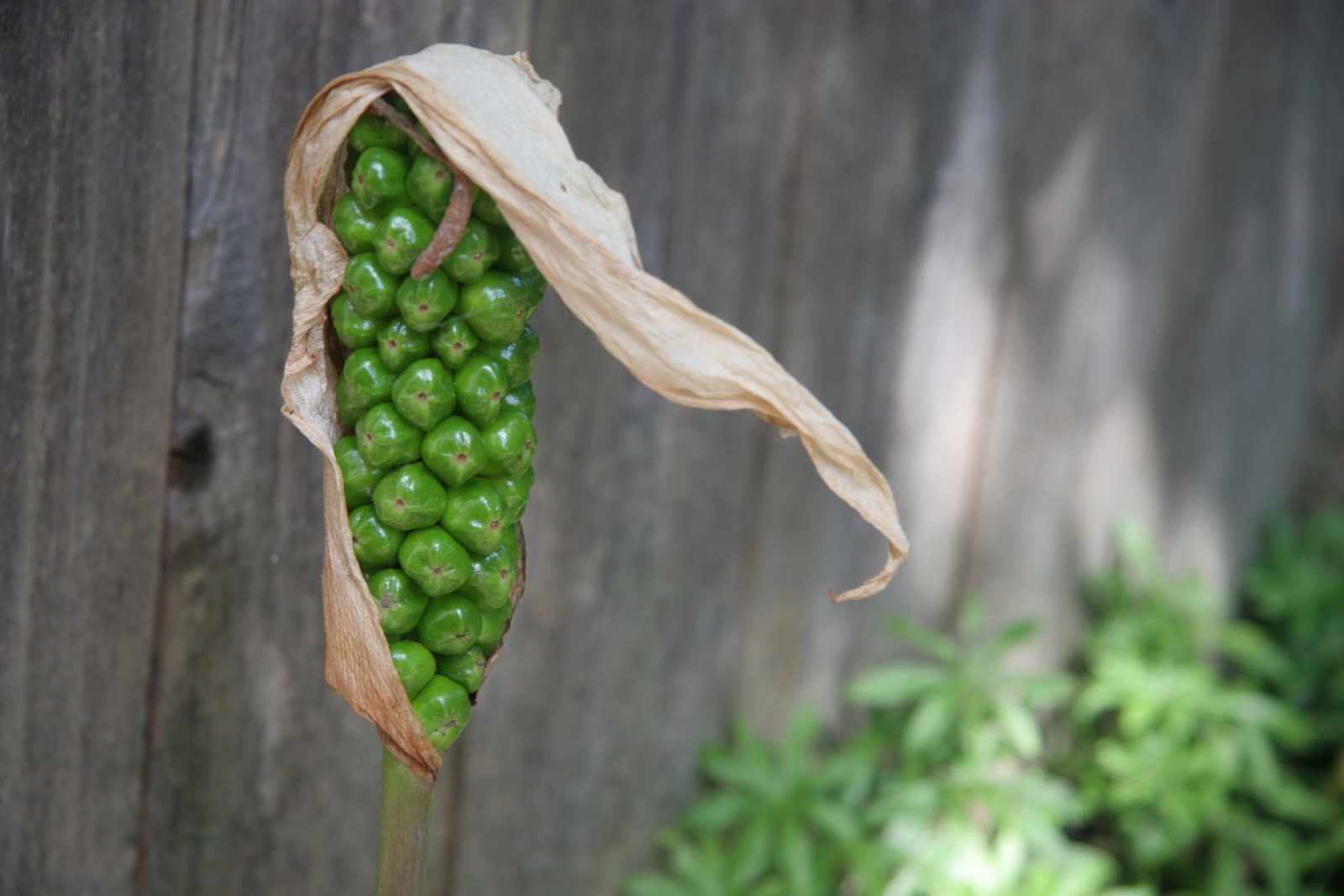
Right about this time at the end of summer, the spike inflorescences – called a spadix – and its dozens of bright orange berries are all that is left. The leaves have given up the ghost for the season. Italicum is part of the Arum (Araceae) family and is commonly called Cuckoo Pint and Italian Lords-and-Ladies. The genus name we are guessing refers to the fact that this plant grows quite well in Italy. The spadices are shown here in a late 1970s (?) Orient and Flume Tiffany-styled vase.

Ironically, we purchased this American-made vase in Venice of all places. The further Italian link to the italicum (and completely coincidental as well) is that behind the vase is a piece of the painting: Padre e figlio (1997) by Alessandro Gambetti, an Italian artist. We purchased this piece in Castellina in Chianti, oh some many years ago.

Arum italicum Leaves

Arum italicum Green Berries

Sunday, September 11, 2011

The Colour of My Dreams: The Surrealist Revolution in Art

The Colour of My Dreams: The Surrealist Revolution in Art - Brochure
Interviewer: “So why do you want to work at the Bureau of Surrealist Research?”
Interviewee: “I’ve always dreamed about working here.”

The existence of the Bureau of Surrealist Research was just one of the interesting tidbits we learned about at the The Colour of My Dreams: The Surrealist Revolution in Art at the Vancouver Art Gallery May 28, 2011 – October 2, 2011. (On the drive up from Seattle we came with the interviewer/interviewee joke.) The brochure features Claude Cahun (1894 – 1954) in Self portrait (as weight trainer) (1927). The other iconic imagery used as part of the promotion for the exhibition includes Edith Rimmington (1902 – 1986) The Oneiroscopist (1947) and Joan Miró (1893 - 1983) Ceci est la couleur de mes rêves (1925). Oneiroscopist means a specialist in looking at dreams – appropriate for the surrealists - and Miró’s piece, with the translated title this is the color of my dreams, is the source of exhibition title.

Edith Rimmington – Oneiroscopist (1947) and Joan Miro (1925) Ceci est la couleur de mes rêves
Edith Rimmington – Oneiroscopist (1947) Joan Miro (1925) Ceci est la couleur de mes rêves

So what is surrealism? Surrealism is a cultural movement (not an art movement or style) that began in the early 1920s and that the Manifesto of Surrealism (1924) describes as “[p]ure psychic automatism by which it is intended to express, either verbally or in writing, the true function of thought. Thought dictated in the absence of all control exerted by reason, and outside all aesthetic or moral preoccupations.” And, that “[s]urrealism is based on the belief in the superior reality of certain forms of association heretofore neglected, in the omnipotence of the dream, and in the disinterested play of thought. It leads to the permanent destruction of all other psychic mechanisms and to its substitution for them in the solution of the principal problems of life.” Automatism is spontaneous creation such as a drawing or writing with no conscious censorship. People, other movements, and events that came before surrealism like Freud, Dadaism, and World War I guided how the surrealist movement developed. It was a time of change and the surrealist motto was “Transform the World – Change Life”.

It is interesting to note that initially painting, as a surrealist activity, was emphasized very little in the manifesto; yet, it is painting that comes to mind most readily when talking about surrealism, especially the works of Dalí. Some early surrealists thought that the trouble with painting was that the expression (i.e. the mechanics) would get in the way of the automatic response so sought after as pure surrealism. The idea of letting automatism take hold and guide your creations is an intriguing one for those (like us) so used to executing a certain degree of control over our output – for work or pleasure.

A theme explored in the exhibition is the connection between First Nations art of the Pacific Northwest Coast and Alaska and surrealism. The surrealist artists Kurt Seligmann and Wolfgang Paalen visited the Northwest in in the late 1930s. Others like Andre Breton and Max Ernst purchased Northwest art. The surrealists were by accounts moved by the indigenous ceremonial art, drawn to the authentic nature of the work. However, as the essay Scavengers of Paradise by Colin Browne that appears in the exhibition guide points out: “…the surrealist relationship with the ceremonial objects of North America was complex, fluid and often naively idealistic. Many surrealist artists became collectors of primitive art but were unaware of the provenance or function of the objects they acquired …”.

The exhibit was broken into themed sections: Revolution by Night; The Colour of My Dreams; Behind the Screen; Spaces of the Unconscious; The Surrealist Object; Myths, Maps, Magic; The Lure of the Pacific Northwest; and Anatomies of Desire. On display there are several types of media: publications, photos, paintings, collage, sculpture, film, and objects. But, we confess it was really the paintings that grabbed us the most as can be deduced for the list of what we found interesting. Though, we do have a newfound appreciation of Man Ray (1890 - 1976); a number of his photographs and rayographs (really photograms) are included in the exhibition.

What we found interesting at the exhibition:

- Georgio di Chirico (1888 – 1978) was an important figure to the surrealists, a “haunting father”. The exhibit starts with de Chirico’s La cerveau de l’enfant or The Child’s Brain (1914). As a side note, it is interesting (for us) to see our reaction to di Chirico’s work in an exhibition in Palermo, La Metafisica continua. We did not like it.

Georgio di Chirico (1914) La cerveau de l’enfant or The Child’s Brain

- Pablo Picasso (1881 – 1873) seemed to flirt on the edges of surrealism.

- Kurt Seligmann (1900 – 1962): Seligmann’s The Four Temperaments (1946) or The Meeting of the Elements (1939) could have been easily at home on a Yes album cover. Roger Dean is the artist behind the Yes album covers. We wonder if he was influenced by Seligmann’s biomorphic forms.

- Joan Miró (1893 - 1983) Miró’s work Photo: ceci est la couleur de mes rêves. (1925) lends its name to the exhibition title. Such a simple and elegantly conceived work.

- Claude Cahun (1894 – 1954) was a woman. Not until after the exhibit did we realize he was a she.

- André Masson (1896 - 1987): Masson’s Meditation on an Oak Leaf (1942) is a crazy, contorted study. The information card describing the work said that Masson called it a “triumphant tellurism” style. Tellurism has to do with the hypothesis of animal magnetism put forth by Dr. Keiser. Masson’s The Metaphysical Wall (1940) was in the last room of the show and is a beautiful work.

- Wilhelm Freddie (1909 - 1995). Part of the Dutch surrealist movement, Freddie’s The Prayer (1940) is a stark, simple painting with a deflated figure praying at the very bottom of a dark purple canvas.

- Leonora Carrington (1917 – 2011). Carrington’s The House Opposite (1945) is a dreamlike scene not so different than the number of Renaissance domestic scenes we saw in Florence, just a little more surreal.

Leonora Carrington (1945) The House Opposite (detail left and right)

- Yves Tanguy (1900 – 1955). His work seems to have its own symbolic language, fragments of the symbols scattered here and there about eerie landscapes such as in The Doubter (1937) and Death Watching His Family (1927) – both in the exhibition.

- Exquisite corpse. Le cadavre – esquis – boira – le vin – nouveau or “the exquisite corpse will the drink the new wine.” is a method the surrealist used to create collaborative work. The works in this part of the exhibit were fascinating. Related methods included dessign collectif or collective drawing. An interesting example is the work Le jeu de’oie (1929) – The Game of Goose. The circular board game was created by André Breton, Suzanne Muzard, Jeannette Tanguy, Pierre Unik, Georges Saboul, and Yves Tanguy.

Le jeu de’oie (1929)

- Joseph Cornell (1903 – 1972) and his “poetic theatres” like The Crystal Cage (Portrait of Bernice) (1943 – 1960s). A fictional heroine Bernice, a young girl who performs ingenious scientific experiments inspired by the sights and sounds of the world.

- Hans Bellmer (1902 – 1975) and his arranged, life-sized, pubescent poupées (dolls) evoked a bit of wincing on our part and that fact alone made us wonder about the punch of his work.

- René Magritte (1989 - 1967) – L’Anniversaire (1959) or the rock in the room, from a distance is wonderfully deceiving.

Magritte (1959) L’Anniversaire
Le jeu de’oie (1929)

The Colour of My Dreams: The Surrealist Revolution in Art – Brochure
The Colour of My Dreams: The Surrealist Revolution in Art - Brochure

Thursday, September 8, 2011

Beauty and Bounty: American Art in an Age of Exploration

Albert Bierstadt: Puget Sound on the Pacific Coast (1870) [SAM collection]
Albert Bierstadt: Puget Sound on the Pacific Coast (1870)  

The exhibition Beauty & Bounty: American Art in an Age of Exploration is at the Seattle Art Museum (SAM) from June 30 – September 11. We popped in Thursday night to catch it before it closed and had a good time. A well-spoken and engaging docent led a 7:00 pm tour that was awesome.

The exhibition includes landscape paintings and photos from the last half of the 19th century and the beginning of the 20th century that focus on how American artists reacted to and recorded nature in the still relatively new country of America. Nature and in particular, the West were sources of wonder, solace, and opportunity. Even as the country struggled through the Civil War (1861 – 1865), artists kept exploring and depicting nature. Several of the artists were key figures in the westward expansion of the United States. Many were instrumental in the formation of natural parks such as the landscape painters Thomas Moran (1837 – 1926), Albert Bierstadt (1830 – 1902), Sanford Robinson Gifford (1823 – 1880), Federic Edwin Church (1826 – 1900), George Inness (1825 – 1894), and John Frederick Kensett (1816 – 1872) – of which you see works in the Beauty & Bounty. One artist that stood out for us was Martin Johnson Heade (1819- 1904) and his salt marsh landscapes of the East Coast. Heade seemed to stand apart from the other landscape painters in his approach and we couldn’t escape being reminded of Andrew Weyth ever so slightly.

Martin Johnson Heade: Sudden Shower - Newbury Marshes (1865-1875) [Private collection]
Martin Johnson Heade: Sudden Shower - Newbury Marshes (1865-1875)

Sanford Robinson Gifford: Mount Rainer, Bay of Tacoma – Puget Sound (1875) [SAM collection]
Sanford Robinson Gifford: Mount Rainer, Bay of Tacoma – Puget Sound (1875)  

John Frederick Kensett: Naragansett Bay (1861) [SAM collection]
John Frederick Kensett: Naragansett Bay (1861)

The first few rooms of Beauty & Bounty prepare you ready for the high point (or maybe low point for some) of the exhibit: Albert Bierstadt’s Puget Sound on the Pacific [1870] (shown at the head of this post). This large oil painting though it is titled Puget Sound was painted with Bierstadt never having seen the Puget Sound. Instead he relied on other’s writing and imagery (especially of Northwest tribes) and a dollop of imagination to create the work. This fact later caused a bit of a dimming of his artistic star.

We were impressed by a painting by Emily Inez Denny (1853 – 1918), the eldest child of Seattle pioneers David and Louisa Denny. In the painting, The San Juans and the Olympic Range (1888), she really captures the particular grey light of Puget Sound.

As a companion exhibit to Beauty & Bounty, SAM is also presenting Reclaimed: Nature and Place Through Contemporary Eyes. There are many interesting pieces in Reclaimed, two of which are Whiting Tennis’s Bovine [2006] – a camper made of found plywood (and a little bit of Hank Williams) - and Susan Point’s beautiful and sinuous carving The First People [2008] - made of red and yellow cedar that pays homage to her Salish heritage. In contrast to Beauty & Bounty, the pieces of Reclaimed instead of depicting nature like Moran or Bierstadt did, comment on the bounty of nature and often use raw materials in that commentary.

Whiting Tennis: Bovine (2006) [SAM collection]
Whiting Tennis: Bovine (2006)

Susan Point: The First People (2008) [Photo from www.susanpoint.com]
Susan Point: The First People (2008)

Wednesday, September 7, 2011

Thank You Fremont - Cat Found in Fremont

 
We couldn’t pass up mentioning this sign. So often you see a poster for a missing pet and you don’t know if the pet was ever found. The loop is never closed. You are left wondering. Well, here is proof that at least one pet was found and the owner wanted to thank Fremont and close that loop.

Sunday, September 4, 2011

Skyline Divide Hike – Flowers, Butterflies and Mount Baker

View to Mt. Baker from Skyline Divide
Skyline Divide Meadows
We can’t believe we hadn’t done this hike before. We thought about the Chain Lakes hike but it still had too much snow, so we were advised to try the Skyline Divide hike. A great recommendation. We hiked 10 miles round trip starting from the trailhead (parking lot on FR 37) in about 6.5 hours with two stops to eat and lots of stopping to enjoy the flowers and vistas. The trailhead is at 4,300 feet and the highest we hit was about 6,560 feet on Chowder Ridge. Skyline Divide connects up to Chowder Ridge as shown below (taken from reference [1]).

Skyline Divide Route

From talking to various folks we learned that it has been a late summer up on Skyline Divide. That meant a little bit of snow to walk over or around, but not that much. Today it was 60-65F and wildflowers were out en masse. Before we get to the bulk of photos let’s address a few basics we wondered about before and during the hike:

· What is Mt Baker named for? Mt Baker was named by George Vancouver who named it after his 3rd Lieutenant Joseph Baker of the HMS Discovery, who first saw the mountain on April 30, 1792 as described in Vancouver’s Discovery of Puget Sound [p. 82]

· Why is it called Chowder Ridge? From the Taylor and Douglas 1978 paper, Chowder Ridge is made up of sedimentary rock and the marine fossils sometimes found in the rock on the ridge are responsible for the name “Chowder Ridge.” This ridge is a special place in that it has several contrasting habitats in one area: steep, dry, southerly slopes and cool, snowy, steep north slopes. The former habitat is similar to the eastern Cascades and the northern Rockies. The latter habitat is characteristic of the western Northern Cascades.

· What’s a krummholz? A krummholz is a contorted often stunted subarctic or subalpine tree. The physical aspects of krummholz trees are formed by the severe conditions they grow in.

· Is that red snow I see? Why is snow red? According to Colored Snow Chemistry an article on About.com, the red snow is caused by the growth of algae and one in particular called Chlamydomonas nivalis. Sometimes the red snow is called watermelon snow and has a sweet-scent. (We did not go up and smell it to verify that!) The pigment causing the red color is red carotenoid , astaxanthin. Astaxanthin is found also in salmon, shrimp and providing the red color of salmon meat and cooked shellfish. This is “Chowder Ridge” after all.

A list of useful resources used to create this post is given below the images. In regard to references, we have to say that it’s been a struggle navigating all the different information sources in regard to naming. Years ago, a friend scolded us to stop using common names and use the established binomial nomenclature to ensure being understood. So, we did. Well that same friend came over recently and lamented about the unstable naming in the orchid world. And we find a bit of that when consulting different references for flowers we saw on Skyline Divide. At most we can say the genus with some degree of certainty. It makes you start to wonder if common names are not so bad after all.

Valerian sitchensis - Sitka Valerian

Phlox diffusa
Phlox diffusa

Potentilla flabellifolia


Penstemon procerus


Skyline Divide Meadow

Skyline Divide Meadow

Achillea millefolium

Lupinus latifolius - Lupine

Erigeron peregrinus

Polygonum bistortoides - American Bistort

Claytonia lanceolata - Spring Beauty

Euphydryas anicia - Anicia Checkerspot

View of Mt Baker from Skyline Divide

Solidago multiradiata - Northern Goldenrod (?)

Penstemon davidsonii - Davidson's Penstemon
A very small leaved plant with oversized flowers.

Phyllodoce empetriformis - Pink Mountain Heather

Erythronium grandiflorum – Yellow Glacier Lily

Pedicularis racemosa

Luetkea pectinata - Patridgefoot (Rose family)

Eriogonum umbellatum - Sulfur Buckwheat Blossom

Castilleja parviflora (white)

Sedum lanceolatum

Sedum lanceolatum - in bloom

Saxifraga

Saxifraga bronchialis

Chowder Ridge Leading Looking to Mt Baker


Chowder Ridge Edge


Papilio zelicaon – Anise Swallowtail

Eriogonum (or Buckwheat) of some sort. Eriogonum umbellatum or a subspecies?

Mt Baker Backdrop. Chowder Ridge

The Classic Blue Layers Northwest View from Chowder Ridge

Dasiphora floribunda - Shrubby Cinquefoil. Syn. Potentilla fruticosa

Lupinus lepidus var. lobbii – Dwarf Lupine on Scree

Icaricia icarioides - Boisduval's blue

Pedicularis bracteosa – Towering or Fernleaf Lousewort

Clintonia uniflora - Queen's Cup. (Lily family)

Heracleum lanatum - Cow Parsley – Trailhead

Resources Used in this Post:

1. Plants of the Pacific Northwest Coast: Washington, Oregon, British Columbia and Alaska
We’ve had the book for a while and not until now did we realize how handy this book is. In particular, the notes sections of each plant is what is useful, giving a little history, a little folklore, a little about the etymology, or related plants. It makes the book especially useful, yet, it is a good, compact guide.

2. The Washington Trails Association articles on Spotting Butterflies: How, when and where to find Lepidoptera in the Cascades and Olympics.
A quick and easy read to help you figure out the most common butterflies you will see.

3. Washington Native Plant Society

4. Turner Photographics Pacific Northwest Wildflowers
You can look up plants by family, genus, color or flower type. Handy.

5. Taylor and Douglas’s 1978 paper Plant Ecology and Natural History of Chowder Ridge, Mt. Baker: A Potential Alpine Research Natural Area in the Western North Cascades

6. Burke Museum’s University of Washington Herbarium (WTU) Online Collection

7. Colored Snow Chemistry article on About.com

8. Vancouver’s Discovery of Puget Sound

9. Wild Flowers West
Sites like this make it easier to figure out what plant you saw.